Cool-Down Trailers in Data Center Construction: Keeping Workers Safe in High-Heat Build Environments
1. The Data Center Construction Boom and Its Hidden Heat Stress Challenge
The United States is experiencing an unprecedented surge in data center construction. In 2025 alone, data center construction starts reached an estimated $77.7 billion, representing a 190% year-over-year increase from the previous year.1 This explosive growth is driven by massive capital investments from hyperscalers—Amazon, Google, Microsoft, Meta, and Oracle—who collectively forecast over $600 billion in capital expenditure for 2026, with approximately 75% directed toward artificial intelligence infrastructure.2
This construction boom translates to unprecedented workforce demand. The 2026 data center construction boom is projected to create 650,000 new jobs across the United States.3 From Northern Virginia to the Dallas-Fort Worth metroplex to Phoenix, construction crews are mobilizing at massive scale. Individual hyperscale facilities will employ as many as 4,000 to 5,000 workers simultaneously during peak construction phases, creating on average $140,000 in total wages and benefits per worker per year.4
Yet amid this economic opportunity lies a critical and largely unaddressed occupational health hazard: extreme heat exposure during data center construction. While industry articles and safety guidance have extensively covered data center operational heat management and cooling efficiency, virtually no comprehensive resources address heat stress prevention for the construction workforce itself. Construction workers during the build, commissioning, and activation phases face unique, intense heat hazards that traditional construction heat safety protocols are inadequate to address.
Why Data Centers Are Growing Faster Than Ever
The data center construction boom is not a temporary spike. Global data center construction spending is projected to grow at a steady 6.8% compound annual growth rate (CAGR), from $241.1 billion in 2026 to $434.7 billion by 2035.5 This expansion is driven by three converging forces:
- AI Infrastructure Buildout: The race to scale AI training and inference capacity has accelerated hyperscaler capital expenditure to record levels. Infrastructure investment is expected to require up to $3 trillion by 2030 globally.6
- U.S. Market Dominance: The United States represents approximately 60% of global operating data center capacity, with projections indicating capacity growth to 132 GW by 2030.7
- Geographic Diversification: Construction is accelerating in multiple regions. Northern Virginia remains the largest market but faces grid constraints; Texas is positioned to overtake Northern Virginia as the world’s largest data center market by 2030.8 Arizona, with its abundant power and emerging grid capacity, is also experiencing major buildout.
650,000 New Construction Jobs—and Massive Heat Exposure Risks
The scale of workforce deployment is staggering. A single large-scale data center employs as many as 1,500 construction jobs for up to three years.9 Within the next six months alone, ConstructConnect is tracking 76 data center projects set to start in the U.S., valued at over $88 billion.10 With each project requiring hundreds to thousands of workers, the total construction workforce exposure to heat hazards is unprecedented.
Here’s what makes this hazardous: data center construction doesn’t unfold like typical commercial construction. It involves specialized, heat-intensive work phases that create extreme thermal conditions inside enclosed structures. The next section details exactly why data center construction sites generate heat stress hazards that are fundamentally different from—and far more intense than—conventional construction.
2. Unique Heat Hazards in Data Center Construction
Data center construction involves four heat-stress scenarios that are not typical in other construction verticals. Each creates extreme thermal environments; together, they define the operational reality of data center project crews.
Heat Load Testing & Commissioning Work
Before a data center can go live, it must undergo extensive commissioning and load testing. During this phase—lasting 4 to 12 weeks—electrical and HVAC teams operate portable load banks to simulate full-facility power draw. Load banks are massive resistive load devices that convert electrical current directly into heat.
A single 5 MW load bank in a confined mechanical room generates approximately 17 million BTU/hour of waste heat—equivalent to dozens of blast furnaces running continuously. During this phase, rooftop mechanical rooms and electrical equipment spaces reach 120-140°F, with HVAC commissioning technicians and electrical engineers working in these spaces for 4-8 hour shifts performing inspections, adjustments, and troubleshooting. These workers stand within 3-5 feet of running load banks and chiller systems, experiencing direct radiative and convective heat exposure while monitoring gauges and logging data.
In a mechanical room at 130°F with moderate humidity, a worker’s Wet Bulb Globe Temperature (WBGT) can exceed 95°F—firmly in the heat illness risk zone for sustained work. The challenge is compounded by the fact that commissioning crews wear heavy arc-rated electrical PPE when working near live electrical systems, adding significant thermal load to the body.
Concrete Pours and Exothermic Heat
Data center foundations are massive concrete slabs—often 18-36 inches thick and covering 10,000-50,000 square feet. When poured as a single lift, the exothermic reaction is intense. Concrete reaches peak temperature 24-72 hours after placement, with surface temperatures of 130-160°F and internal temperatures exceeding 170°F.11
Workers finishing and curing the concrete surface—performing broom-finishing, control joints, thermal stress management, and moisture control—are exposed to both radiant heat from the concrete and ambient heat. On a 95°F day, a concrete surface radiating 140°F creates combined heat stress equivalent to 115-120°F dry bulb temperature for nearby workers. Water used during the curing process evaporates from the concrete surface, further increasing local humidity and reducing the effectiveness of evaporative cooling for workers.
Large pours require 10-14 day curing cycles with frequent worker visits for moisture management, curing compound application, and thermal stress inspection. This means multiple 8-hour shifts of exposure to high-heat conditions over an extended period. American Concrete Institute (ACI) standards require concrete temperature monitoring with embedded thermometers; workers must check these every 2-4 hours during peak curing—meaning repeated heat exposure in the worst-case thermal conditions.
Rooftop HVAC Installation in Extreme Conditions
Rooftop HVAC installation for large data centers involves positioning massive chiller units—often 8-12 feet long and weighing several tons—on rooftops. These units remain staged for weeks before installation while electrical and piping connections are built. Rooftop surface temperature in direct sun reaches 140-160°F due to blacktopping effects. Equipment left on rooftops absorbs this heat, creating extremely hot work zones.
HVAC technicians spend 4-8 hours daily on rooftops during summer commissioning, performing piping connections and pressure testing, electrical hookups and controls calibration, duct connection and sealing, and vibration testing and startup procedures. Rooftops offer limited or no shade. A 95°F ambient day becomes 110-120°F equivalent for workers in direct sun, and rooftop work amplifies radiant heat by 10-20°F compared to ground-level work due to high altitude exposure and solar intensity.
Underfloor Cable Management in Confined Spaces
Data center underfloor spaces are heat traps during construction. Raised floors (typically 18-24 inches above the structural deck) are designed for cold-aisle/hot-aisle airflow during operations. During construction, ventilation is minimal. Each power cable carrying 400+ amps generates significant heat; a bundle of 50 PDU power cables in a confined subfloor space can generate 50-100 kW of heat in a small area.
During construction, cable trays are often overcrowded and inadequately spaced for airflow, violating the 50% capacity rule designed to maintain ventilation. Blocked pathways and piled materials further reduce airflow. In a subfloor with just 3 feet of space, no exhaust ventilation, and dense cable bundles, temperatures can reach 110-130°F while the main data hall above maintains 75°F. Workers crawling under equipment to route cables experience a 40-50°F temperature spike upon entering the subfloor. Underfloor cable work takes weeks or months, with workers spending 2-4 hours daily in these tight spaces. In a 120°F subfloor with moderate humidity, WBGT reaches 85-92°F—firmly in the heat-illness risk zone for sustained work.
The Compounding Effect: Multiple Heat Sources on One Site
Data center construction sites don’t experience a single heat hazard; they experience multiple overlapping heat zones simultaneously. During the commissioning phase, for example, a site experiences:
- Outdoor ambient: 95°F, 40% humidity = WBGT ~85°F
- Interior spaces with HVAC shut down: 110-130°F, 50-70% humidity = WBGT ~95-105°F
- Mechanical rooms with load banks running: 140°F+, high humidity = WBGT exceeds 110°F
- Underfloor confined spaces: 110-130°F = WBGT 85-92°F
- Rooftop HVAC work: 110-120°F equivalent = WBGT 90-105°F
Workers transition between these environments throughout their shifts. Traditional WBGT sensors measure ambient conditions only; they don’t capture the interior heat pockets and micro-climate zones created by mechanical systems and confined spaces. WBGT monitoring becomes essential, but only if sensors are positioned in the actual work areas—interior mechanical spaces, underfloor zones, and rooftop work stations—where heat stress risks are highest.
3. The Construction Industry’s Disproportionate Heat Risk
Construction is not a typical occupational sector when it comes to heat stress. Workers in construction account for a shocking disproportionate share of occupational heat-related deaths despite being a minority of the total workforce.
Construction Workers Account for 36% of Heat-Related Deaths
Between 1992 and 2016, construction workers—comprising just 6% of the total U.S. workforce—accounted for 36% of all occupational heat-related deaths.12 This disproportionate death rate persists: in 2023, the construction industry continued to account for a significant plurality of heat-related deaths.13 Construction remains the occupational sector with the largest plurality of environmental heat-related fatalities on an annual basis.14
Why is construction so vulnerable? The sector combines multiple risk factors: outdoor work in direct sun, heavy physical exertion in hot climates, work performed during peak heat seasons (spring through early fall), limited access to shade or cooling, and aging workforces with higher heat susceptibility. Data center construction adds to this burden by including indoor, enclosed-space heat hazards that are not addressed by outdoor heat safety protocols.
Economic Cost: $80,000+ Per Worker Incident
Heat-related illness is costly. If a worker suffers a heat-related illness, the cost to the employer can exceed $80,000, including medical bills, workers’ compensation, and lost work time.15 For large data center projects with crews of 1,500-5,000 workers, a single summer with inadequate heat controls could result in dozens of incidents and millions in direct costs.
The economic impact extends beyond individual incidents. The economic impact of heat-related illness includes broader productivity losses. Heat-induced declines in labor productivity account for an estimated $100 billion annually in the United States.16 This figure is projected to reach $200 billion by 2030 and $500 billion by 2050 as climate impacts intensify.17
For construction firms, extreme heat decreases labor productivity where much work occurs outdoors or in extreme interior conditions. Agriculture, construction, and utility companies face twice the risk of incurring increased healthcare claims during heat events.18 Additionally, high temperatures are linked to increased workers’ compensation claims, with claim frequencies rising by up to 10% during temperature extremes. Higher claims increase companies’ experience modification rates, translating to greater insurance and operating costs.
OSHA Enforcement Intensifies: What Employers Must Know
OSHA’s enforcement activity on heat hazards has increased dramatically. From January 2017 through December 2022, OSHA investigated 1,054 heat-related injuries, illnesses, and fatalities, including 625 heat-related hospitalizations and 211 heat-related fatalities.19
More recently, from April 2022 through December 2024, OSHA conducted approximately 7,000 heat-related inspections, issued 60 heat citations, and issued 1,392 Hazard Alert Letters to employers, helping protect nearly 1,400 employees from ongoing exposure to hazardous heat.20 In 2024 alone, OSHA issued over $2 million in heat-related penalties.21
4. Regulatory Pressure: OSHA’s Heat Standard & State Requirements
The regulatory landscape for heat stress is evolving rapidly. Employers today face enforcement under multiple mechanisms: the General Duty Clause (current law), state-specific heat standards (in seven states), OSHA’s National Emphasis Program (through April 2026), and a proposed federal heat standard (expected finalization in late 2025 or early 2026). Understanding this complex landscape is essential for data center construction safety managers.
OSHA’s Extended National Emphasis Program (Through April 2026)
OSHA’s National Emphasis Program (NEP) on Outdoor and Indoor Heat-Related Hazards signals OSHA’s enforcement priority for heat-related violations. The NEP was extended on January 16, 2025, through April 8, 2026, representing an additional year of heightened enforcement focus.22
The NEP targets multiple sectors including manufacturing, wholesalers, restaurants, retail, bakeries, landscaping, and construction. Important note: The NEP does not create new legal obligations. Rather, it signals OSHA’s inspection priority and enforcement intent. Employers remain subject to the General Duty Clause, which is the actual legal basis for enforcement under Section 5(a)(1) of the Occupational Safety and Health Act of 1970. Employers must provide employees with a place of employment “free from recognized hazards that are causing or likely to cause death or serious harm to employees.”
Proposed Federal Heat Standard (Expected Mid-to-Late 2026)
On August 30, 2024, OSHA published in the Federal Register a Notice of Proposed Rulemaking (NPRM) for “Heat Injury and Illness Prevention in Outdoor and Indoor Work Settings.” This proposed standard is not yet enforceable as of February 2026. OSHA’s public comment period closed January 15, 2025, after receiving over 43,000 comments. Informal public hearings occurred from June 16 to July 2, 2025, with an additional comment period ending October 30, 2025.
OSHA has indicated an anticipated timeline for finalizing this regulation in late 2025 or early 2026, followed by a 150-day phase-in period. However, no official finalization date has been announced. OSHA rulemaking timelines frequently experience delays. Until the rule is finalized, employers cannot be cited under this specific standard; current enforcement relies on the General Duty Clause and applicable state heat standards.
State Heat Standards: Expanding Coverage Across Jurisdictions
Seven states have already enacted occupational heat safety standards, though the scope varies by state:
- California: Covers both indoor and outdoor workers (including data center construction)
- Maryland: Covers both indoor and outdoor workers; applies when heat index ≥ 80°F
- Nevada: Covers both indoor and outdoor workers (regulation effective April 2025)
- Oregon: Covers both indoor and outdoor workers when heat index ≥ 80°F
- Washington: Covers outdoor workers only; does NOT explicitly cover indoor construction activities
- Minnesota: Covers indoor workers only
- Colorado: Covers agricultural workers only
An important consideration for data center construction: since data center construction occurs largely indoors, states with indoor heat standards (California, Maryland, Nevada, Oregon, and Minnesota) have enforceable heat illness prevention requirements. Employers in Washington state conducting data center construction indoors may not be covered by that state’s heat standard, despite significant heat exposure. Employers should verify applicable requirements in their specific jurisdiction, as coverage and requirements vary significantly.
Legislative momentum for heat standards is accelerating. During the 2025 legislative session, eighteen states proposed heat safety legislation—more than double the number in 2024.23 The number of states with enforceable heat standards will likely increase in 2026 as these bills advance through state legislatures.
What “Compliance” Means for Data Center Projects
For data center construction projects, compliance requires a multi-layered approach:
- General Duty Clause Compliance (Federal – NOW): Employers must assess heat hazards, provide hazard controls (shade, hydration, monitoring, rest breaks, acclimatization), train workers, and respond to heat illness. This is enforceable immediately under current law.
- State Standard Compliance (if applicable – NOW): If a project operates in California, Maryland, Nevada, Oregon, or other states with heat standards, employers must comply with specific, threshold-based requirements (e.g., Maryland requires protections at ≥80°F heat index).
- Proposed Federal Standard Alignment (Expected 2026): Employers who implement controls aligned with OSHA’s anticipated final heat standard now demonstrate good-faith compliance effort, reduce litigation risk, and prepare for future enforcement under the finalized rule.
- Industry Best Practices: Leading employers exceed minimum legal requirements by implementing WBGT monitoring, acclimatization protocols, medical surveillance, emergency response procedures, and mobile cooling infrastructure.
5. Cool-Down Trailers: The Mobile Heat Mitigation Solution
Effective heat stress prevention requires multiple controls: hazard assessment, worker training, hydration management, schedule adjustments, and shade or cooling infrastructure. For data center construction—with its intense, multi-zone heat hazards—a single stationary cool-down shelter is inadequate. Mobile cool-down trailers address this gap by providing portable, rapid-deployment cooling infrastructure positioned exactly where heat stress is highest.
How Cool-Down Trailers Work
Cool-down trailers are mobile, climate-controlled structures designed to provide rapid heat relief for workers. Modern, non-evaporative cool-down trailers use R32 refrigerant (sealed mechanical refrigeration systems) to maintain consistent cooling regardless of ambient humidity or temperature.
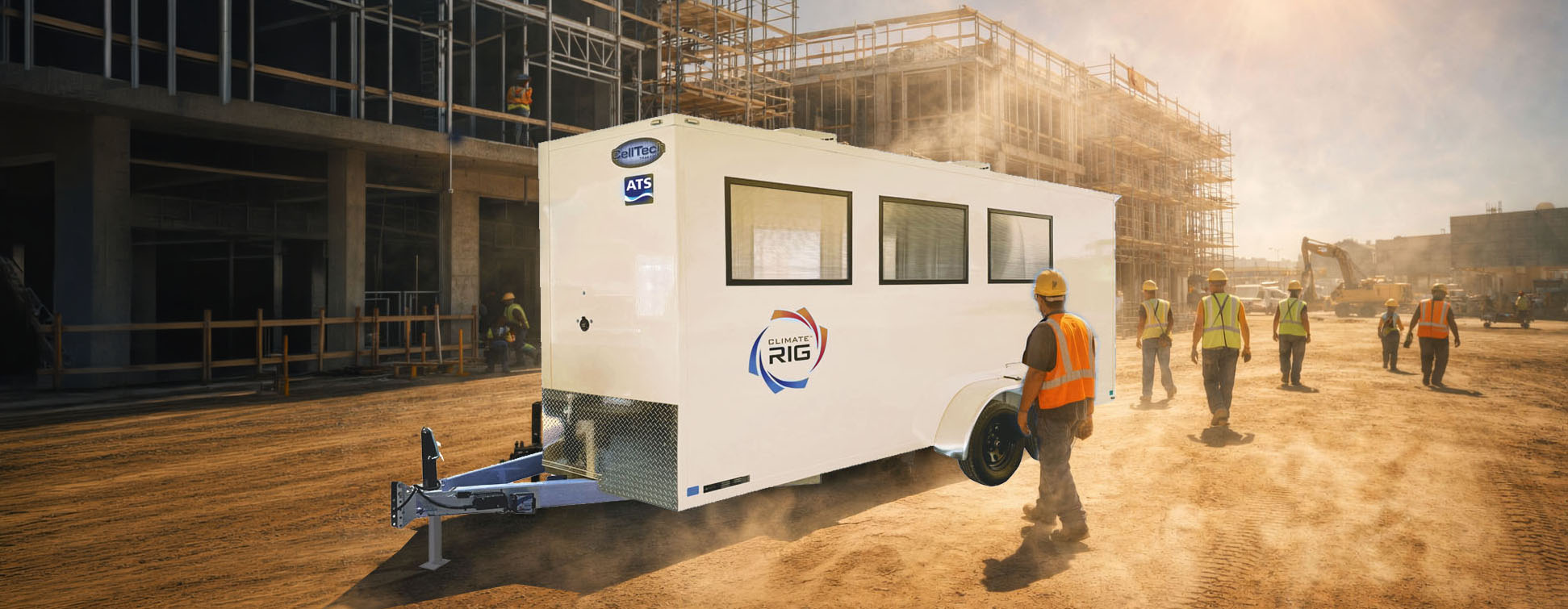
The ClimateRig, for example, features 32,000 BTU total cooling capacity (dual 16,000 BTU Fogatti InstaCool Ultra units), an interior of 128 square feet (7′ × 21′), a capacity for 18 workers, and cooling activation in approximately 4 minutes. The trailer uses patented CellTech all-steel panel construction (no wood or plywood), providing durability in aggressive construction environments. Power requirement is a standard NEMA 14-30 inlet (30-amp service), commonly available on construction sites.
When workers enter a properly-conditioned cool-down trailer after 1-2 hours of work in 95-110°F heat stress zones, their core body temperature begins to normalize within 15-20 minutes of rest. This cooling cycle interrupts the progressive heat accumulation that leads to heat exhaustion and heat stroke. Workers return to their work zones with restored thermal capacity, allowing sustained productivity even in extreme heat conditions.
Benefits for Data Center Construction Sites
Cool-down trailers offer specific advantages for data center construction environments:
- Mobility: Data center campuses often span 5-10+ separate work zones (foundation pours, mechanical rooms, electrical rooms, rooftop work, cable runs). A single stationary cool-down structure serves only 1-2 zones. Mobile trailers can be repositioned between heat-stress zones, with towing and setup requiring approximately 20-30 minutes. This ensures workers in the hottest zones can access rapid cooling within 100 feet of their work area, minimizing rest time and lost productivity.
- Durability in Aggressive Environments: Data center construction sites experience heavy equipment operation (cranes, forklifts, concrete trucks, excavators), risk of accidental contact, concrete dust, cable debris, metal shavings, and hydraulic fluid spills. All-steel construction withstands equipment contact, dust infiltration, and vibration without moisture absorption or structural degradation that plagues wood-framed trailers. CellTech all-steel panels carry a 10-year warranty.
- Non-Evaporative Cooling in Humid Climates: Data center construction occurs in humid regions (Northern Virginia dew points 70°F+, Texas Gulf Coast 80°F+, Arizona monsoon season). Evaporative coolers (swamp coolers) lose cooling effectiveness in humid conditions because they depend on dry-bulb to wet-bulb differential. R32 refrigeration systems maintain full 32,000 BTU cooling capacity regardless of humidity, ensuring consistent cooling regardless of season or climate.
- Crew Capacity Matching Rotation Needs: Typical data center commissioning crews include rooftop HVAC crews (4-6 workers), electrical commissioning teams (6-8 workers), load bank operators (2-3 workers), and rotating HVAC technicians (4-6 workers). An 18-worker capacity allows entire crews to access rapid cool-down on the same site. A crew size of 20-25 workers can use the trailer in two 10-minute rest cycles per shift, achieving 100% crew coverage without walking time delays to distant cool-down locations.
- Phased Construction Flexibility: Hyperscale facilities are built in phases (Building A, Building B, Building C) over 2-3 years. Each phase has distinct heat-stress periods: foundation → structural → mechanical → electrical → commissioning. The trailer’s portability eliminates infrastructure waste—moving with construction heat from phase to phase rather than requiring stationary investment that becomes obsolete when phases complete.
WBGT Monitoring Integration
The ClimateRig integrates WBGT monitoring capability, allowing safety teams to track heat stress risk before and after worker rest cycles. Workers using the trailer as a rest station can access interior WBGT readings, or site safety teams can correlate interior work WBGT with ClimateRig interior conditions (typically 68-72°F). This creates a heat-stress baseline—comparing pre-cool-down WBGT (95-110°F in work zones) with post-cool-down WBGT after 15-20 minute rest (normal, safe conditions). Data from WBGT monitoring helps inform heat-illness prevention program decisions and demonstrates good-faith compliance effort.
Cost-Benefit Analysis: Preventing $80K+ Heat Incidents
The economic case for cool-down trailers on data center projects is straightforward. A single heat-related illness incident costs the employer up to $80,000 in direct and indirect costs. On a 1,500-worker project spanning three years, assuming industry-average heat illness rates, even two preventable incidents justify full cost of mobile cooling infrastructure. When factored against project timelines, worker productivity gains, and regulatory compliance benefits, cool-down trailers represent sound risk management investment.
6. Implementing Cool-Down Trailers in Your Data Center Project
Deploying cool-down trailers effectively requires strategic planning: heat hazard assessment, equipment placement, and integration with existing safety programs.
Assessing Your Site’s Heat Risk Zones
Begin with a heat risk assessment specific to your project phases. During planning, identify:
- High-heat work periods: Foundation pours (summer), commissioning phases (peak heat season)
- High-heat locations: Mechanical rooms with load banks, rooftop HVAC work, underfloor spaces, equipment vaults
- Crew concentrations: Where are peak crew sizes? Where are multiple heat hazards overlapping?
- Baseline WBGT conditions: Use historical weather data and WBGT calculators to estimate expected conditions during critical work phases
- Worker vulnerability factors: Age, fitness, acclimatization status, medical conditions—all affect heat susceptibility
Data center construction projects in Northern Virginia, Texas, and Arizona should assume peak summer WBGT will reach 85-95°F+ outdoors and exceed 100°F in mechanical spaces and confined areas. Planning cooling infrastructure for these conditions is essential.
Placement Strategy for Maximum Worker Access
Position cool-down trailers strategically within your site:
- Proximity to peak-heat zones: Place the trailer within 100 feet of areas where workers experience highest heat stress (mechanical rooms, rooftop access, underfloor entry points). This minimizes rest time and reduces further heat accumulation during transit.
- Multi-phase positioning: As construction phases progress, relocate the trailer to align with the current phase’s heat-stress zone. A rooftop HVAC commissioning phase may require placement near rooftop access; later electrical work may require underfloor access positioning.
- Shade and protection: Position the trailer in shade when possible to reduce solar heat gain and extend cooling efficiency. However, accessibility to workers is more important than placement optimization; a trailer in direct sun but within 50 feet of work is preferable to one in shade but 300 feet away.
- Power availability: Ensure 30-amp service is available within extension cord range. Plan electrical infrastructure early; trailer deployment depends on power connectivity.
Integrating with Your Existing Safety Program
Cool-down trailers are one component within a comprehensive heat illness prevention program. A complete program must include:
- Hazard Assessment: Identify heat sources, work environments, worker vulnerability factors, and heat illness risk levels
- Worker Training and Acclimatization: Train all workers to recognize heat illness symptoms (dizziness, confusion, muscle cramps, weakness). Implement phased acclimatization over 1-2 weeks to help workers build heat tolerance
- Hydration and Nutrition Management: Ensure unlimited access to water; encourage electrolyte replacement for extended heat exposure
- Administrative Controls: Adjust work schedules to cooler times of day when possible; provide frequent breaks during peak heat hours; allow workers to report heat stress symptoms without penalty
- Engineering Controls: Provide shade structures, ventilation improvements, and cooling infrastructure (cool-down trailers)
- Medical Surveillance: Screen workers for conditions that increase heat susceptibility; provide baseline vitals; implement protocols for recognizing and responding to heat illness
- Emergency Response: Develop procedures for rapid response to heat exhaustion or heat stroke, including immediate cooling, medical evaluation, and emergency services activation
- Monitoring and Communication: Track WBGT conditions; communicate heat alerts to crews; monitor work-rest cycles; adjust work intensity based on heat conditions
7. Conclusion — Protecting the Workforce Building Tomorrow’s Digital Infrastructure
The data center construction boom represents unprecedented economic opportunity—650,000 new jobs, $77.7 billion in annual construction spending, and critical infrastructure enabling artificial intelligence, cloud computing, and digital innovation. This opportunity comes with an equally unprecedented occupational health challenge: extreme heat exposure during construction phases.
Construction workers—who comprise just 6% of the U.S. workforce—account for 36% of occupational heat-related deaths. Data center construction, with its unique combination of outdoor work, extreme interior heat zones (commissioning mechanical rooms at 140°F+, underfloor spaces at 110-130°F, rooftop work at 110-120°F equivalent), and compressed timelines, amplifies this risk. Without active heat mitigation, data center projects will inevitably experience preventable heat-illness incidents, workers’ compensation claims, lost productivity, and regulatory enforcement action.
The regulatory environment is shifting. OSHA’s National Emphasis Program through April 2026, a proposed federal heat standard expected in late 2025 or early 2026, and expanding state heat standards across 18 states all signal that heat stress prevention is an enforcement priority. Employers who implement heat controls now—including mobile cool-down infrastructure—demonstrate good-faith compliance effort and prepare for regulatory requirements that will inevitably tighten.
Cool-down trailers represent a proven, scalable solution for data center construction heat mitigation. By providing mobile, rapid-deployment cooling positioned at heat-stress zones, they enable workers to interrupt progressive heat accumulation, maintain productivity, and return to work safely. Combined with comprehensive heat illness prevention programs—hazard assessment, worker training, hydration management, schedule adjustment, and medical surveillance—cool-down trailers help employers protect their workforce, comply with evolving regulations, and complete projects on schedule.
Ready to protect your data center workforce? The time to implement heat stress prevention is now—during project planning and early construction phases, not in response to heat illness incidents or regulatory citations. Request a consultation with ClimateRig’s safety experts to assess your project’s heat hazards and design a heat mitigation strategy aligned with your construction schedule and workforce needs.
Request a quote for your data center project, or contact ClimateRig directly to learn how mobile cool-down trailers can be integrated into your heat safety program.
LEGAL AND REGULATORY DISCLAIMERS
LEGAL DISCLAIMER: This article is provided for informational and educational purposes only and does not constitute legal advice. Workplace safety laws and regulations vary by jurisdiction, and requirements may change. Employers should consult with qualified safety professionals and legal counsel in their jurisdiction to ensure compliance with all applicable occupational safety and health standards. The views and recommendations presented here are general guidance and do not apply uniformly to all workplaces.
REGULATORY NOTICE: Heat safety regulations and standards vary significantly by state and jurisdiction. The federal OSHA heat standard referenced in this article is a proposed rule not yet finalized as of February 2026. Employers should verify current and applicable heat safety requirements in their location, which may include state-specific standards such as those in California, Maryland, Oregon, Washington, Nevada, Minnesota, and other jurisdictions. Compliance may require measures beyond those discussed in this article.
MEDICAL NOTICE: If you suspect heat-related illness in yourself or a coworker—including signs of heat exhaustion, heat cramps, or heat stroke—seek immediate medical attention by calling 911 or going to the nearest emergency facility. This article does not provide medical diagnosis or treatment guidance. Heat illness is a medical emergency.
PRODUCT SUPPORT STATEMENT: The ClimateRig cool-down trailer is a tool designed to support occupational heat stress prevention and mitigation. It is not a substitute for a comprehensive heat safety program. A complete program must include hazard assessment, worker training and acclimatization, medical surveillance, engineering controls, administrative controls, emergency response procedures, and ongoing monitoring. Using the ClimateRig does not guarantee compliance with occupational safety laws or eliminate heat-related risks.
References
- ConstructConnect. (January 2026). Data Center Construction Spending Surges Fivefold in Two Years.
- IEEE ComSoc. (December 2025). Hyperscaler CapEx $600B in 2026, a 36% Increase Over 2025.
- The Birm Group. (2026). The Data Center Construction Boom: Hiring Surge in 2026.
- The Birm Group. (2026). The Data Center Construction Boom: Hiring Surge in 2026.
- GM Insights. (2025). Global Data Center Construction Market, 2025-2035.
- Programs.com. (2026). Data Center Statistics 2026.
- JLL. (2026). 2026 Global Data Center Outlook.
- JLL. (2025). North America Data Center Report, Year-End 2025.
- The Birm Group. (2026). The Data Center Construction Boom: Hiring Surge in 2026.
- ConstructConnect. (December 2025). December Data Center Report: Starts, Spending Gains, But Costs Do Too.
- Converge.io. (2025). Thermal Stresses and Temperature Control of Mass Concrete.
- EPA. (2024). Heat-Related Workplace Deaths Documentation.
- CPWR. (August 2025). Data Bulletin: Heat-Related Deaths in Construction.
- Maryland Legislature. (2020). Heat-Related Deaths Among Construction Workers.
- JobSite Care. (2025). Avoid Data Center Health Hazards: Key Risks & Prevention Guide.
- EPA. (2024). A Closer Look at Heat-Related Workplace Deaths.
- Public Citizen. (2024). Heat Stress: The Cost of Inaction.
- Federal Reserve Bank of San Francisco. (May 2024). Impact of U.S. Labor Productivity Losses from Extreme Heat.
- Center for American Progress. (2024). Extreme Heat is More Dangerous for Workers Every Year.
- Federal Register. (August 30, 2024). Heat Injury and Illness Prevention in Outdoor and Indoor Work Settings.
- OSHA. (2025). Heat Injury and Illness Prevention.
- Jackson Lewis. (2025). OSHA Extends Heat Hazard Program; Employers Should Act Before Summer Sets In.
- MultiState. (July 2025). State Extreme Weather Laws: 18 States Propose Heat Safety Legislation in 2025.
About the author : Stephen

Stephen Allred is a dynamic and accomplished executive with over 20 years of experience in sales and marketing, currently serving as the CMO and CTO of ATS. Renowned for his ability to craft highly effective marketing campaigns, he drives business growth through cutting-edge technology and a results-oriented approach, focusing on high-impact strategies that align with corporate goals while steering clear of ego-driven pursuits. With a deep understanding of customer behavior, Stephen creates compelling campaigns that resonate with consumers, underpinned by the discipline to prioritize the most critical tasks. Boasting over 25 years of management experience, he is a committed leader dedicated to assembling talented teams and unlocking their potential to achieve ambitious objectives. As an adept strategist, he draws on an extensive study of both modern thought leaders and historical figures like Clausewitz and Sun Tzu to devise plans that propel corporate success. A champion of continual learning, Stephen stays ahead of industry trends and fosters a culture of innovation, encouraging his team to think creatively and embrace calculated risks. He graduated Magna Cum Laude from Utah Valley University with a Bachelor’s degree in Finance, where his exceptional performance earned him the prestigious “Outstanding Student Award.”