OSHA Heat Illness Prevention: The Complete 2026 Employer Guide
1. Introduction — Why 2026 Is a Pivotal Year for Heat Safety
On August 30, 2024, the Occupational Safety and Health Administration (OSHA) published a proposed Heat Injury and Illness Prevention Standard in the Federal Register, marking the most significant regulatory development in workplace heat safety in decades. For safety managers, EHS professionals, and construction project managers, this moment represents both a challenge and an opportunity to formalize the heat illness prevention practices that leading organizations have already begun implementing.
The numbers are stark. In 2023 alone, the Bureau of Labor Statistics documented 36 heat-related workplace deaths in the United States, with over 3,970 additional heat-related illnesses and injuries reported1. Heat is the leading cause of weather-related death in the country2, and the problem is intensifying as global temperatures rise and outdoor work expands in traditionally cooler climates.
What makes 2026 critical is that the proposed OSHA standard—currently under final agency review after a comment period that closed December 30, 2024—is expected to reshape mandatory compliance frameworks across oil and gas, construction, agriculture, manufacturing, and other heat-exposed industries. Even before the federal standard is finalized, OSHA’s National Emphasis Program (NEP), which has been active since 2013 and has been extended through April 8, 20263, ensures aggressive enforcement of heat safety under the General Duty Clause. Meanwhile, pioneering states like California, Oregon, Washington, Maryland, and Minnesota have already implemented their own enforceable heat standards, creating a patchwork of requirements that employers must navigate.
This comprehensive guide walks you through the proposed federal standard, existing state regulations, and actionable strategies to build a heat illness prevention program that protects your workers, reduces liability, and positions your organization ahead of regulatory change. Whether your company operates in a state with existing heat standards or is preparing for anticipated federal requirements, the time to act is now.
2. Understanding OSHA’s Proposed Heat Illness Prevention Standard
What the Proposed Rule Requires
OSHA’s proposed Heat Injury and Illness Prevention Standard, published in the Federal Register (89 FR 70804)4, outlines a comprehensive framework that employers would be required to implement when the standard is finalized. The rule establishes two critical heat trigger points:
- Initial heat trigger at 80°F heat index: Employers must implement basic heat illness prevention measures, including ensuring access to drinking water, shade, and adequate rest breaks.
- High heat trigger at 90°F heat index: Enhanced requirements activate, including mandatory work/rest schedules, designated cool-down areas with air conditioning or equivalent cooling, and continuous worker monitoring for signs of heat illness.
The proposed rule also mandates that employers develop a written Heat Injury and Illness Prevention Plan (HIIPP) that addresses acclimatization of new and returning workers, emergency response procedures for heat-related medical events, and worker training on heat illness recognition and prevention.
It is important to note that this proposed standard is not yet finalized. The rule remains under interagency review, and the timeline for final publication is uncertain. Employers should plan to implement these practices—many of which reflect industry best practices already adopted by safety leaders—but should use language of anticipation and preparedness rather than assuming the rule is mandatory today. That said, the General Duty Clause and the National Emphasis Program create enforceable standards right now.
Current Enforcement — The General Duty Clause
While the proposed federal standard is under review, OSHA continues to pursue heat illness enforcement through Section 5(a)(1) of the OSH Act—the General Duty Clause—which requires employers to furnish “employment and a place of employment which are free from recognized hazards that are causing or are likely to cause death or serious physical harm to employees.”
Under the General Duty Clause, OSHA has successfully cited employers for failing to protect workers from heat stress, even without a specific OSHA heat standard. OSHA’s legal position is that heat illness is a recognized hazard, and employers who fail to implement reasonable controls face serious violation citations and penalties up to $16,550 per violation5. Willful violations carry penalties up to $165,514.
For a comprehensive understanding of how these proposed regulations align with existing guidance, review OSHA’s Heat Regulations Guide, which breaks down the regulatory landscape in detail.
The National Emphasis Program (NEP)
OSHA’s National Emphasis Program on heat-related hazards, which has been extended through April 8, 20263, directs OSHA investigators to prioritize enforcement of heat illness prevention in high-risk industries during warm months. The NEP has been instrumental in raising enforcement activity across construction, agriculture, landscaping, and outdoor manufacturing sectors.
During NEP periods, OSHA inspectors actively target industries and geographic regions where heat-related incidents are most likely. This targeted enforcement serves as a powerful signal to regulated industries: heat illness prevention is not optional, and non-compliance carries real consequences.
3. State Heat Safety Standards — Where the Bar Is Already Higher
Five states have already enacted enforceable heat safety standards that go beyond general OSHA guidance and in some cases establish more stringent requirements than the proposed federal rule. For any employer with operations in these states, understanding and complying with state standards is non-negotiable.
California: California OSHA enforces two heat standards—one for outdoor work (Cal/OSHA §3395) and one for indoor work (Title 8 §3396). The outdoor standard triggers mandatory protections at 80°F heat index, while the indoor standard activates at 82°F wet-bulb globe temperature (WBGT)6. California’s standard is notably detailed on acclimatization schedules and cool-down area specifications.
Oregon: Oregon’s heat illness prevention rule (OAR 437-002-0156)7 applies to all outdoor workers and mandates employer action at 80°F, with enhanced measures at 90°F. Oregon’s rule includes explicit requirements for rest periods, hydration, and emergency planning similar to the proposed federal standard.
Washington: Washington State enforces an outdoor-only heat illness prevention standard (WAC 296-307-097 through 09760)8 that applies to outdoor workers and includes provisions for work/rest schedules, shade, water, and acclimatization. Washington’s rule does not currently cover indoor workers.
Maryland: Maryland’s Heat Stress Standard, which took effect May 15, 2024, applies to outdoor workers and establishes an 80°F heat index trigger9. This relatively new standard signals Maryland’s proactive stance on heat safety and serves as a model for other states considering similar regulations.
Minnesota: Minnesota operates as an OSHA Plan State and has implemented a WBGT-based indoor heat safety standard10. This makes Minnesota unique among states for explicitly addressing indoor heat hazards in warehouses, foundries, and other enclosed hot environments.
Employers with multi-state operations must audit their heat illness prevention practices against the most stringent applicable standard in each jurisdiction. In many cases, adopting California’s framework—the most comprehensive—will provide coverage for operations in other states as well.
4. Building a Heat Illness Prevention Plan (HIIPP)
Written Plan Requirements
A Heat Injury and Illness Prevention Plan (HIIPP) is the foundation of any compliant heat safety program. Whether mandated by state law or anticipated federal requirements, a written HIIPP should be treated as a living document that guides your organization’s heat safety response and is reviewed annually and updated as conditions change.
Your written plan should clearly identify:
- Heat hazard assessment: A detailed analysis of job tasks, outdoor vs. indoor environments, seasonal variations, and worker populations most at risk for heat illness.
- Heat illness triggers and response procedures: Specific heat index or WBGT thresholds that trigger implementation of control measures, along with clear procedures for moving workers to shade or cool-down areas, providing hydration, and monitoring for symptoms.
- Responsible personnel: Names and titles of managers, supervisors, and safety coordinators accountable for implementing each component of the plan.
- Acclimatization schedules: Detailed protocols for new and returning workers, including duty cycle increases and monitoring requirements.
- Emergency response procedures: Step-by-step actions for suspected heat exhaustion or heat stroke, including first aid measures, emergency service notification, and medical evaluation.
Your HIIPP should also address how the plan will be communicated to employees, when and how often training will occur, and how you will document and track heat-related incidents and near-misses.
Key Components Every Employer Needs
While every workplace is unique, a comprehensive heat illness prevention program includes these foundational elements:
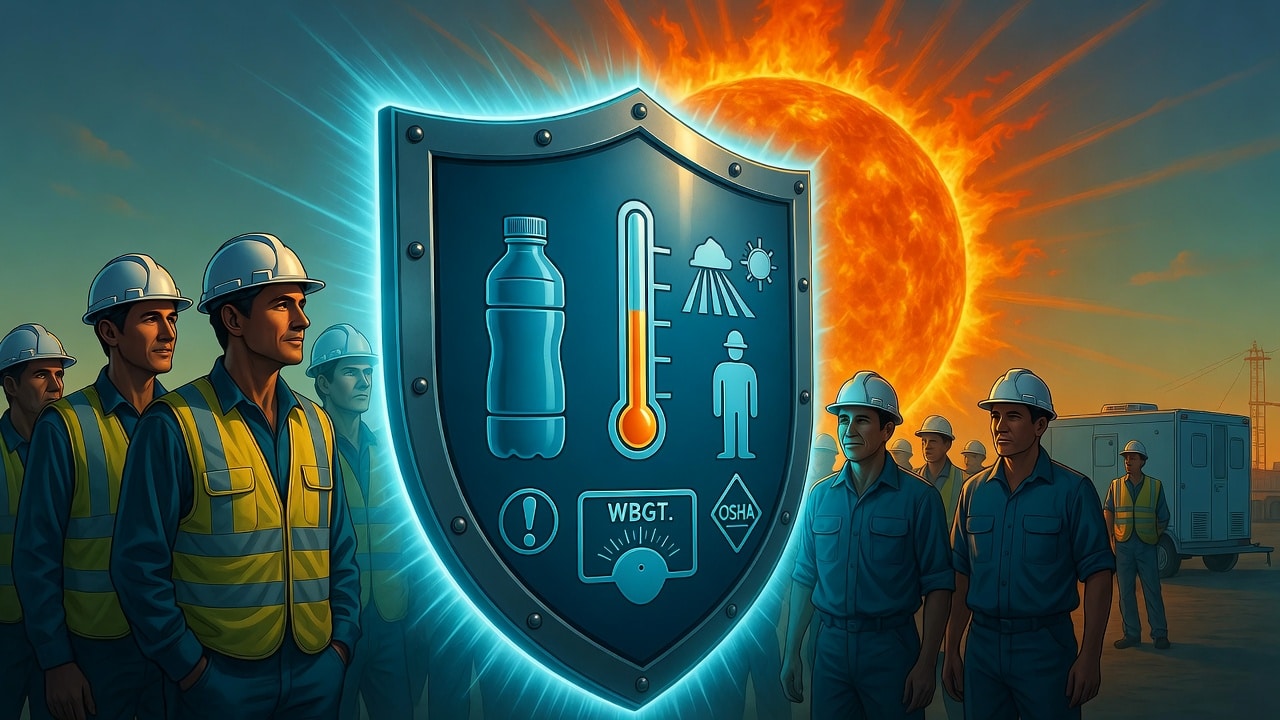
- Water access and hydration protocol: Ensure all workers have unlimited access to clean drinking water at a minimum rate of 1 quart (32 oz) per worker per hour, with protocols for hydration reminders and monitoring of fluid intake.
- Rest areas and shade: Provide designated rest areas in shade (natural or artificial) or in air-conditioned spaces where workers can cool down during breaks. Rest areas should be equipped with seating, water, and monitoring capability.
- Work/rest schedules: As temperatures rise, reduce work duration and increase rest period frequency. Rest periods should be long enough for core body temperature to decline.
- Medical monitoring and first aid: Train supervisors and designated personnel to recognize early signs of heat exhaustion and heat stroke. Ensure that medical first aid is immediately available and that emergency services can be contacted without delay.
- Worker training and communication: All employees exposed to heat hazards should receive training on heat illness recognition, prevention measures, the importance of hydration and acclimatization, and their rights to report hazardous conditions without retaliation.
For detailed guidance on the monitoring and prevention elements of your plan, see our comprehensive guide to heat stress monitoring and prevention.
5. WBGT Monitoring — The Gold Standard for Heat Stress Assessment
Why WBGT Beats Heat Index
While heat index (the apparent temperature based on air temperature and relative humidity) is widely reported by weather services, the Wet-Bulb Globe Temperature (WBGT) is the superior measure for occupational heat exposure. WBGT accounts for four environmental factors: air temperature, relative humidity, radiant heat from the sun or nearby surfaces, and wind speed. This makes WBGT a far more accurate indicator of how much thermal stress a worker will experience.
WBGT is calculated using the formula: 0.7 × Tw + 0.2 × Tg + 0.1 × Td, where Tw is wet-bulb temperature, Tg is globe temperature, and Td is dry-bulb temperature11. The result is expressed in degrees Fahrenheit.
The difference is practical and significant. A construction site in direct sunlight on a windless day may have a heat index of 95°F but a WBGT of 105°F—reflecting the intense radiant heat that workers actually experience. This distinction can mean the difference between requiring work/rest breaks at 90-minute intervals versus 30-minute intervals.
For a deeper dive into WBGT science and measurement, review our WBGT monitoring guide.
Implementing WBGT-Driven Work/Rest Schedules
Once you begin measuring WBGT at your work sites, you can implement evidence-based work/rest schedules that maintain worker safety while optimizing productivity. Standard WBGT-based guidance establishes these thresholds:
- Below 82°F WBGT: Normal work/rest cycles; no special restrictions.
- 82-87°F WBGT (Moderate heat): Mandatory rest breaks every 2-3 hours; increase hydration monitoring.
- 87-92°F WBGT (High heat): Mandatory rest breaks every 1-2 hours; move rest periods to shaded or cooled environments; increase frequency of heat illness monitoring.
- Above 92°F WBGT (Very high heat): Limit work periods to 15-20 minutes with equivalent or longer rest periods in cooled environments; consider suspending non-essential outdoor work.
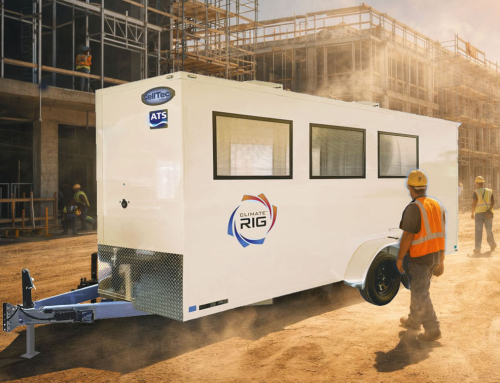
The ClimateRig Cool-Down Trailer integrates WBGT monitoring into its operational framework, allowing employers to tie cooling infrastructure directly to real-time heat measurements. With 32,000 BTU of cooling capacity and a 128 square-foot interior capable of accommodating up to 18 workers, the ClimateRig provides a mobile, construction-grade cool-down station that can follow crews to multiple job sites. The trailer’s integration with WBGT-based scheduling ensures that workers have access to adequate cooling exactly when heat stress levels are highest.
6. Acclimatization — The Most Overlooked Safety Control
Physiology of Heat Acclimatization
Heat acclimatization is the physiological adaptation process by which the body becomes more efficient at coping with heat stress. When a worker is exposed to heat over consecutive days, the body undergoes measurable changes: the onset of sweating occurs at a lower core temperature, sweat production increases in rate and distribution across the body, cardiovascular stability improves, and electrolyte regulation becomes more efficient12.
The practical consequence is dramatic: an unacclimatized worker exposed to the same heat as an acclimatized worker faces exponentially higher risk of heat exhaustion and heat stroke. Worse, 50-70% of heat-related workplace deaths occur in workers’ initial days on the job13—a clear signal that failure to properly acclimatize is a critical vulnerability.
Acclimatization is not instantaneous. It typically requires 10-14 days of progressive heat exposure for a worker to adapt. However, this adaptation is also reversible: workers who have been away from heat exposure for as little as two weeks will lose a significant portion of their acclimatization and must re-acclimatize before returning to hot environments at full duty.
Acclimatization Schedules for New and Returning Workers
Your HIIPP should include explicit acclimatization protocols. For new workers with no prior heat exposure, a standard approach is the 5-week progressive acclimatization schedule:
- Week 1: 20% of planned duty cycle; monitor for heat illness symptoms daily; encourage frequent water breaks.
- Week 2: 40% of planned duty cycle; continue monitoring; ensure adequate hydration.
- Week 3: 60% of planned duty cycle; reduce frequency of enforced breaks but maintain hydration protocols.
- Week 4: 80% of planned duty cycle; worker approaching full acclimatization.
- Week 5: 100% of planned duty cycle; full acclimatization achieved.
Returning workers—those away from heat exposure for less than two weeks—typically acclimatize faster on a 4-day schedule with similar duty cycle progression. Workers returning after more than two weeks away should follow the full 5-week schedule for maximum safety.
Best practice is to track acclimatization status in personnel records and to assign returning workers to a supervisor or mentor during their re-acclimatization period. Some organizations include acclimatization status in daily work briefings so that all team members understand who is still in acclimatization and why those workers may have modified duties or more frequent breaks.
For a comprehensive review of heat stress physiology and prevention strategies, see our deep dive into heat stress deaths and prevention solutions.
7. Cool-Down Infrastructure — From Shade to Mobile Climate Control
What Counts as an Adequate Cool-Down Area
The proposed OSHA standard and existing state regulations emphasize that employers must provide “cool-down areas” where workers can rest and lower their core body temperature during and after exposure to heat. However, the definition of “adequate” has evolved as enforcement experience has accumulated.
A minimally compliant cool-down area meets these criteria:
- Temperature differential: The cool-down area must be meaningfully cooler than the outdoor environment. A shaded area on a 95°F day may only reach 85°F—insufficient to lower core body temperature effectively. Best practice is to maintain a cool-down area at least 10-15°F cooler than the working environment.
- Accessibility: Workers must be able to reach the cool-down area within a reasonable time (typically 5-10 minutes of walking from the work site) and without hazardous conditions or obstacles.
- Amenities: The cool-down area should include seating, drinking water, and ideally shade (natural or artificial). In very hot conditions, fans or air movement improve cooling efficiency.
- Privacy and dignity: Workers should be able to rest without feeling rushed, and the area should provide reasonable privacy if workers need to remove layers of protective equipment.
In fixed-location work sites, employers typically establish permanent cool-down areas in air-conditioned break rooms, office trailers, or purpose-built structures. For mobile or dispersed work sites—common in construction, oil and gas, and agriculture—a portable or semi-permanent solution becomes necessary.
Mobile Cool-Down Stations as a Compliance Tool
A mobile cool-down station addresses a practical challenge that many construction and oil and gas operators face: how to provide adequate cool-down areas at remote job sites or on projects that move frequently.
The ClimateRig Cool-Down Trailer is engineered specifically for this application. Featuring dual 16,000 BTU Fogatti InstaCool Ultra cooling units delivering 32,000 BTU of total cooling capacity, the ClimateRig maintains interior temperatures 10-15°F below outdoor ambient temperature even in extreme heat conditions. The 128 square-foot interior can accommodate up to 18 workers at a time, with built-in seating and ample space for hydration stations.
Key specifications of the ClimateRig include:
- Portability: At approximately 2,500 lbs, the trailer is towable by a half-ton pickup truck, allowing operators to move cool-down infrastructure from site to site as project locations change.
- Durability: Construction-grade materials and weather-sealed construction ensure reliable operation even in harsh jobsite environments.
- Temperature management: The cooling system uses R32 refrigerant and is designed to prevent thermal shock—operators should avoid setting interior temperatures more than 15°F below outdoor temperature to prevent heat stress upon re-exposure.
When integrated into a comprehensive heat illness prevention plan, a mobile cool-down station like the ClimateRig supports compliance by ensuring that workers have access to genuinely effective cooling regardless of work site location. The trailer should be part of your broader strategy—not a substitute for hydration protocols, work/rest scheduling, acclimatization, and emergency planning, but rather a key tool within that comprehensive system.
For more on how mobile cooling infrastructure aligns with regulatory requirements, review how the ClimateRig meets OSHA standards and the advanced cooling technology powering these systems.
8. Penalties, Enforcement, and the Cost of Non-Compliance
OSHA Penalty Structure
OSHA’s penalty system creates powerful economic incentives for compliance. As of 2026, OSHA’s penalty amounts for serious violations—including heat illness violations under the General Duty Clause—can reach $16,550 per violation5. Willful violations, where an employer deliberately disregards a known hazard, carry penalties up to $165,514 per violation.
For an employer operating multiple job sites, a single heat illness incident that triggers an OSHA investigation can result in multiple citations—one at each site where similar hazards exist. A construction company with 10 active projects that fails to implement basic heat illness controls could face exposure of $165,000+ in penalties from a single heat-related death or serious injury.
Penalties increase further if OSHA determines that an employer knowingly violated the standard or had prior violations. Repeat violations can double penalties, while failure to abate can result in $16,550+ per day of continued non-compliance.
The Hidden Costs Beyond Fines
While OSHA penalties are significant, the total cost of heat illness extends far beyond regulatory fines. A single heat stroke case that results in hospitalization can exceed $50,000 in direct medical costs. Heat exhaustion cases requiring emergency transport and treatment typically cost $5,000-15,000. If a heat illness incident results in a fatality, wrongful death litigation can exceed $1 million in total liability—settlements, legal fees, and ongoing medical costs.
Beyond the immediate costs, heat illness incidents create secondary business costs:
- Lost productivity: Workers out due to heat-related illness, plus time spent by supervisors and managers responding to the incident, documenting the case, and coordinating medical care.
- Reputational damage: Serious incidents or fatalities can harm your company’s reputation with clients, contractors, and potential employees, affecting ability to win bids and attract talent.
- Insurance impact: Workers’ compensation insurance premiums are tied to your incident history. Heat illness claims increase your experience modifier, raising premiums for all future coverage.
- Regulatory scrutiny: A heat-related incident triggers investigation, audit, and documentation requirements that consume management time and create potential for discovery of additional violations.
For a detailed analysis of heat illness costs, see the hidden costs of heat stress in the workplace.
Legal Disclaimer: This article is for informational purposes only and does not constitute legal advice. Consult a qualified safety professional or legal counsel for guidance specific to your workplace and jurisdiction.
9. Conclusion — Preparing Your Organization for 2026 and Beyond
The heat safety landscape for 2026 and beyond is defined by three realities: first, OSHA’s proposed federal standard—while not yet finalized—will almost certainly become law and will reshape compliance requirements across heat-exposed industries; second, multiple states have already implemented their own heat standards and are actively enforcing them; and third, the General Duty Clause and the active National Emphasis Program create immediate enforcement risk for any employer failing to implement reasonable heat illness prevention controls.
The good news is that building an effective heat illness prevention program is achievable and does not require heroic effort. The core elements—written HIIPP, hydration and shade, work/rest schedules tied to WBGT measurements, acclimatization protocols, and cool-down infrastructure—reflect industry best practices already proven across thousands of worksites.
Getting ahead of regulatory change offers multiple benefits: it demonstrates commitment to worker safety that enhances recruitment and retention, it reduces incident-related costs and regulatory penalties, it positions your company as a safety leader in competitive bidding situations, and most importantly, it protects workers from heat illness and death.
Start by auditing your current practices against the components outlined in this guide. Identify gaps in your written plan, assess your cool-down infrastructure, and ensure that all supervisory and safety staff understand heat illness recognition and emergency response. If you operate in California, Oregon, Washington, Maryland, or Minnesota, ensure that your program meets or exceeds state-specific requirements.
Regulatory Disclaimer: Heat safety regulations vary by state and jurisdiction. Employers should verify current requirements with their state occupational safety agency and consult with qualified legal and safety professionals before implementing new policies.
For employers in construction, oil and gas, agriculture, and manufacturing, heat illness prevention is no longer a “nice to have” component of occupational safety. It is a core compliance requirement and a fundamental obligation to the workers who depend on your leadership and judgment.
Product Disclaimer: The ClimateRig is designed to support heat illness prevention programs as part of a comprehensive safety plan. It does not replace hydration protocols, work/rest schedules, medical oversight, acclimatization procedures, or other required safety measures.
If your organization operates in heat-exposed industries and you’re ready to build or strengthen your heat illness prevention program, ClimateRig can support your compliance efforts. The ClimateRig Cool-Down Trailer provides mobile, construction-grade cooling infrastructure that helps employers deliver effective cool-down areas across dispersed work sites. Request a quote today to learn how ClimateRig can support your comprehensive heat illness prevention strategy and help position your organization for compliance with evolving regulatory requirements. Contact ClimateRig for more information.
References
- Bureau of Labor Statistics. (2024). Occupational injuries and illnesses data. U.S. Department of Labor. Retrieved from BLS Injuries, Illnesses, and Fatalities database.
- CDC/NIOSH. (2024). Heat stress and occupational health. Centers for Disease Control and Prevention. Heat-related illness prevention guidance.
- OSHA. (2024). National Emphasis Program on heat-related hazards. Occupational Safety and Health Administration. NEP extended through April 8, 2026.
- OSHA. (2024). Proposed Heat Injury and Illness Prevention Standard. Federal Register, 89 FR 70804, published August 30, 2024.
- OSHA. (2026). OSHA Penalty Amounts. Occupational Safety and Health Administration. Current penalty amounts for serious and willful violations.
- California Division of Occupational Safety and Health. (2024). Outdoor heat illness prevention standard. Cal/OSHA §3395.
- Oregon OSHA. (2024). Heat illness prevention rule. OAR 437-002-0156.
- Washington Department of Labor and Industries. (2024). Heat illness prevention standard for outdoor workers. WAC 296-307-097 through 09760.
- Maryland Department of Labor. (2024). Heat Stress Standard. Effective May 15, 2024.
- Minnesota Office of the Revisor of Statutes. (2024). WBGT-based indoor heat safety standard. Minnesota OSHA Plan State regulations.
- CDC/NIOSH. (2024). Heat Safety Tool – WBGT monitoring resources. Wet-bulb globe temperature assessment for occupational heat exposure.
- OSHA. (2024). Heat illness prevention training guide. Guidance on acclimatization, WBGT monitoring, and control measures.
- CDC/NIOSH. (2024). Heat-related illness statistics. Acclimatization and worker vulnerability data.
About the author : Stephen

Stephen Allred is a dynamic and accomplished executive with over 20 years of experience in sales and marketing, currently serving as the CMO and CTO of ATS. Renowned for his ability to craft highly effective marketing campaigns, he drives business growth through cutting-edge technology and a results-oriented approach, focusing on high-impact strategies that align with corporate goals while steering clear of ego-driven pursuits. With a deep understanding of customer behavior, Stephen creates compelling campaigns that resonate with consumers, underpinned by the discipline to prioritize the most critical tasks. Boasting over 25 years of management experience, he is a committed leader dedicated to assembling talented teams and unlocking their potential to achieve ambitious objectives. As an adept strategist, he draws on an extensive study of both modern thought leaders and historical figures like Clausewitz and Sun Tzu to devise plans that propel corporate success. A champion of continual learning, Stephen stays ahead of industry trends and fosters a culture of innovation, encouraging his team to think creatively and embrace calculated risks. He graduated Magna Cum Laude from Utah Valley University with a Bachelor’s degree in Finance, where his exceptional performance earned him the prestigious “Outstanding Student Award.”