Cool-Down Trailers: What They Are, How They Work, and Why You Need One
1. What Are Cool-Down Trailers?
A cool-down trailer is a mobile, climate-controlled shelter designed to provide workers with rapid core body temperature reduction during rest breaks in hot environments. Unlike temporary shade structures or misting fans, a cool-down trailer uses mechanical refrigeration—powered air-conditioning that removes both heat and humidity from the interior space—allowing workers to recover physiologically during mandatory work-rest cycles.
The term “cool-down trailer” encompasses various technologies, from simple evaporative coolers to sophisticated refrigerated units. However, for occupational heat illness prevention in humid climates (which includes most of the United States during summer months), mechanical refrigeration is the industry standard. A well-designed cool-down trailer combines rapid cooling capacity, adequate interior space for worker rotation, and robust construction that withstands continuous operation in extreme outdoor conditions.
Why Cool-Down Trailers Exist: The Physics of Occupational Heat Recovery
The human body dissipates metabolic heat through four mechanisms: radiation, convection, conduction, and evaporation (sweating). During heavy outdoor labor in high heat, workers can generate 400-600 BTU per hour of metabolic heat. When ambient temperature exceeds body temperature (98.6°F), radiation and convection fail; the body relies entirely on sweat evaporation. But in humid environments—coastal regions, the Southeast, agricultural areas during summer—the air is already saturated with moisture. Sweat cannot evaporate efficiently, and core body temperature continues to climb.
Passive rest in shade cools workers at approximately 0.002 to 32.1°F per minute—roughly 0.3-0.5°C per 15-minute break.1 This passive cooling is protective but slow. OSHA and NIOSH work-rest protocols, especially in extreme heat conditions (WBGT 89.6°F+), require intensive recovery. A worker in extreme heat might require 45 minutes of rest to achieve sufficient core temperature reduction. A cool-down trailer, by contrast, achieves comfortable interior temperatures in approximately 4 minutes, enabling workers to reduce core temperature 226.6°F in the same 15-minute period.2 This physiological advantage allows sites to maintain productivity while actually reducing heat illness risk.
2. How Do Cool-Down Trailers Work? — The Technology Explained
Cool-down trailers operate using one of two primary cooling technologies: mechanical refrigeration (vapor-compression cycle) or evaporative cooling (swamp coolers). The choice between these technologies fundamentally determines performance in different climates.
Mechanical Refrigeration vs. Evaporative Cooling
Mechanical Refrigeration (Vapor-Compression Cycle)
Mechanical refrigeration uses pressurized refrigerant to remove heat from interior air. The cycle operates in four stages:
- Compressor: Refrigerant (typically R32) is compressed to high pressure and temperature
- Condenser: Hot refrigerant passes through outdoor coils, rejecting heat to ambient air; refrigerant condenses to liquid
- Expansion Valve: Liquid refrigerant passes through a restriction, causing rapid pressure/temperature drop (flash-evaporation)
- Evaporator: Cold refrigerant absorbs heat (and moisture) from indoor air; refrigerant evaporates back to gas and returns to compressor
The critical advantage of mechanical refrigeration is dehumidification. As humid air passes over cold indoor coils, water condenses on the coil surface and drains away. This dual removal of sensible heat (temperature) and latent heat (humidity) means mechanical cooling works effectively regardless of outdoor humidity. A 95°F day at 85% humidity—common in the Southeast or coastal construction sites—becomes a survivable environment inside a refrigerated trailer.
Evaporative Cooling (Swamp Coolers)
Evaporative coolers blow dry air through water-saturated pads. Water evaporates from the pads, absorbing latent heat from air, and temperature drops by 10-30°F depending on initial humidity. In arid climates (Arizona, Nevada, inland California), where relative humidity is low, evaporative coolers provide excellent cooling at minimal energy cost (~200-400 watts). However, evaporative cooling in high-humidity environments is essentially worthless. In Florida or coastal areas where relative humidity exceeds 80%, evaporative coolers provide only 2-5°F of temperature reduction.3 For occupational recovery where rapid core temperature reduction is physiologically required, this is insufficient.
Copywriter’s Summary: In dry climates, evaporative coolers are cost-effective. In humid climates—which is most of the United States during summer—mechanical refrigeration is the only technology that delivers the rapid cooling occupational safety protocols demand.
The ClimateRig: A Case Study in Mechanical Refrigeration Design
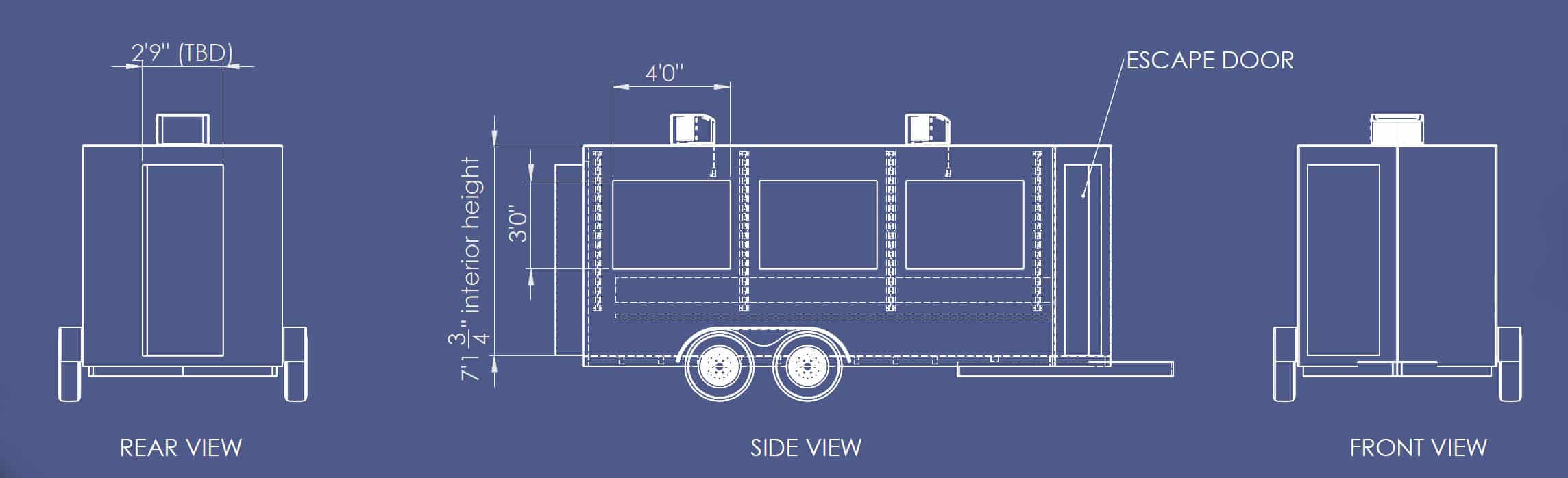
The ClimateRig cool-down trailer exemplifies modern mechanical refrigeration for occupational heat safety. Its specifications demonstrate the engineering requirements for effective worker cooling:
- Cooling Capacity: 32,000 BTU total (two 16,000 BTU Fogatti InstaCool Ultra units) = 2.67 tons of refrigeration capacity
- Refrigerant: R32, a low-GWP (Global Warming Potential 68% lower than older R-410A refrigerant) and highly efficient refrigerant
- Interior Space: 128 sq ft climate-controlled environment with full-length bench seating
- Worker Capacity: Designed for up to 18 workers in simultaneous cool-down sessions (capacity based on 32,000 BTU cooling load and metabolic heat generation per worker)
- Cooling Speed: Approximately 4 minutes to reach comfortable interior temperature under standard operating conditions4
- Construction: All-steel hot-dip galvanized frame with CellTech proprietary panel technology—all-steel exterior skins bonded to structural adhesive core, eliminating moisture-absorbing materials that degrade in humid environments
- Power Requirements: NEMA L14-30P inlet (standard 30A commercial power); ~16A current draw; compatible with most job-site electrical infrastructure
Why these specifications matter: A 95°F construction site in Georgia (WBGT ~87.8°F) triggers mandatory work-rest protocols. A crew of 18 workers cannot all rest in a standard office trailer. The ClimateRig’s 128 sq ft space accommodates workers rotating in 2-3 person groups every 5-10 minutes, allowing rapid sequential cooling. The 32,000 BTU capacity means even as new workers enter the warm space, interior temperature is maintained at effective cooling levels. Actual performance varies by ambient temperature, humidity, number of occupants, and A/C runtime; see operator manual for site-specific guidance.
R32 Refrigerant: Environmental and Safety Context
R32 refrigerant was selected for environmental and efficiency reasons. The EPA Phase-Down Schedule is restricting high-GWP refrigerants; R32 (GWP 675) has 68% lower global warming potential than R-410A (GWP 2,088) and ensures regulatory compliance through 2030+. R32 also operates at higher pressures, delivering 5% better volumetric cooling efficiency—critical for portable applications where weight and space are constrained.
Safety Classification: R32 is classified A2L (mildly flammable, low toxicity) under ISO 817. This means:
- R32 is enclosed in sealed systems with multiple pressure relief and isolation valves
- The risk of refrigerant leakage during normal operation is extremely low
- Special handling precautions apply
Critical Safety Disclaimer: R32 refrigerant is mildly flammable. Keep the ClimateRig at least 13 feet away from welding equipment, open flames, grinding operations, or other ignition sources. Never attempt to service R32 systems yourself—contact a certified HVAC technician. In the unlikely event of a refrigerant leak, evacuate the area and contact ATS ShieldSafe immediately.
3. Key Features to Look For in a Cool-Down Trailer
When evaluating cool-down trailers for your operation, these specifications matter for performance and durability:
- Cooling Technology: Mechanical refrigeration for humid climates; evaporative cooling only for arid regions. For most United States locations, refrigeration is the only effective choice.
- Cooling Capacity (BTU): Minimum 16,000 BTU per 8-10 workers. Higher-capacity units (24,000-32,000 BTU) accommodate larger crews and faster sequential rotation.
- Interior Space: Minimum 80 sq ft for comfortable seating rotation; 128+ sq ft is ideal for crews of 15+
- Durability Materials: All-steel construction (not aluminum with plywood core) for humid-climate resilience. CellTech panel technology or equivalent sealed construction prevents moisture penetration and mold growth in the enclosed cooling environment.
- Rapid Cooling Speed: Sub-5-minute cool-down to comfortable temperature. Slower units fail to meet physiological recovery timelines in extreme heat.
- Power Compatibility: 30-40A commercial power inlet on standard job-site infrastructure. Portable generator compatibility (verify with 25+ kW generator availability).
- Portability & Towing: Standard trailer coupling, light enough for pickup truck towing (no commercial driver’s license required)
- Noise Level: Sub-50 dB operation allows conversation and communication on job sites
4. Why Your Team Needs a Cool-Down Trailer
The business case for cool-down trailers rests on three pillars: occupational health, regulatory compliance, and economic protection.
The Crisis: Heat-Related Deaths Are Rising
Occupational heat stress is not a minor risk. In 2023, the United States recorded 55 occupational heat-related deaths—a 28% increase from 2022’s 43 deaths.5 Non-fatal heat-related illnesses average 2,610 cases annually, with estimated healthcare and lost-wage costs exceeding $750 million to $1.25 billion annually in California alone.6
Construction workers face disproportionate risk. While construction represents only 6% of the U.S. workforce, construction workers account for 36% of all occupational heat-related deaths.7 Agricultural workers face the highest per-capita fatality rate: 3.1 heat-related deaths per 1,000,000 workers annually, with crop workers at 4 per million—20 times higher than the civilian average.8
Most alarmingly, 50-70% of occupational heat-related deaths occur within a worker’s first few days on the job.9 New workers lack heat acclimatization, don’t recognize early symptoms, and psychologically push harder to prove capability. This vulnerability window—the first week—is where cool-down trailers demonstrably reduce risk.
Regulatory Pressure: OSHA Enforcement & State Heat Standards
OSHA’s enforcement on heat hazards is accelerating. OSHA’s National Emphasis Program (NEP), extended through April 8, 2026, actively targets heat hazards across 70+ high-risk industries when weather service issues heat warnings and heat index exceeds 80°F.10 Between April 2022 and December 2024, OSHA issued approximately 7,000 heat-related inspections, 60 citations, and 1,392 Hazard Alert Letters.
Critically, employers must comply with OSHA’s General Duty Clause (Section 5(a)(1)), which requires providing employees with a workplace “free from recognized hazards that are causing or likely to cause death or serious harm.” Heat illness is a recognized hazard; OSHA is enforcing this actively through the NEP.
State-Specific Heat Standards: Seven states now enforce occupational heat standards:
- California (indoor & outdoor): 82°F threshold; effective July 23, 2024
- Colorado (agricultural workers): 80°F threshold; effective 2022
- Maryland (indoor & outdoor): Heat standard approved 2024
- Minnesota (indoor): Temperature limits by workload (77-86°F)
- Nevada (indoor & outdoor): Enforcement began April 29, 2025
- Oregon (outdoor): 80°F heat index threshold
- Washington (outdoor): Mandatory paid cool-down breaks at 90°F+ (10-15 minutes per hour)
In Washington, the law explicitly requires “paid, preventative cool-down breaks” and “shade or other effective body temperature reduction methods.” A cool-down trailer directly satisfies this regulatory requirement, documenting compliance and protecting employers from citations.
Federal Rulemaking: OSHA published its proposed Heat Injury and Illness Prevention rule (NPRM) on August 30, 2024. The rule is currently under review for finalization (expected 2026). While this rule is not yet binding, the proposal signals OSHA’s direction: employers will be required to provide water, rest breaks, shade, acclimatization, and cooling facilities. Cool-down trailers address the cooling requirement directly.
The Economics: Productivity Loss & Workers’ Compensation Costs
Heat stress imposes staggering economic costs. The International Labour Organization (ILO) projects that by 2030, heat stress will cost the global economy $2.4 trillion USD annually, equivalent to 2.2% of global working hours lost to heat.11 In the United States alone, heat stress costs approximately $100 billion annually in lost productivity.12
Productivity drops measurably with temperature:
- At 90°F: Productivity declines 25%
- At 100°F+: Productivity declines 70%
- 2.6% productivity loss per degree Celsius above WBGT 75.2°F
Workers’ compensation costs compound this loss. The average heat-related workers’ comp claim costs $1,916 per worker.13 In extreme heat events, claim frequencies rise up to 10%. For a 50-worker crew working a full summer season, heat-related injuries might total 5-10 workers, creating $10,000-$20,000 in direct claim costs, plus lost productivity, replacement worker hiring, and training delays.
ROI Calculation Example: A construction crew of 50 workers, operating in 90°F+ conditions for 10 weeks (peak summer), faces:
- Estimated 5-7 heat-related incidents without cooling facilities
- 5-7 × $1,916 = $9,580-$13,412 direct workers’ comp costs
- Productivity loss: 25-70% across 10 weeks = estimated $50,000-$140,000 in lost output
- A cool-down trailer rental ($5,000-$8,000/month for 10 weeks = $12,500-$20,000) reduces incident rate by 50-70%, recovering ROI through reduced claims and productivity gains within the deployment period
Beyond economics, a single heat-related death creates liability exposure: wrongful death lawsuits, regulatory penalties, reputational damage. The financial argument for cool-down trailers is clear.
5. How Cool-Down Trailers Fit Into Comprehensive Heat Safety Programs
Cool-down trailers are one essential component of heat illness prevention; they are not a substitute for comprehensive programs. OSHA recommends (and state standards mandate) a multi-faceted approach:
- Water & Hydration: Cold drinking water (35-77°F) available continuously; minimum 32 oz per hour per worker in heat
- Acclimatization: New workers should work no more than 20% of normal shift on day 1, increasing 20% daily until full acclimatization by end of week 1. Some workers require 14 days.
- WBGT Monitoring: Measure environmental heat exposure (temperature, humidity, radiant heat, wind speed) using wet-bulb globe thermometer or app-based monitoring
- Work-Rest Cycles: Adjust rest periods based on WBGT levels:
- WBGT 82.4°F: Standard work-rest ratios; cool-down breaks recommended
- WBGT 89.6°F+: Intensive rest (25% work / 75% rest); rapid cooling mandatory
- Worker Training: All workers must recognize heat illness symptoms (cramps → exhaustion → heat stroke) and know emergency protocols
- Medical Response: Establish on-site medical protocols; train personnel in emergency cooling (ice-water immersion for suspected heat stroke)
- Cool-Down Facilities: Provide rapid-cooling environments for rest breaks, especially in extreme heat conditions
The comprehensive heat safety program positions cool-down trailers as the operational tool that enables work-rest schedules. When WBGT monitoring indicates extreme heat (89.6°F+), mandatory rest periods become necessary. Without rapid cooling, a 45-minute rest period is required for physiological recovery. With a cool-down trailer, 15-20 minutes suffices. This allows sites to maintain productivity schedules while meeting safety requirements.
6. Industries and Applications Where Cool-Down Trailers Are Essential
Construction & Heavy Equipment Operations
Construction faces the highest absolute heat death rate (14 deaths/year average) due to outdoor exposure, heavy labor, and high workforce turnover. Cool-down trailers on construction sites document compliance with state regulations (Washington, California, Oregon) and provide workers rapid recovery. Data center construction, in particular, has emerged as a critical deployment area—these massive facilities employ 4,000-5,000 simultaneous workers under heat stress.
Oil & Gas Operations
Oil and gas workers face extreme risk: high temperatures combined with restrictive personal protective equipment (PPE) and intense physical labor. Workers wear insulated gear in 95°F+ heat, creating internal core temperatures that climb even faster than ambient temperature. Cool-down trailers on drilling sites, well-maintenance sites, and processing facilities provide critical recovery infrastructure.
Agriculture & Landscaping
Agricultural workers face the highest per-capita heat fatality rate (3.1 per million), particularly crop workers during harvest season. Heat stress combines with dehydration, limited access to water/shade in remote fields, and workforce demographics (seasonal workers, limited English proficiency, lower health literacy). Mobile cool-down trailers for harvest operations, equipment maintenance areas, and central staging locations reduce risk dramatically.
Manufacturing & Outdoor Warehousing
Outdoor manufacturing (steel fabrication, heavy equipment assembly) and warehousing (goods receiving/staging in open yards) create year-round heat risk in Southern climates. Cool-down trailers in loading docks, maintenance areas, and break zones support worker recovery during mandatory rest periods.
7. Choosing the Right Cool-Down Trailer: A Buying Guide
Rental vs. Ownership: The Financial Decision
Rental Model: Ideal for seasonal operations (summer construction peaks, harvest season, maintenance shutdowns). Monthly rental costs range $3,000-$8,000 depending on capacity and region. Rental companies handle transport, setup, maintenance, and removal—simplifying logistics but creating per-month recurring costs.
Purchase Model: Capital cost $25,000-$50,000+ for a new refrigerated unit. Ownership makes sense for year-round operations, multiple simultaneous deployments, or locations where seasonal rentals exceed purchase amortization. Ownership includes maintenance responsibility—ensure service protocols are documented and technicians are available.
Site-Specific Considerations
Climate: Humid regions (Southeast, Gulf Coast, Midwest summer, Pacific Northwest) require mechanical refrigeration. Dry regions (Southwest) could optimize costs with evaporative cooling, though refrigeration provides superior performance.
Workforce Size: Capacity selection drives efficiency. A crew of 30 workers needs minimum 32,000 BTU (either two 16,000 units or one large 32,000+ unit) to accommodate 15-18 workers simultaneously with rapid sequential cooling. Undersized units create bottlenecks—workers queue for limited cooling slots, reducing actual rest time and defeating the safety purpose.
Power Availability: Confirm 30A commercial power is available at the site. If operating from portable generator, specify minimum 25-50 kW generator capacity; undersized generators may experience voltage droop during A/C startup, causing compressor instability.
Electrical Configuration: Staggered A/C unit startup (10-second delay between units) reduces inrush current and prevents breaker nuisance trips on undersized systems. Request operator manual guidance before deployment.
Critical Questions to Ask Vendors
- Cooling Capacity & Technology: “Is this mechanical refrigeration or evaporative cooling?” (Mechanical for humid climates)
- BTU & Worker Capacity: “What is the BTU capacity and recommended simultaneous worker count?” (Verify against your crew size)
- Cooling Speed: “What is typical interior temperature achievement time under your climate conditions?” (Request documented performance specs)
- Construction Durability: “What materials are used? All-steel or aluminum with plywood core?” (All-steel/sealed construction for humid reliability)
- Maintenance & Service: “What is the warranty? What maintenance is required? Who services the A/C system locally?” (Ensure EPA-certified technicians are available)
- Power Requirements: “What voltage and amperage inlet? What generator size do you recommend?” (Verify site electrical compatibility)
- Transportation & Setup: “What are transport costs, setup time, and connection requirements?” (Account for logistics in deployment timeline)
Product Spotlight: CellTech Panel Construction
Premium cool-down trailers use advanced panel construction designed for humid-climate durability. CellTech panels represent a evolution beyond traditional aluminum-with-plywood construction. All-steel exterior skins bonded to a structural adhesive core create moisture-resistant assemblies that prevent delamination, mold growth, and insulation degradation. In a cool-down trailer operating with high interior-to-exterior temperature differential (interior 65°F, exterior 95°F), water condenses continuously on interior surfaces. Traditional plywood-core trailers develop mold in this environment, contaminating the air workers breathe during recovery. CellTech eliminates this hazard through sealed construction.
8. Conclusion: Making Cool-Down Trailers Part of Your Heat Safety Strategy
Heat-related occupational illness and death are preventable. The 2023 spike to 55 fatalities represents not an inevitable cost of hot-weather work, but a regulatory and management failure. Workers deserve safe conditions; employers have both moral and legal obligations to provide them.
Cool-down trailers are not luxury items. They are evidence-based occupational safety equipment that:
- Reduces core body temperature 226.6°F in 15 minutes (vs. 45+ minutes of passive rest)
- Enable compliance with WBGT-based work-rest protocols in extreme heat
- Satisfy state heat standard requirements (Washington, California, Oregon, Maryland, Colorado, Nevada, Minnesota)
- Support OSHA General Duty Clause compliance and alignment with proposed federal heat rules
- Reduce workers’ compensation claims and heat-related incident rates by 50-70%
- Recover ROI through productivity gains and incident cost avoidance within deployment periods
Important Disclaimer: Cool-down trailers are one component of comprehensive heat illness prevention programs. They do not, by themselves, prevent all heat-related illnesses or injuries. Employers must implement complete heat safety programs including water availability, rest breaks, acclimatization, worker training, WBGT monitoring, and emergency medical response procedures as outlined by OSHA and relevant state regulations. If a worker exhibits signs of heat exhaustion or heat stroke (confusion, rapid pulse, loss of sweating, loss of consciousness), immediately call emergency medical services (911). Consult with occupational safety professionals and legal counsel to ensure your heat safety program meets all applicable requirements.
The regulatory landscape is shifting. OSHA’s NEP is active through April 2026. Seven states enforce heat standards today. A federal rule is expected 2026. Organizations that deploy cool-down trailers now—as part of comprehensive heat safety programs—position themselves ahead of compliance requirements and demonstrate genuine commitment to worker wellbeing.
Ready to implement heat safety at your job site? Support your heat illness prevention program with the ClimateRig cool-down trailer. Contact ATS ShieldSafe today for a personalized consultation on deploying mobile cooling solutions that meet your site-specific heat safety needs.
References
- PMC – Post-Work Core Temperature Cooling Rates (Post-work cooling analysis across occupational settings)
- ClimateRig-T25-Manual-Working-v2.txt (Manufacturer specifications)
- Ice Cool Trailers – Evaporative Cooling vs. Refrigeration (Comparative cooling effectiveness by humidity)
- ClimateRig Technical Specifications (Cooling time under standard operating conditions)
- OSHA Heat Injury and Illness SBREFA (2023 occupational heat death data)
- ResearchGate – Impact of Occupational Heat Stress on Worker Productivity and Economic Cost (California healthcare and disability cost analysis)
- EPA – Heat-Related Workplace Deaths (Construction industry fatality percentage)
- CDC/NIOSH – Preventing Heat-Related Illness Among Agricultural Workers (Agricultural fatality rates)
- OSHA – Protecting New Workers (50-70% of heat deaths in first few days)
- Vensure – OSHA Extends Heat Hazard Emphasis Program Through April 2026 (NEP extension and inspection data)
- ILO – Working on a Warmer Planet (Global economic impact and 2030 projections)
- Public Citizen – Heat Stress: The Cost of Inaction (U.S. annual economic cost)
- ResearchGate – Impact of Occupational Heat Stress on Worker Productivity (Average workers’ compensation claim costs)
- OSHA General Duty Clause (Section 5(a)(1)) (Employer responsibility for hazard-free workplace)
- California Department of Industrial Relations – Indoor Heat Protections (California heat standard effective July 23, 2024)
- NRDC – Occupational Heat Safety Standards in the United States (State heat standards comparison)
- Washington Department of Labor & Industries – Outdoor Heat Rules (Washington paid cool-down break requirements)
- OSHA Heat Illness Regulations Guide (Proposed federal rule status and requirements)
- Wet Bulb Globe Temperature (WBGT) Measurement & Safety Thresholds (WBGT formula and occupational thresholds)
- Protecting Workers from Heat Stress: A Comprehensive Guide to Monitoring and Prevention (Comprehensive heat safety program framework)
- The Hidden Cost of Heat Stress in the Workplace (Economic impact and productivity loss analysis)
- The Heat Response of CellTech Panels: A Deep Dive (Advanced panel construction technology)
About the author : Stephen

Stephen Allred is a dynamic and accomplished executive with over 20 years of experience in sales and marketing, currently serving as the CMO and CTO of ATS. Renowned for his ability to craft highly effective marketing campaigns, he drives business growth through cutting-edge technology and a results-oriented approach, focusing on high-impact strategies that align with corporate goals while steering clear of ego-driven pursuits. With a deep understanding of customer behavior, Stephen creates compelling campaigns that resonate with consumers, underpinned by the discipline to prioritize the most critical tasks. Boasting over 25 years of management experience, he is a committed leader dedicated to assembling talented teams and unlocking their potential to achieve ambitious objectives. As an adept strategist, he draws on an extensive study of both modern thought leaders and historical figures like Clausewitz and Sun Tzu to devise plans that propel corporate success. A champion of continual learning, Stephen stays ahead of industry trends and fosters a culture of innovation, encouraging his team to think creatively and embrace calculated risks. He graduated Magna Cum Laude from Utah Valley University with a Bachelor’s degree in Finance, where his exceptional performance earned him the prestigious “Outstanding Student Award.”