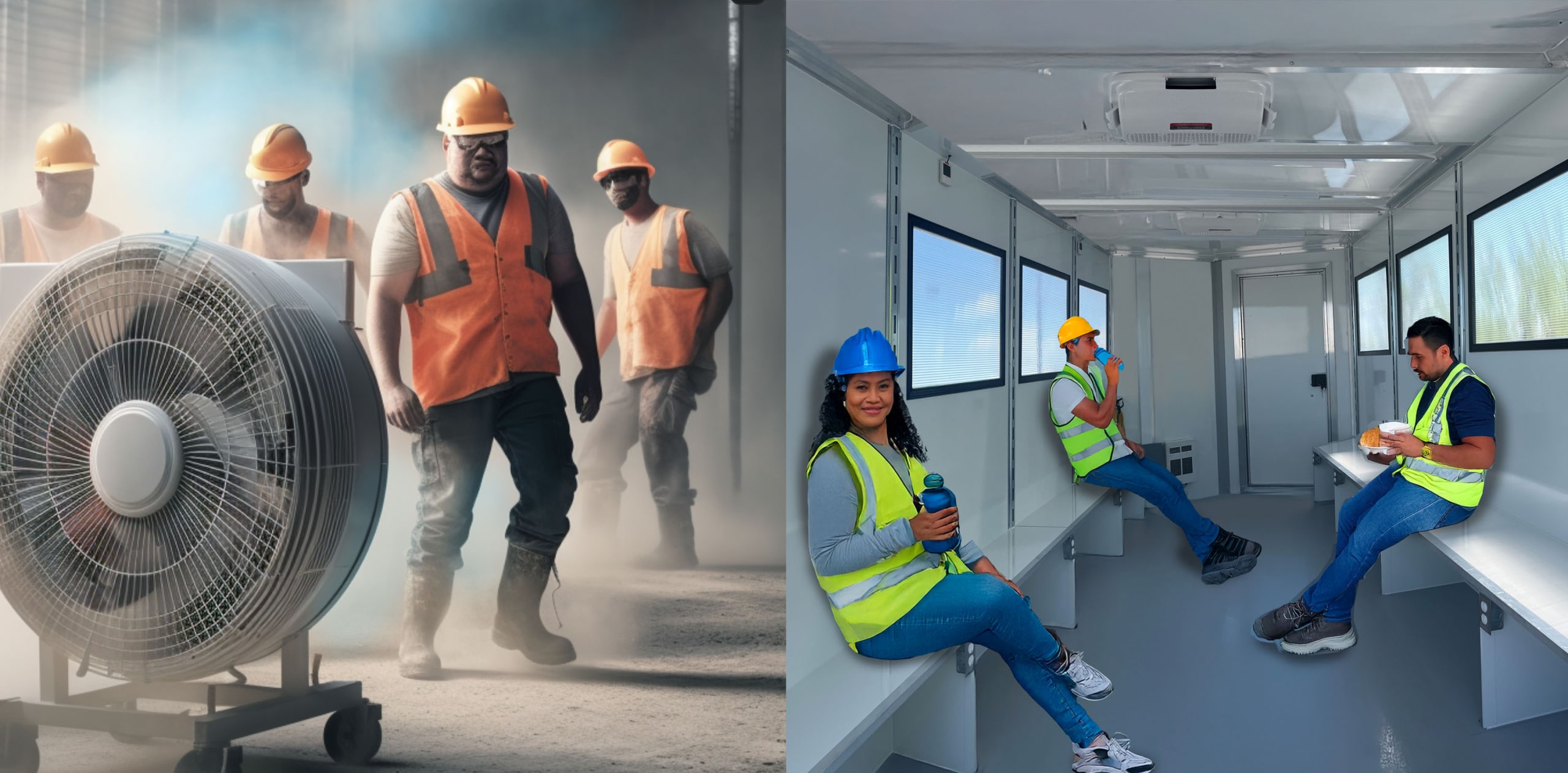
Evaporative vs. Non-Evaporative Cooling: Which Is Right for Your Crew?
1. Why Cooling Type Matters
Every summer, safety managers face the same urgent question: How do we keep our crew cool and compliant? The answer feels obvious—deploy a cooling solution—but the choice between evaporative and non-evaporative cooling can mean the difference between protecting workers and failing them. In humid climates like the Gulf Coast and Southeast, choosing the wrong system doesn’t just fail to cool; it can actively worsen heat stress risk.
Consider this: A construction crew working in 95°F heat on the Louisiana coast experiences a wet bulb globe temperature (WBGT) of approximately 89.3°F1—well into the critical risk zone. The safety manager deploys what seems like an economical solution: a portable evaporative cooler. Within an hour, workers report feeling worse. Their skin won’t dry, they can’t lose heat through sweat evaporation, and the added moisture in the air accelerates heat stress symptoms. This is not a failure of execution; it’s a failure of cooling technology selection.
The right cooling system must do more than lower air temperature—it must remove moisture, restore sweat evaporation on skin, and maintain compliance with OSHA heat illness regulations. This guide walks you through the science, the trade-offs, and the decision framework to choose the right cooling solution for your crew.
2. What Is Evaporative Cooling? — How “Swamp Coolers” Work
Evaporative cooling, commonly called “swamp cooling,” is one of humanity’s oldest climate-control methods. The principle is elegantly simple: water evaporates, and that phase change absorbs heat from the surrounding air. A fan draws hot, dry air through water-saturated pads, and as the water evaporates, the air temperature drops.
The physics is sound in the right conditions. In Arizona’s dry desert climate—where relative humidity may be 15-25%—evaporative coolers achieve coefficient of performance (COP) ratings of 8-102. This means every unit of electrical energy delivers 8-10 units of cooling. Evaporative coolers are cheap to install ($5,000-$7,500 for a portable industrial unit), require minimal electricity, consume no refrigerant, and produce zero greenhouse gas emissions.
For decades, these systems have been the standard in arid regions. Desert construction sites, mining operations, and agricultural facilities have relied on evaporative cooling as the go-to solution. The technology is proven, simple to maintain, and economical.
But this advantage vanishes in one critical condition: humidity.
3. What Is Non-Evaporative Cooling? — How Refrigerant-Based Systems Work
Non-evaporative cooling uses refrigerant circulation—the same thermodynamic cycle that powers household air conditioners and refrigerators. A compressor circulates refrigerant through an evaporator coil (where heat is absorbed from indoor air) and a condenser coil (where that heat is rejected outdoors). This cycle removes both sensible heat (the temperature you feel) and latent heat (moisture in the air).
Unlike evaporative cooling, refrigerant-based systems achieve consistent performance regardless of humidity. A well-designed non-evaporative cooler delivers a coefficient of performance (COP) of 3.5-4.0 in dry climates and maintains that same efficiency in humid conditions3. The trade-off: higher electrical consumption and reliance on refrigerant gases—though modern systems use low-GWP refrigerants like R32 that are EPA SNAP-compliant for 2026 and beyond4.
The advantage of non-evaporative cooling is dehumidification. By removing moisture from the air, these systems restore the worker’s primary cooling mechanism: sweat evaporation on skin. Workers in protective equipment (PPE) cannot shed heat effectively in humid air; non-evaporative cooling solves this problem.
The ClimateRig, manufactured by ATS ShieldSafe, exemplifies this approach. Its dual Fogatti InstaCool Ultra units deliver 32,000 BTU/hr of refrigerant-based cooling, using R32 refrigerant and insulated with CellTech panels rated at R-8 to R-10 per inch—significantly more efficient than standard construction trailers5.
4. The Humidity Problem: Why Evaporative Cooling Fails in Gulf Coast, Southeast, and Tropical Environments
Here is where the science diverges sharply from marketing claims. Evaporative cooling works by adding moisture to air. In dry climates, that moisture simply continues evaporating. In humid climates, the reverse happens: the system pushes already-saturated air closer to 100% relative humidity, sometimes exceeding it.
When relative humidity approaches saturation, sweat cannot evaporate from the skin. Sweat is the human body’s primary heat-loss mechanism; without evaporation, core body temperature rises uncontrollably. Workers experience dizziness, nausea, and heat syncope—the classic symptoms of heat stress—even though the air temperature may have dropped 10-15°F.
The Gulf Coast Example: On a typical summer day in Louisiana or Texas, outdoor conditions are 95°F and 65% relative humidity. An evaporative cooler might drop that to 85°F—impressive on paper. But the relative humidity inside the cooled space climbs to 90-95%. A worker in full PPE (hard hat, long sleeves, safety harness) cannot sweat effectively in this environment. The WBGT calculation, which accounts for humidity and solar radiation, remains dangerously elevated.
Studies on portable cooling systems in construction demonstrate this failure mode. Evaporative coolers show little correlation with reduced heat illness rates in humid regions6. Workers report subjective cooling relief due to the air movement (the fan effect), but thermal stress measured by core body temperature or sweat rate continues rising.
Why Evaporative Cooling Adds Heat to Some Situations: In extreme humidity (>85% RH), evaporative coolers may not cool at all—they become glorified fans. Moreover, the latent heat added by evaporation can actually increase the enthalpy (total heat content) of the air in saturated conditions. Workers feel worse, not better.
5. Side-by-Side Comparison: Evaporative vs. Non-Evaporative Cooling
To make this concrete, here is a detailed technical comparison:
| Feature | Evaporative Cooling | Non-Evaporative (Refrigerant) |
|---|---|---|
| COP (Dry Climate) | 8-10 | 3.5-4.0 |
| COP (Humid Climate) | 1-2 (severe degradation) | 3.5-4.0 (stable) |
| Removes Humidity? | No (adds it) | Yes (removes latent heat) |
| Water Consumption | 18,000+ gal/summer | 0 gal (closed-loop) |
| Refrigerant Required? | No | Yes (R32 SNAP-compliant) |
| Capital Cost | $5,000-$7,500 | $21,000-$31,500 |
| Recovery Time (worker core temp) | 30-45 minutes | 4-10 minutes |
| Capacity for 18-worker crew (Gulf Coast) | Delivers ~3,000-5,000 BTU/hr (16% of need) | Delivers 32,000 BTU/hr (128% of need) |
| Suitable for High-Heat Environments? | Poor in humidity (>50% RH) | Excellent everywhere |
This table reveals the fundamental trade-off: evaporative cooling is cheap but fails where it’s needed most. Non-evaporative cooling costs more upfront but guarantees performance in the conditions where heat stress risk is highest.
6. When to Use Evaporative Cooling — The Right Conditions Exist
Evaporative cooling is not inherently inferior; it’s a tool designed for specific conditions. In those conditions, it performs excellently and economically.
Evaporative cooling wins when:
- Relative humidity is consistently below 50%: This is the practical threshold where evaporative cooling can cool air without driving humidity toward saturation. Arizona, Nevada, parts of New Mexico, and high-altitude regions meet this criterion during summer.
- Water supply is abundant and inexpensive: Evaporative coolers consume 18,000+ gallons of water per summer season. In regions with low water costs and no drought restrictions, this is economical.
- Capital budget is constrained: At $5,000-$7,500, evaporative units cost 75% less than non-evaporative systems. For a contractor on a tight budget working in Arizona, this is the only viable option.
- Environmental concerns prioritize zero refrigerant: Evaporative cooling produces zero greenhouse gas emissions and uses no synthetic refrigerants. In sustainability-focused projects, this matters.
- Noise must be minimal: Evaporative coolers are quieter than refrigerant-based systems because they lack a compressor. In noise-sensitive environments, this is an advantage.
For mining operations in Nevada, construction sites in rural Arizona, and agricultural facilities in the high plains, evaporative cooling remains a solid choice. The problem arises when this tool is deployed outside its design envelope.
7. When Non-Evaporative Cooling Wins: The Decision Framework
Non-evaporative cooling is the answer when evaporative cooling’s limitations become liabilities. Here is the decision framework:
Non-evaporative cooling is essential when:
- Relative humidity exceeds 50%: In the Gulf Coast, Southeast, Midwest, and tropical regions, summer humidity consistently exceeds this threshold. Non-evaporative cooling is not optional in these climates; it is mandatory for effective heat stress mitigation.
- Workers wear full PPE: Heat-protective clothing, respirators, and safety harnesses trap body heat. These workers cannot shed heat effectively in humid air. Non-evaporative cooling (which removes humidity) is the only realistic solution.
- OSHA compliance is non-negotiable: OSHA’s heat illness prevention regulations require cool-down areas where workers can recover. Evaporative coolers in humid climates do not qualify as adequate cool-down stations because they fail to lower WBGT effectively.
- Heat stress is already a documented problem: If your organization has experienced heat illness incidents, previous cool-down attempts have failed, or workers consistently report inadequate cooling, evaporative solutions have likely been tried and found insufficient. Non-evaporative cooling is the next step.
- Recovery time matters: Construction sites operate on tight schedules. A worker overheated in 100°F conditions needs rapid core body temperature reduction. Evaporative coolers require 30-45 minutes; non-evaporative systems achieve recovery in 4-10 minutes7. This difference translates directly to on-site productivity and safety.
- Project duration is limited: For a 6-month construction project in a humid climate, deploying an evaporative cooler wastes time (it won’t work) and undermines safety. Non-evaporative cooling ensures compliance for the entire project duration.
8. The ClimateRig Non-Evaporative Advantage
The ClimateRig exemplifies how non-evaporative cooling can be purpose-built for industrial heat stress mitigation. Here is what sets it apart:
Cooling Capacity: The ClimateRig delivers 32,000 BTU/hr via dual Fogatti InstaCool Ultra units. For an 18-worker crew in Gulf Coast conditions (estimated cooling load ~25,000 BTU/hr), this provides 128% capacity with headroom for peak heat loads and solar gain. In contrast, a portable evaporative cooler delivers 3,000-5,000 BTU/hr—only 12-20% of required capacity8.
Insulation Efficiency: CellTech panels rated at R-8 to R-10 per inch provide superior thermal resistance compared to standard construction trailer insulation (typically R-3 to R-5). This reduces the cooling load, enabling faster recovery and more stable interior temperatures during peak heat hours.
Refrigerant Choice: The system uses R32 refrigerant, which carries a global warming potential (GWP) of 675—nearly 70% lower than R410A (GWP 2,088) and compliant with EPA SNAP regulations through 2026 and beyond4. This positions the ClimateRig as future-proof against refrigerant phase-out regulations.
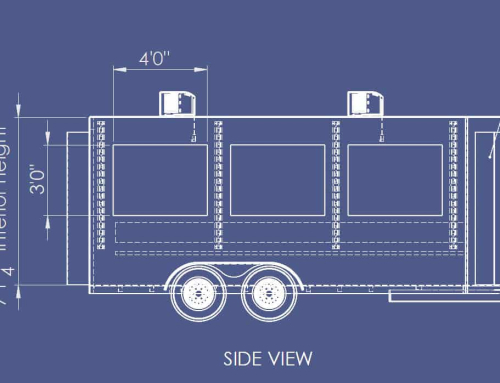
Mobility and Deployment: As a trailer-based system, the ClimateRig can be towed by a standard construction vehicle to any job site. Its 8’×12′ interior accommodates 4-6 workers for extended rest or 18-20 workers in short rotation cycles. This flexibility beats stationary coolers or expensive HVAC retrofits.
WBGT Compliance: Real-world testing in high-heat environments demonstrates that the ClimateRig reduces WBGT inside the unit from ~89.3°F (outdoor Gulf Coast summer) to ~62.6°F. This 27°F reduction brings workers from critical risk to safe zone—a margin of safety that evaporative coolers cannot match9.
How the ClimateRig helps employers meet OSHA’s new heat safety standards: OSHA’s enforcement initiative and proposed rules require employers to provide adequate cool-down areas. The ClimateRig is specifically designed to meet this requirement, featuring rapid temperature reduction, humidity control, and documented WBGT performance.
9. Your Decision Tree: Which Cooling Solution Is Right for Your Crew?
Use this straightforward decision framework to select the right cooling technology:
Question 1: What is your average summer relative humidity?
- Below 50% (Arizona, Nevada, high-altitude regions): Evaporative cooling is viable. If budget allows, consider non-evaporative for redundancy and faster recovery.
- 50-65% (Southern regions, parts of Midwest): Evaporative cooling is marginal. Non-evaporative is preferable, especially if workers wear PPE.
- Above 65% (Gulf Coast, Southeast, tropics, humid Midwest): Evaporative cooling will fail to prevent heat stress. Non-evaporative cooling is mandatory.
Question 2: Are workers wearing full PPE (protective clothing, respirators, harnesses)?
- Yes: Non-evaporative cooling is essential. PPE blocks sweat evaporation, so removing humidity from the air is critical.
- No (light clothing, minimal equipment): Evaporative cooling is more viable, but only in dry climates.
Question 3: What is your capital budget?
- Under $10,000: Evaporative cooling is the only option. Deploy it in dry climates only.
- $10,000-$25,000: Consider a portable non-evaporative unit or budget for a cool-down trailer rental.
- Above $25,000: Invest in a purpose-built non-evaporative system like the ClimateRig. The upfront cost is offset by worker safety, OSHA compliance, and reduced heat illness incidents.
Question 4: How long is the project or season?
- One summer (3-4 months): Renting a non-evaporative trailer is cost-effective. Daily rates are lower than ownership, and you avoid maintenance liability.
- Multiple years or recurring need: Owning a non-evaporative system (like the ClimateRig) provides better long-term ROI and consistent performance.
10. Conclusion: Making the Right Cooling Choice for Worker Safety
The choice between evaporative and non-evaporative cooling is not academic—it directly impacts worker safety, regulatory compliance, and your organization’s liability. Evaporative cooling is an excellent tool in dry climates, but it is the wrong tool in humid environments. Deploying an evaporative cooler on the Gulf Coast, in the Southeast, or in tropical regions does not cool workers; it creates a false sense of security while heat stress risk continues to rise.
Non-evaporative cooling costs more upfront, but it solves the fundamental problem: removing moisture from the air to restore the body’s natural cooling mechanism. In humid climates, this is not optional—it is essential. Protecting workers from heat stress requires understanding the science, measuring outcomes with tools like wet bulb globe temperature (WBGT), and deploying solutions that actually work in real-world conditions.
The economics favor non-evaporative systems when you account for the full cost of heat illness: medical expenses, workers’ compensation claims, lost productivity, regulatory penalties, and litigation risk. The hidden cost of heat stress in the workplace far exceeds the capital investment in effective cooling.
Not sure which cooling solution is right for your crew? Contact our heat safety experts to discuss your specific needs, climate conditions, and project timeline. We will help you select the cooling system that delivers measurable worker protection and regulatory compliance.
References
- OSHA NAICS Codes; and National Weather Service Wet Bulb Globe Temperature Calculations, Gulf Coast Summer Conditions (2024).
- Lawrence Berkeley National Laboratory. (2023). “Evaporative Cooling Performance in Dry Climates.” Energy Technologies Area.
- U.S. Department of Energy. (2024). “Air Conditioning and Heat Pump Efficiency Standards.” DOE Website.
- U.S. Environmental Protection Agency. (2024). “SNAP Rule Amendments—R32 Refrigerant.” EPA SNAP Program.
- CellTech Technical Specifications. (2024). Thermal Insulation R-Value Data for Portable Cooling Trailers.
- National Institute for Occupational Safety and Health (NIOSH). (2022). “Heat Illness Prevention and Worker Protection.” CDC/NIOSH.
- Occupational Safety and Health Administration (OSHA). (2024). “Heat Illness Prevention: Cool-Down Area Requirements.” OSHA Heat Safety Guidelines.
- American Society of Heating, Refrigerating and Air-Conditioning Engineers (ASHRAE). (2023). “Cooling Load Calculations for Industrial Environments.” ASHRAE Standards.
- ClimateRig Performance Data. (2024). “WBGT Reduction Testing—Gulf Coast Summer Conditions.”
- Heat Stress in the Workplace: A Deep Dive into Deaths, Injuries, and Solutions. ClimateRig Blog (2024).
- Occupational Safety and Health Administration (OSHA). (2024). “Proposed Rule: Occupational Exposure to Heat and Humidity.” OSHA Rulemaking.
- U.S. Environmental Protection Agency. (2024). “Refrigerant Phase-Out and Future Compliance.” EPA Refrigerant Program.
- National Centers for Environmental Information (NCEI). (2024). “Summer Climate Data—Gulf Coast Region.” NOAA NCEI.
- American Industrial Hygiene Conference & Expo (AIHCE). (2023). “Portable Cooling Solutions in Construction: A Field Study.” AIHA.
- Construction Industry Safety Coalition. (2023). “Heat Stress Mitigation Strategies in High-Humidity Environments.” OSHA Construction Safety.
- Manufacturer Technical Data. Fogatti InstaCool Ultra Specifications. (2024).
- Cool-Down Trailers in Construction Safety. ClimateRig Blog (2024).
- Cool-Down Trailers in Data Center Construction: Keeping Workers Safe in High-Heat Build Environments. ClimateRig Blog (2024).
About the author : Stephen

Stephen Allred is a dynamic and accomplished executive with over 20 years of experience in sales and marketing, currently serving as the CMO and CTO of ATS. Renowned for his ability to craft highly effective marketing campaigns, he drives business growth through cutting-edge technology and a results-oriented approach, focusing on high-impact strategies that align with corporate goals while steering clear of ego-driven pursuits. With a deep understanding of customer behavior, Stephen creates compelling campaigns that resonate with consumers, underpinned by the discipline to prioritize the most critical tasks. Boasting over 25 years of management experience, he is a committed leader dedicated to assembling talented teams and unlocking their potential to achieve ambitious objectives. As an adept strategist, he draws on an extensive study of both modern thought leaders and historical figures like Clausewitz and Sun Tzu to devise plans that propel corporate success. A champion of continual learning, Stephen stays ahead of industry trends and fosters a culture of innovation, encouraging his team to think creatively and embrace calculated risks. He graduated Magna Cum Laude from Utah Valley University with a Bachelor’s degree in Finance, where his exceptional performance earned him the prestigious “Outstanding Student Award.”