Powering a Cool-Down Trailer in the Middle of Nowhere: Generator, Shore Power, and Solar Hybrid Compared
1. The Question That Kills Good Safety Decisions
Every cool-down trailer sales conversation eventually arrives at the same question, usually about ten minutes in.
“How are we going to power this thing on the back forty?”
It is the question that kills more good safety decisions than any other. Procurement signs off on the trailer. Operations cannot figure out the power. The trailer sits in the yard while a heat wave passes through. Two months later the safety manager is on the phone with a hospital.
Here is what your three real options look like in 2026, what each one costs, and where each one falls apart — written for the operator who has to make the call, not for the brochure.
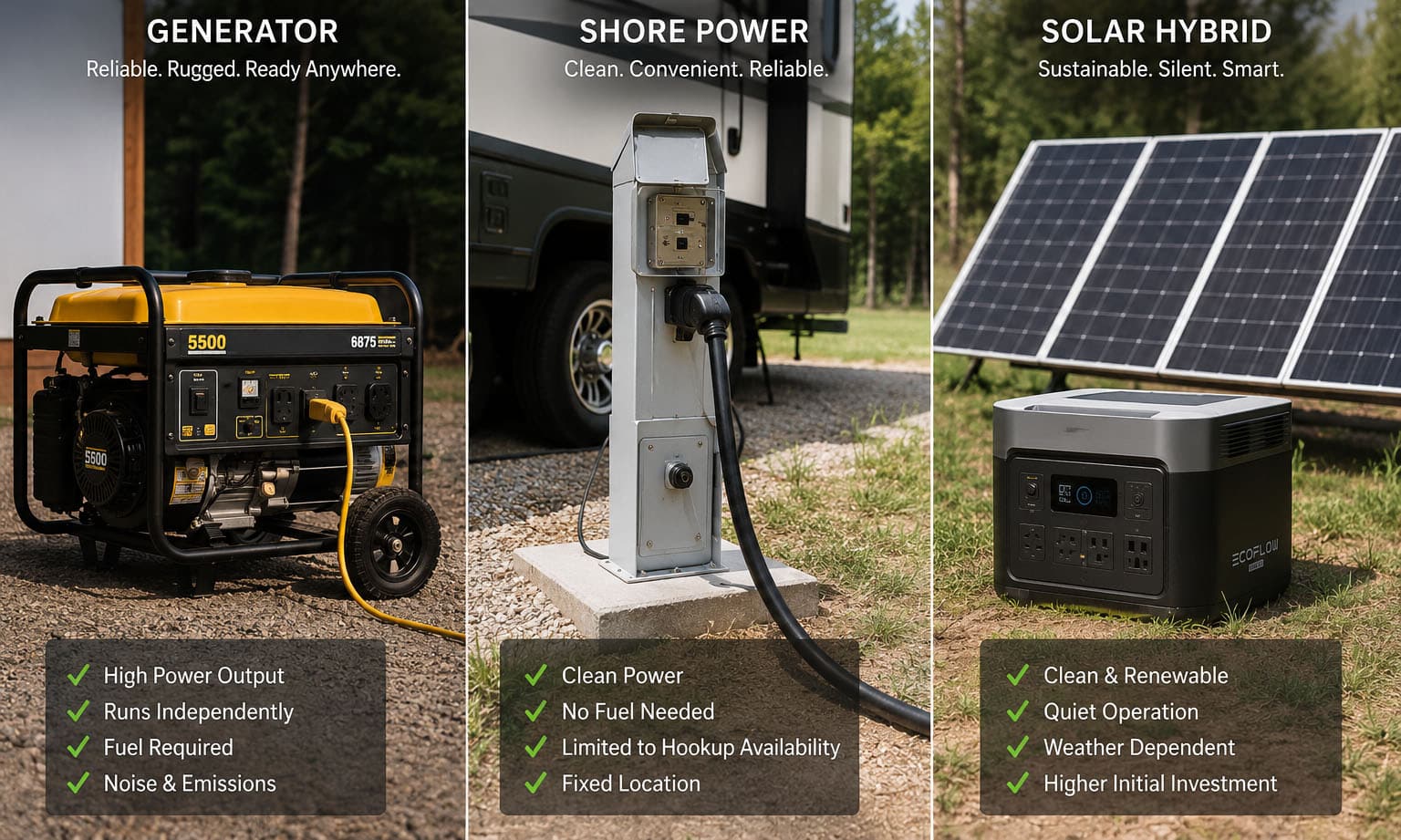
2. Option 1: Tongue-Mounted Generator — The Default for Remote Work
The ClimateRig™ generator upgrade is a Generac 15,000-watt unit hardwired to the trailer. You roll up, drop the stabilizers, turn the key, and you have cold air within minutes.
Strengths
- Zero dependence on site infrastructure. Drill pads, pipeline right-of-ways, disaster response sites — you bring your own power. If the grid is hours away or has not been pulled to the work zone yet, this is the only option.
- Headroom for the full load. Dual 15,000 BTU AC units pull a sustained 24 amps under load. A 15 kW generator handles that with room for lighting, charging stations, and the optional 2,000-watt heater for shoulder seasons.
- Predictable runtime. Diesel runtime on a single fill covers a full shift plus margin in most field conditions.
Weaknesses
- Fuel logistics. Someone has to schedule top-offs. On a remote site that is a real operational line item — fuel delivery, on-site storage, and the paperwork that comes with both.
- Noise. Inverter generators are quieter than open-frame units, but you are still adding 65 to 72 dB at the source. On urban infill or near residential, that is a permitting and PR issue.
- Emissions and Tier 4 compliance. CARB and EPA Tier 4 matters in California, parts of Oregon, and on most federal contracts. Verify the engine tier before you order, not after the trailer is on the lowboy.
Best for: oil and gas, remote infrastructure, disaster response, demolition, anywhere outside grid reach.
3. Option 2: Shore Power via L14-30 Inlet — The Cheapest Power You Will Ever Buy
Every ClimateRig™ ships with a 30-amp L14-30 power inlet. If your site has temporary power — and most permitted construction sites do — this is the answer your CFO has been waiting for.
Strengths
- Roughly $0.40 per hour of operation in most utility markets. Over a full hot-weather season, the savings against diesel are substantial.
- Silent. No exhaust. No emissions reporting. Your neighbors stop calling the city about the noise.
- One less piece of equipment to maintain. No fuel, no oil changes, no air filter, no winterization step.
Weaknesses
- Requires a dedicated 240V/30A circuit. Not every temporary service has one available, and adding it costs roughly $400 to $1,200 depending on the electrician and the run.
- Voltage drop on long runs. Cord runs over 50 feet introduce voltage drop that compounds in summer heat. Plan the trailer placement before the electrician leaves the site.
- Site power goes down, your trailer goes with it. If site power fails — and on jobsites it does — you lose the cool-down environment at the exact moment workers need it most. Plan a backup.
Best for: longer-duration construction projects with established temp power, data center builds, refinery turnarounds inside the fence line, stadium and event venue work.
4. Option 3: Solar Hybrid — The Option That Actually Works in 2026
Solar-only is still not realistic for two 15,000 BTU AC units running through a 95°F afternoon. The physics do not work — you cannot put enough panels on a trailer roof to carry that load. Anyone selling you a pure-solar cool-down trailer is selling you a science project, not jobsite equipment.
Solar hybrid, however, has become viable in the past 18 months. The configuration that works:
- A 5 to 10 kWh lithium battery bank installed adjacent to the trailer.
- A 3 to 5 kW solar array charging the battery during the day.
- A generator or shore-power connection as a backup that kicks in only when battery state drops below threshold.
- Smart load management that runs lighter loads (lighting, charging stations, heater) on solar and pushes the AC compressors to whatever source is most efficient at the moment.
Strengths
- Fuel consumption drops 40 to 70 percent compared to generator-only on a typical hot-season project.
- Quiet operation during shoulder hours when solar carries the load. Morning huddles and end-of-day debriefs happen without competing with a generator.
- ESG and Scope 1 emissions story for clients who care — and an increasing number do, especially on federal, utility, and Fortune 500 projects.
Weaknesses
- Capital cost. The hybrid setup adds meaningful budget over a straight generator configuration. ROI is real but takes a season or two of operating data to defend in front of finance.
- Complexity. More components mean more failure modes. Specify a system with remote monitoring and a clear service path — the worst time to debug an inverter is on a 105°F day with workers waiting.
- Footprint. The battery bank and solar array need somewhere to live. On a tight urban site, the geometry can be the deal-breaker.
Best for: long-duration projects, ESG-sensitive clients, sites with existing solar infrastructure, fleet operators running multiple trailers across a region.
5. The Honest Recommendation
If you are buying your first cool-down trailer, get the generator. It works everywhere, every time, and your team already knows how to operate it. Save the optimization for trailers two through five.
If you are buying your fifth trailer and most of your work is on permitted sites with temp power, configure the new units for shore power and keep one generator-equipped trailer for the surprise jobs. The cost-per-shift drops noticeably and you maintain the optionality for off-grid work.
If you are running a fleet and your clients are asking about emissions, the hybrid is no longer a science project. It is operational equipment that pays back, with a clean story to tell on ESG-sensitive bids.
The wrong answer is paralysis. A trailer in the yard helps no one.
6. The Power-Source Decision Matrix
| Site Condition | Best Power Option | Why |
|---|---|---|
| Remote / no grid access | Generator | Only realistic option; predictable runtime; familiar logistics |
| Permitted site, temp power available | Shore power | Lowest operating cost; silent; one less machine to maintain |
| Urban / noise-sensitive | Shore power or hybrid | Eliminates generator noise complaints; meets local permit conditions |
| Federal / CARB jurisdiction | Hybrid or Tier 4 generator | Emissions compliance is non-negotiable |
| Multi-trailer fleet on long projects | Hybrid | Fuel savings + ESG narrative justify capital cost |
| Disaster response / emergency deployment | Generator | Site conditions unpredictable; self-sufficiency is the requirement |
7. Three Mistakes That Cost Real Money
- Specifying the trailer before specifying the power. The cheapest configuration on the order form may need power infrastructure your site cannot deliver. Walk the site first.
- Undersizing the generator. Some buyers try to save money with a smaller portable generator on the assumption that the trailer’s AC units “do not run continuously.” On a hot afternoon they do. Plan for the full nameplate load with margin.
- Treating fuel logistics as someone else’s problem. A trailer with an empty fuel tank is the same as a trailer in the yard. Build the refill schedule into your weekly site plan and assign it to a name.
8. The Bottom Line
- Generator wins on flexibility and self-sufficiency. Buy this first.
- Shore power wins on operating cost and noise. Add it for fleet trailers on permitted sites.
- Solar hybrid wins on long-term economics and ESG. The math closes on long-duration projects and multi-trailer fleets.
- Pair the power decision with placement. The most efficient power source still fails if the trailer is 400 feet from the work face. Plan the geometry before the electrician arrives.
For the underlying work-rest math and how power downtime translates to compliance exposure, see OSHA Work/Rest Cycles in Heat: What Employers Must Know. For the full equipment context, see Cool-Down Trailers: What They Are, How They Work, and Why You Need One.
Related reading on ClimateRig.com:
- Cool-Down Trailers: What They Are, How They Work, and Why You Need One
- ClimateRig™: Built to Outlast Your Longest Projects
- The Heat Response of CellTech Panels: A Deep Dive
- Heat Stress Mitigation for Oil & Gas: Industry-Specific Solutions
- Personal Cooling Vests vs. Cool-Down Trailers: When Each Wins, and Why Most Sites Need Both
- OSHA Work/Rest Cycles in Heat: What Employers Must Know
Want a power-configuration worksheet for your specific site? Visit atspro.co/BPX-Power or call 800.747.9953 and we will walk through your site requirements in under fifteen minutes.
About the author : Bryce Hinckley