Personal Cooling Vests vs. Cool-Down Trailers: When Each Wins, and Why Most Sites Need Both
1. The Either/Or Question That Misses the Point
A safety manager called me last August. His crew was pouring concrete in 104°F heat, and he was choosing between two budget lines on a procurement form: phase-change cooling vests for every worker, or one mobile cool-down trailer for the site.
He framed it as either/or. That was his first mistake.
After watching jobsite heat programs succeed and fail across construction, oil and gas, data center builds, and emergency response, the pattern is clear: cooling vests and cool-down trailers solve different problems. Treating them as substitutes is how compliant-on-paper programs still end up with workers in the ER.
Here is the honest breakdown.
2. What a Cooling Vest Actually Does
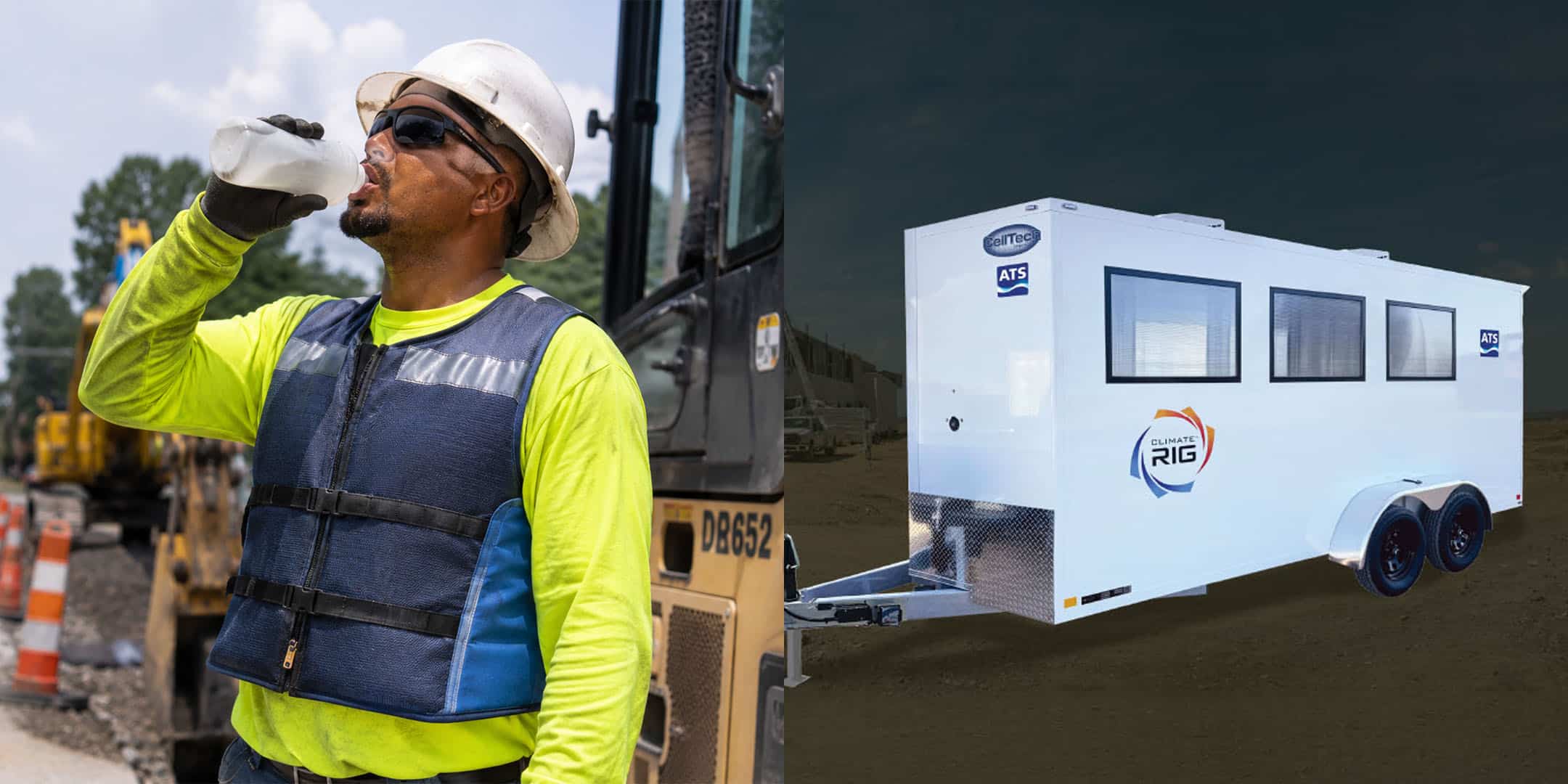
A phase-change or evaporative vest pulls heat off the worker’s torso while they keep working. It buys time — typically 90 minutes to three hours of continuous wear before the packs are spent. The good ones drop perceived exertion noticeably. The bad ones add weight, restrict movement, and make workers sweat under a wet shell.
Where Vests Win
- Workers cannot leave the immediate work area — tower climbers, confined-space entry, scaffold tasks at height, welders on a platform.
- Short-cycle tasks where the worker is back on the ground or out of the suit within the vest’s runtime.
- Managing radiant heat exposure on a specific worker, not on a whole crew.
Where Vests Fail
- Once core body temperature has started to climb, a vest is not a cooling intervention; it is a delay tactic. The worker still needs an actual recovery environment.
- When recharge logistics get sloppy. Spent ice packs in a hot toolbox are just dead weight by 10 a.m. You need a chilling system and a rotation plan, which most jobsites do not have.
- When heat is environmental rather than task-specific. A vest cannot reset a worker’s thermal load — only a cool environment can do that.
3. What a Cool-Down Trailer Does
A trailer like ClimateRig™ produces an actual recovery environment. Dual 15,000 BTU air conditioners, 125 square feet of bench seating, sub-75°F air for up to 18 workers per cycle. Workers walk in elevated and walk out reset.
That distinction matters under OSHA’s emerging heat rule and Cal/OSHA §3395: the regulation requires access to shade or other means to cool the body, with shade defined as a space that allows the body to cool. A canopy hitting 95°F under a 105°F sun does not meet that bar. A 72°F trailer does. For the full breakdown of what counts as compliant shade, see Cal/OSHA vs. Federal OSHA: Where Heat Illness Rules Differ in 2026.
Where Trailers Win
- Reset core temperature, not just slow its rise. Mechanical refrigeration drives recovery; passive shade does not.
- Crews of 8+ workers, where rotating individual vests through a recharge cycle becomes a logistical job in itself.
- Sustained heat — full shifts in WBGT 86°F+ environments where a vest’s 90-minute runtime falls short.
- Documented, defensible compliance. A trailer log showing entry/exit times is gold during an OSHA inspection. A pile of empty ice packs is not.
Where Trailers Fail
- As a substitute for active cooling on the work line. A trailer at the staging area does nothing for the welder who never leaves the platform.
- When the trailer is too far from the work face. Workers will not walk 400 feet in the last hour of a shift. Trailer placement is a real planning input, not an afterthought.
4. Why Most Sites Need Both
The mature programs treat vests and trailers as a system:
- Vests keep individual workers in safe physiological range between mandatory breaks.
- Trailers reset every worker fully during the work-rest cycle’s recovery interval.
- Together, they satisfy the OSHA test: prevention plus recovery, environmental control plus personal protection.
The math also works in favor of the combined approach. One ClimateRig™ trailer serves 18 workers per cycle. Outfitting those same 18 workers in premium phase-change vests with two pack sets each runs into five figures up front, plus recurring spend on replacement packs every season and the chilling infrastructure to keep them cold. Vests support the trailer; they do not replace it.
For the underlying work-rest math see OSHA Work/Rest Cycles in Heat: What Employers Must Know.
5. The Decision Framework
Three questions before you write the PO:
- Can workers leave the active work zone every 60 to 90 minutes? If no, you need vests. If yes, you need a trailer.
- Are you managing a single high-exposure task or a whole-shift environmental load? Task = vest. Environment = trailer.
- Will an OSHA compliance officer accept your shade structure as a “place to cool the body”? If you are unsure, you need a trailer.
In nearly every real-world program, the answer to all three is “both, and here is how they work together.”
6. Common Mistakes That Cost Programs Real Money
- Buying vests instead of fixing recovery. A vest budget is easier to defend in procurement than a capital trailer purchase, so safety managers reach for it first. The result is a program that delays incidents instead of preventing them.
- Sizing trailers by headcount alone. A trailer that fits 18 workers on a single break still fails if your recovery cycle requires 24 workers cooled in the same 10-minute window. Cycle math matters more than total crew size.
- Treating the trailer as the entire heat plan. Without hydration discipline (see The Hydration Math), trained supervisors, and documented work-rest cycles, the trailer is an expensive air-conditioned waiting room.
- Ignoring vest maintenance. Phase-change packs degrade. Evaporative vests need clean water. A vest in service for three seasons without replacement of consumables is providing maybe half of its rated cooling.
7. The Bottom Line
- Vests buy time. They are the right tool for workers who cannot leave the active work zone.
- Trailers reset workers. They are the right tool for whole-crew recovery and OSHA-defensible compliance.
- Most programs need both, and the buy decision is which one comes first, not which one to choose.
- If you can only afford one this season, buy the trailer. It serves more workers, satisfies the regulatory shade definition, and produces the documented log of compliant recovery that vests cannot.
The safety manager who called me last August? He bought the trailer first and added vests in October for his structural steel crew. Zero recordable heat illness incidents that season. That is what a system looks like.
For the engineering side and a 90-page playbook, see the Time on Tool guide, with WBGT-driven work-rest tables, ROI worksheets, and pre-season checklists.
Related reading on ClimateRig.com:
- Cool-Down Trailers: What They Are, How They Work, and Why You Need One
- Cal/OSHA vs. Federal OSHA: Where Heat Illness Rules Differ in 2026
- OSHA Work/Rest Cycles in Heat: What Employers Must Know
- The Hydration Math: Gallons Per Worker, Electrolyte Ratios, and Why Plain Water Falls Short
- Evaporative vs. Non-Evaporative Cooling: Which Is Right for Your Crew?
- Heat Acclimatization for Workers: The Science-Backed Protocol
Want the side-by-side cost-per-worker-hour model and a copy of the ClimateRig competitor comparison? Visit atspro.co/BPX-Vests or call 800.747.9953 for a 15-minute heat-program review.
About the author : Bryce Hinckley