The 3 Key Elements of OSHA Heat Illness Prevention (and the 4 Most Plans Miss)
1. The 3 Key Elements of OSHA Heat Illness Prevention
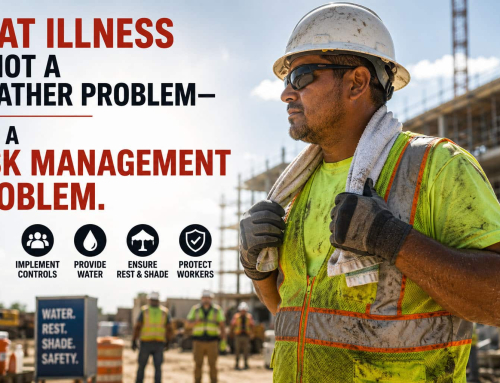
The three key elements of OSHA’s heat illness prevention guidance are water, rest, and shade. Federal OSHA campaigns, the Heat National Emphasis Program (NEP) inspection checklist, and Cal/OSHA’s outdoor heat standard (Title 8 §3395) all treat these three as the foundation of a compliant heat program:1
- Water — fresh, cool, free, with at least one quart per worker per hour available, encouraged at frequent intervals.
- Rest — paid breaks scaled to the heat load, taken in cool-down areas, with mandatory 10-minute cool-down rest every two hours in high-heat industries.
- Shade — present and accessible at temperatures above 80°F, ventilated, sized to accommodate everyone on a recovery break at the same time.
These three elements are necessary, mandated, and well-understood. They are also, on their own, insufficient to prevent serious heat illness in the conditions modern outdoor and industrial workforces actually face. The heat illness prevention plans that meaningfully reduce fatality and incident rates include four additional elements OSHA’s three pillars don’t directly require — but that the science of human thermal regulation says you need.
2. Why Water, Rest, and Shade Are Table Stakes — Not a Prevention Program
OSHA’s three pillars are administrative controls in the language of occupational safety. They depend on three assumptions, all of which break down on a real jobsite:
- Workers will recognize their own heat strain in time. The earliest signs of heat illness include impaired judgment and reduced cognitive function — the very faculties needed to recognize that something is wrong. By the time a worker realizes they need to stop, they are often already in trouble.
- Supervisors will enforce the breaks. In piecework pay structures, behind-schedule projects, or short-staffed crews, the pressure runs the other way. OSHA’s rest provisions don’t enforce themselves.
- Shade is sufficient cooling. Shade reduces radiant heat load, but it does not actively remove heat from the body. On a 100°F day with humid air, shade may bring the felt temperature down to 95°F — still above the threshold at which a working core body temperature can recover in a 10-minute break.
The OSHA-recorded data on heat fatalities tells the story: even on jobsites where water, rest, and shade were nominally provided, the fatalities continue. The standard’s own enforcement record demonstrates that compliance with the three pillars correlates only weakly with the absence of heat illness on the worksite.2 Compliance is the floor. Prevention is the ceiling.
3. The 4 Elements Most Heat Illness Prevention Plans Miss
A heat illness prevention plan that meets the science adds four elements to OSHA’s three. None of them are exotic. None require new technology. All of them are defensible on ROI grounds when measured against the productivity loss documented in cool-down trailer industry research and the heat-fatality data analyzed in our 2026 heat-deaths breakdown.
Element 4: Engineering Controls
Engineering controls remove heat from the worker physically rather than relying on the worker to remove themselves from the heat. For heat illness prevention, that means mechanical refrigeration — air-conditioned recovery space cool enough (72–74°F) and reliable enough to actually drop a worker’s core body temperature during a 20–30 minute break.
Two design points matter here. First, cooling capacity has to match crew size: a single window unit in a tool trailer is not a recovery space. Second, cooling has to be redundant: a single A/C unit failing on the hottest day of the year is a single point of failure for your entire prevention plan. Dual independent cooling systems — the design ClimateRig was built around — remove that vulnerability.
Cal/OSHA’s indoor standard (§3396) explicitly requires engineering controls when indoor temperatures reach 87°F. The federal proposed rule contemplates similar requirements. The plans that get ahead of the regulation rather than reacting to it are the ones that build engineering controls into their HIPP from the start.
Element 5: WBGT-Driven Monitoring
Air temperature on a phone is the wrong metric. Heat strain on the human body is a function of Wet Bulb Globe Temperature (WBGT) — a composite of dry-bulb temperature, humidity, radiant heat, and air movement. A 90°F day with 80% humidity carries a substantially higher WBGT than a 95°F day with 30% humidity, but a phone weather app reads the lower number as more dangerous.
A real heat illness prevention plan ties work-rest cycles to WBGT-based thresholds — the standard NIOSH Recommended Alert Limit and Recommended Exposure Limit charts, calibrated for the metabolic load of the work being done.3 Concrete pour crews, steel erection crews, and field service technicians do not have the same heat exposure under the same air temperature.
For a deeper treatment, see Wet Bulb Globe Temperature: The Heat Stress Metric That Actually Matters.
Element 6: Structured Acclimatization
OSHA’s published data and Cal/OSHA’s enforcement records consistently find that roughly 75% of heat-related occupational fatalities involve workers in their first week on the job — or first week back after time off.4 A worker who is physically capable of a job in cool conditions is not physiologically prepared for that same job in 95°F+ heat without a structured ramp-up.
A defensible acclimatization protocol limits new-employee work duration during their first 14 days, increases it incrementally, and applies the same ramp to all employees during heat waves (defined as 10°F+ above the recent average and at least 80°F). Cal/OSHA §3395 mandates close observation during this period; an effective HIPP goes further with documented work-duration limits and check-in schedules.
For protocol details, see Heat Acclimatization for Workers: The Science-Backed Protocol.
Element 7: Incident Response Infrastructure
When prevention fails, response time saves lives. Heat stroke can become irreversible within 30 minutes. The plans that close the loop include four response capabilities most HIPPs leave vague:
- Designated heat illness contact on every shift, with authority to call EMS and stop work.
- EMS access path documented for the worksite — not assumed.
- Cold-water immersion or aggressive cooling capability on-site, the field-proven first-line treatment for heat stroke before EMS arrival.
- Two-way observation system at WBGT thresholds where workers may not recognize their own decline.
4. The Hierarchy of Controls Applied to Heat
NIOSH’s hierarchy of controls ranks safety interventions from most to least effective:5
- Elimination — remove the hazard (e.g., reschedule work to cooler hours)
- Substitution — replace the hazard (e.g., automate a heat-exposed task)
- Engineering controls — physically isolate workers from heat (mechanical cooling, ventilation, recovery infrastructure)
- Administrative controls — rules and procedures (water, rest, shade; work-rest cycles; training)
- Personal protective equipment — cooling vests, ice packs
OSHA’s three pillars sit at the fourth rung — administrative controls. Cooling vests sit at the fifth. The interventions that demonstrably reduce heat fatality rates — mechanical refrigeration, redundant cooling, structured recovery infrastructure — sit at the third, the highest rung that’s actually deployable on most jobsites. A heat illness prevention plan that lives entirely in the bottom two rungs of the hierarchy is a plan optimized for compliance, not for prevention.
5. A Quick-Build HIPP Template That Includes All 7 Elements
Use this 7-element template as the spine of your written Heat Illness Prevention Plan. Each element should be specific to your worksite, dated, and updated annually.
The 3 OSHA-Mandated Elements
- 1. Water — cool, fresh, free, 1+ quart/worker/hour, encouraged at frequent intervals. Document quantity, location, and refill schedule.
- 2. Rest — paid breaks scaled to heat load. In high-heat industries (95°F+), mandatory 10-min cool-down every 2 hours. Document the schedule and the location.
- 3. Shade — ventilated, accommodates the full crew on break, present at the worksite at 80°F+. Document type and capacity.
The 4 Elements Most Plans Miss
- 4. Engineering controls — mechanical refrigeration, redundant cooling, dedicated recovery space sized for the crew. Document equipment specifications, cooling capacity, and failure-mode response (what happens if a unit goes down).
- 5. WBGT-driven monitoring — on-site WBGT measurement at high-risk worksites; work-rest cycles tied to NIOSH thresholds for the metabolic load of the work. Document the monitoring method and the thresholds.
- 6. Structured acclimatization — documented work-duration limits for new workers (first 14 days) and during heat waves. Document the schedule and the supervisor responsible.
- 7. Incident response infrastructure — designated heat illness contact per shift; documented EMS access path; on-site cold-water immersion or equivalent rapid-cooling capability; two-way observation procedures. Document all four.
A HIPP that addresses all seven elements is one that satisfies federal OSHA, Cal/OSHA §3395 and §3396, and the active state heat standards in WA, OR, MN, MD, CO, and NV simultaneously. For details on the state-by-state landscape, see Cal/OSHA vs. Federal OSHA: Where Heat Illness Rules Differ in 2026.
6. Bottom Line: Compliance Is the Floor, Not the Ceiling
Water, rest, and shade are necessary. They are also where most heat illness prevention plans stop — and the heat fatality data is clear that stopping there is not enough. The plans that reduce incidents and fatalities are the ones that add engineering controls, WBGT-driven monitoring, structured acclimatization, and incident response infrastructure on top of the OSHA baseline.
For an operational walk-through of how to deploy all seven elements on a real jobsite — including ROI worksheets, pre-season checklists, and WBGT-driven work-rest tables — see the Time on Tool guide: 90 pages, free download, built for safety leaders, project managers, and operations executives who want their HIPP to do more than satisfy an inspection.
The 3 elements OSHA mandates protect you from a citation. The 4 most plans miss are what protect your crew.
References
- U.S. Department of Labor, OSHA, Heat Illness Prevention Campaign — Water. Rest. Shade. https://www.osha.gov/heat-exposure
- U.S. Bureau of Labor Statistics, Census of Fatal Occupational Injuries (CFOI), heat-exposure fatality records 2014–2023.
- National Institute for Occupational Safety and Health (NIOSH), Criteria for a Recommended Standard: Occupational Exposure to Heat and Hot Environments, Publication No. 2016-106. https://www.cdc.gov/niosh/docs/2016-106/
- OSHA published guidance on acclimatization, citing analysis that approximately three-quarters of heat-related fatalities involve workers in their first week on the job.
- National Institute for Occupational Safety and Health (NIOSH), Hierarchy of Controls. https://www.cdc.gov/niosh/topics/hierarchy/default.html
- California Code of Regulations, Title 8, Section 3395 (Heat Illness Prevention in Outdoor Places of Employment); Section 3396 (Heat Illness Prevention in Indoor Places of Employment).
Related reading on ClimateRig.com:
- How to Build an OSHA-Compliant Heat Illness Prevention Plan
- OSHA Work/Rest Cycles in Heat: What Employers Must Know
- Heat Acclimatization for Workers: The Science-Backed Protocol
- Wet Bulb Globe Temperature (WBGT)
- Cool-Down Trailers: What They Are, How They Work, and Why You Need One
- ClimateRig: Built to Outlast Your Longest Projects
About the author : Bryce Hinckley