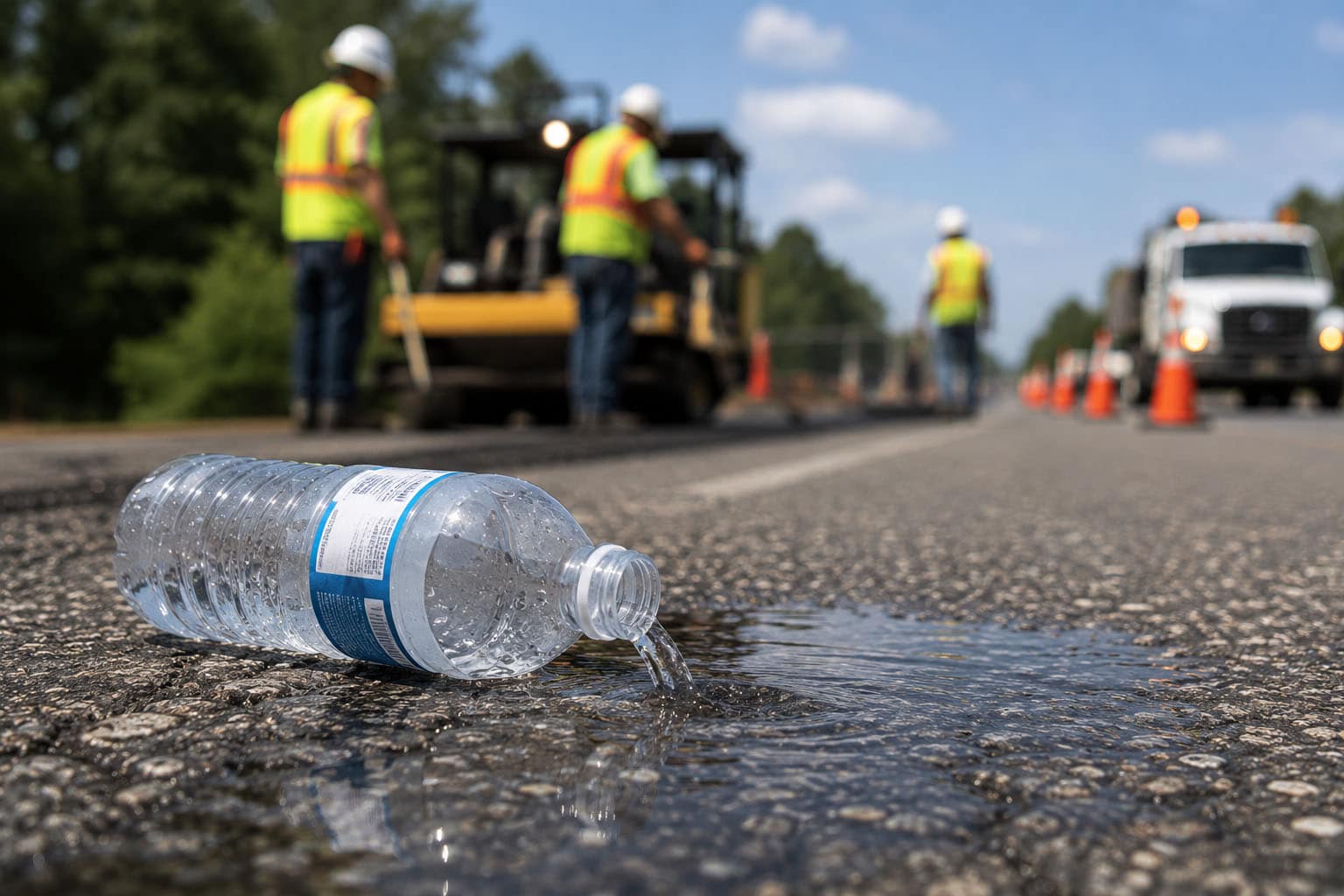
The Hydration Math: Gallons Per Worker, Electrolyte Ratios, and Why Plain Water Falls Short in 8+ Hour Shifts
1. Every Heat Plan Says “Provide Water.” Almost None Do the Math.
Every Heat Illness Prevention Plan (HIPP) I have ever audited includes some version of the line, “provide cool, potable water.” A few specify a quart per worker per hour. Almost none of them do the math on what actually happens to a worker over an eight-hour shift in 95°F heat — and the gap between the regulation’s floor and the worker’s physiological need is where most heat incidents start.
This article does the math. The numbers below come from published occupational physiology, OSHA guidance, and the same protocols used to write the prescriptive hydration sections of California’s §3395 and the proposed federal heat standard. If your HIPP says “water available,” but your purchasing line does not match what follows, you have a paper compliance plan, not an operating one.
2. The Starting Numbers: Sweat Rate, Fluid Loss, and the OSHA Floor
A worker performing moderate-to-heavy labor in WBGT 86°F+ conditions loses approximately one to one and a half liters of sweat per hour. That is published occupational physiology, not a sales pitch.1 Over an eight-hour shift, that is 8 to 12 liters of fluid loss. Call it 2.5 to 3 gallons per worker, per shift.
OSHA’s longstanding guidance — and the language carried into the proposed federal heat standard — is one quart per worker per hour, replenished often.2 Over an eight-hour shift that gets you to 8 quarts, or 2 gallons. For a worker on the low end of the sweat-rate range, that is fine. For a worker on the high end, you are 30 percent short by quitting time.
The first correction: plan for 2.5 gallons of fluid per worker per shift in sustained heat conditions, not 2. For a 15-worker crew, that is 37.5 gallons of cold drinking water available daily. Not stored on the truck. Available at the work face, refilled, and cold.
If your jugs are warm by 10 a.m., your math is already wrong. (More on consumption versus availability in Section 6.)
3. Why Plain Water Stops Being Enough Around Hour Four
Sweat is not just water. It is water plus electrolytes — sodium primarily, with potassium, chloride, magnesium, and calcium in smaller amounts. A worker losing three gallons of sweat is also losing roughly 6 to 12 grams of sodium, depending on individual sweat composition and acclimatization state.
Replace the water without replacing the electrolytes and you create a condition known as exercise-associated hyponatremia — abnormally low blood sodium. Symptoms include nausea, headache, confusion, muscle cramping, and in severe cases seizures.3 They look almost identical to early heat exhaustion, which is part of why this gets missed on jobsites.
The four-hour mark is where the curve breaks. Up to that point, a healthy, well-fed worker can rehydrate with water alone. Past four hours of sustained sweating in heat, plain water starts diluting blood sodium faster than the body can compensate. The worker drinks more, feels worse, drinks more, and ends up in the medical tent thinking they are heat-stroked when they are actually salt-depleted.
For the clinical distinction between heat illness presentations, see Heat Stress vs. Heat Exhaustion vs. Heat Stroke: Know the Difference.
4. The Electrolyte Ratio That Actually Works for Occupational Use
Sports-drink marketing has convinced a generation of safety managers that any colored bottle does the job. It does not. Most retail sports drinks are formulated for one-hour athletic events, not eight-hour shifts. They run high on sugar and low on sodium — fine for a soccer match, inadequate for a roofing crew.
What you want for occupational use, per liter of electrolyte fluid:
- Sodium: 400 to 700 mg per liter
- Potassium: 100 to 200 mg per liter
- Carbohydrate: 4 to 8 percent — enough to support absorption rate, not so much that it slows gastric emptying
- Mix ratio: No more than half of total fluid intake should come from electrolyte beverages. The other half should still be plain water.
A Practical Hydration Schedule for a 10-Hour Shift in WBGT 86°F+ Conditions
- Hours 1 to 3: Plain water, 8 ounces every 15 to 20 minutes.
- Hour 4 and beyond: Alternate water and electrolyte beverage at the same 8-ounce / 15-minute cadence.
- Every cool-down break: One full bottle of electrolyte beverage on entry to the cooling area, with water available for the duration of the break.
- End of shift: Continue rehydration for the first hour off-shift — recovery is not over when the timecard punches out.
5. What This Means for Your Purchasing Line
For a 15-worker crew on a typical hot-weather project, the weekly hydration spend looks something like this:
- Water: 37.5 gallons × 5 days = 187 gallons per week — bulk-bottled or properly maintained jugs, kept cold.
- Electrolyte concentrate: Sufficient for 6 liters of finished electrolyte beverage per worker per week = 90 liters of finished electrolyte fluid per week.
- Ice / chilling capacity: Enough to keep beverages below 60°F at the point of consumption through the entire shift.
Most sites underspend on electrolytes by an order of magnitude. The cost difference between adequate and inadequate hydration supplies on a 15-worker crew over a hot-weather season is roughly the cost of one heat-related emergency room visit. The ROI argues itself before you account for OSHA citation exposure.
6. Supply vs. Consumption: The Piece Most Plans Miss
Hydration is not just about supply. It is about consumption.
Workers in heat self-regulate downward — meaning the thirstier they get, the less they want to drink. This is well-documented in field studies of agricultural and construction workers and is the reason OSHA’s guidance specifies encouraged at frequent intervals rather than simply made available.4
Three field realities determine whether your hydration math actually reaches the worker’s hand:
- Temperature. Cold beverages get consumed. Warm beverages do not. A 110°F tailgate is a beverage graveyard.
- Proximity. Water at the work face gets consumed. Water at the trailer 400 feet away does not, especially in the last hour of a shift when fatigue makes the walk feel longer.
- Palatability. Electrolyte beverage that tastes bad gets dumped at the first opportunity. Letting workers help choose the flavor is not a soft skill — it is a compliance strategy.
This is why cool-down trailers and hydration programs work better together than either alone. Cold beverages stored in a 72°F trailer get consumed. Warm beverages stored on a 110°F tailgate do not. Your hydration math only works if the math arrives at the worker’s hand at the right temperature, at the right distance, in a form they will actually drink.
For more on how a controlled recovery environment supports the work-rest cycle, see OSHA Work/Rest Cycles in Heat: What Employers Must Know and Cool-Down Trailers: What They Are, How They Work, and Why You Need One.
7. Documentation: Track Consumption, Not Just Availability
Cal/OSHA enforcement guidance and the proposed federal rule both expect employers to document the operation of their hydration program, not just its existence on paper. In practice, the strongest defensible documentation looks like:
- Daily consumption log — gallons of water and liters of electrolyte beverage delivered to the worksite, stocked at the work face, and refilled during shift.
- Temperature spot-checks — beverage temperature recorded at the consumption point at mid-shift and end-of-shift.
- WBGT or heat-index reading for the day, tied to the hydration schedule actually delivered.
- Cool-down break entries / exits — when the crew used the recovery space, how long, and whether they consumed beverages during recovery.
Documenting consumption is not bureaucratic theater. It is the evidence that the math arrived at the worker. Without it, your HIPP describes an aspirational program, not an operating one.
8. The Bottom Line
- Plan 2.5 gallons of fluid per worker per shift in sustained heat — not 2.
- Switch in electrolytes by hour four, not when someone collapses.
- Keep beverages cold or accept that your spend is theoretical.
- Document consumption, not just availability, in your HIPP.
- Pair hydration with a controlled recovery environment. A 72°F trailer is where cold beverages and rested workers actually meet.
The crews that survive heat seasons are not the ones with the best gear. They are the ones whose math actually works in the field.
For the engineering side — recovery infrastructure that satisfies both the productivity math and the regulatory bar — see the Time on Tool guide, with WBGT-driven work-rest tables, hydration calculators, and pre-season checklists.
References
- National Institute for Occupational Safety and Health (NIOSH), Criteria for a Recommended Standard: Occupational Exposure to Heat and Hot Environments, DHHS Publication No. 2016-106. https://www.cdc.gov/niosh/docs/2016-106/
- U.S. Department of Labor, OSHA, Heat Illness Prevention Campaign — Water. Rest. Shade. https://www.osha.gov/heat
- Hew-Butler T. et al., “Statement of the Third International Exercise-Associated Hyponatremia Consensus Development Conference,” Clinical Journal of Sport Medicine, 2015.
- California Code of Regulations, Title 8, Section 3395 — Heat Illness Prevention in Outdoor Places of Employment. https://www.dir.ca.gov/title8/3395.html
Related reading on ClimateRig.com:
- Heat Stress vs. Heat Exhaustion vs. Heat Stroke: Know the Difference
- OSHA Work/Rest Cycles in Heat: What Employers Must Know
- Heat Acclimatization for Workers: The Science-Backed Protocol
- Cool-Down Trailers: What They Are, How They Work, and Why You Need One
- How to Build an OSHA-Compliant Heat Illness Prevention Plan
- Wet Bulb Globe Temperature (WBGT): Measurement, Interpretation, and Safety Measures
Want the full hydration calculator and a sample HIPP hydration section? Visit atspro.co/BPX-Hydration or call 800.747.9953 for a 15-minute heat-program review.
About the author : Bryce Hinckley