Roofing in 110°F: Why Asphalt Shingles Push Surface Temps Past 160° and How to Build Breaks Around It
When the thermometer reads 110°F, most safety conversations stop there. For a roofer on a dark asphalt shingle roof, that number tells only part of the story. Three forces compound simultaneously: ambient air temperature, radiant heat reflected upward from the roof surface, and the metabolic heat generated by hard physical work. Together, they push the physiological heat load far beyond what any single thermometer reading suggests.
How Hot Does a Dark Roof Actually Get?
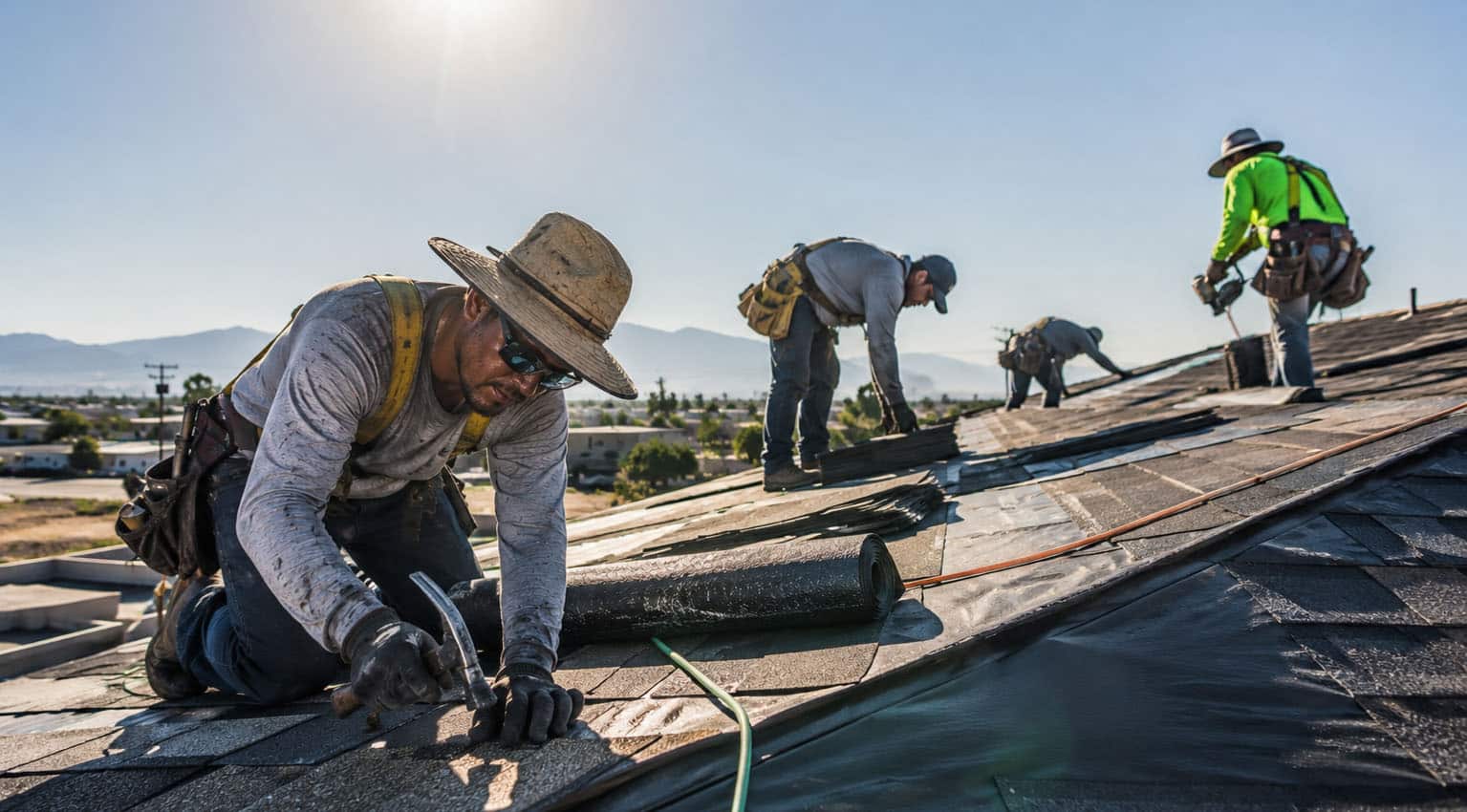
The U.S. Department of Energy documents that conventional dark roofs can reach 150°F or more on a sunny summer afternoon under typical summer conditions. [1] On days when ambient air climbs to 110°F, dark asphalt shingle surfaces routinely exceed 160–170°F. Standard dark shingles reflect only 5–15% of solar radiation, absorbing the rest as heat. The surface a roofer kneels, sits, or stands on is functioning as a radiator — and it is radiating directly at the worker’s body.
This matters because human heat balance is not just about air temperature. The body gains heat from four sources: the environment’s air temperature (convective gain), solar radiation hitting directly (radiant gain from the sky), radiant heat reflected or emitted from nearby surfaces (the roof surface in this case), and internal metabolic heat generated by the work itself. A roofer on a 110°F day with a 165°F shingle surface below them is absorbing radiant energy from multiple directions simultaneously.
Key fact: A conventional dark asphalt roof absorbs up to 95% of solar radiation. At 110°F ambient, the surface beneath a roofer’s knees can exceed 160°F — hot enough to cause contact burns in under a minute.
OSHA’s Radiant Load Concept
OSHA explicitly lists “heat-absorbing roofs” as an occupational heat source — separate and distinct from ambient air temperature — in its Heat Illness Prevention guidance. [2] This distinction matters: an employer whose safety plan references only the NWS ambient temperature forecast is not measuring the actual heat hazard workers face.
The more accurate field measurement is Wet Bulb Globe Temperature (WBGT), which integrates air temperature, humidity, solar radiation, and air movement into a single reading. WBGT on a 110°F day on a dark roof is dramatically higher than ambient temperature alone would suggest. A heat index reading — the standard NWS “feels like” temperature — does not account for radiant surface load at all. Employers relying on heat index alone for roofing operations are systematically underestimating the hazard.
A documented OSHA case illustrates this gap precisely: a roofer died of heat stroke on a day when the ambient temperature was only 86°F with 57% humidity (a 90°F heat index). The investigation found that the total radiant and metabolic load, not the air temperature alone, was the fatal factor. [3] No single environmental reading captured what the worker was actually experiencing.
The Acclimatization Window: Where Most Deaths Occur
NIOSH research consistently shows that a disproportionate number of occupational heat fatalities occur during the first few days of work in the heat — before the body has had time to adapt. The acclimatization process takes 7–14 days for full adaptation; the cardiovascular and sweat-response improvements that make sustained heat work survivable are not present on Day 1.
NIOSH guidance establishes a specific protocol: new workers should not exceed 20% of their usual heat-exposure duration on Day 1, increasing by no more than 20% per day over the 7–14 day acclimatization period. [4] A worker who was doing office work in an air-conditioned environment and starts roofing in July should be treated as a new heat worker regardless of their prior construction experience.
Employers with high summer crew turnover — subcontractors, temp labor, seasonal hires — face this risk repeatedly throughout the season. Each new crew member represents a fresh acclimatization window during which heat tolerance is lowest and risk is highest.
Building the Break Schedule Around the Actual Heat Load
Standard “drink water every hour” guidance is insufficient for roofing in extreme heat. NIOSH and OSHA recommend a specific hydration protocol for moderate-to-heavy work in heat: 1 cup (8 oz) of cool water every 15–20 minutes — not waiting until the worker feels thirsty, since thirst is a lagging indicator of dehydration. [4]
For break scheduling on high-heat roofing days, the following structure reflects NIOSH work-rest ratio guidance applied to roofing-specific conditions:
- Below 91°F WBGT (roughly 100°F ambient on a dark roof): 45 minutes work, 15 minutes rest per hour for heavy physical work.
- 91–100°F WBGT (roughly 100–110°F ambient on a dark roof): 30 minutes work, 30 minutes rest per hour. Limit continuous roof exposure to 45–60 minutes before a mandatory cool-down break.
- Above 100°F WBGT: Consider stopping roof work entirely. At minimum, restrict to very light tasks and increase rest to 2/3 or more of the hour.
Early-morning scheduling is highly effective for managing roof-surface temperatures. By stopping exposed roof work by 10–11 a.m. on days forecast at 105°F+, employers capture the lower-surface-temperature window before the shingles have fully thermally loaded. Starting at first light (5–6 a.m.) and stopping at 11 a.m. gives 5–6 productive hours with far lower radiant load than afternoon exposure.
Why Shade Alone Is Not Enough
A worker resting in the shade at 110°F ambient is resting in 110°F air. Their core body temperature is not recovering — it is simply not increasing as fast as it would in full sun. For genuine physiological recovery during rest breaks, workers need an environment meaningfully cooler than ambient. Air-conditioned rest areas — commonly a climate-controlled job-site trailer maintained at 70–75°F — lower core body temperature during the break period and allow workers to return to the roof with measurably more heat tolerance.
This distinction is significant from both a safety and a productivity standpoint. Workers who cool down between exposures sustain effective work capacity across a full shift. Workers who “rest” in shade in ambient heat accumulate heat stress progressively through the day regardless of break frequency.
Practical Checklist for 100°F+ Roofing Days
- Assess the heat hazard before the shift using WBGT or a corrected heat index — not NWS ambient temperature alone.
- Station cool water within 50 feet of all workers, accessible at all times.
- Brief all workers on heat illness signs and symptoms before work begins, including buddy-system monitoring.
- Schedule new and recently returned workers on the acclimatization protocol — 20% of usual duration on Day 1.
- Set a hard stop time for direct roof exposure on extreme heat days (target 10–11 a.m. when forecasting 105°F+).
- Ensure an air-conditioned rest area is available — not just shade.
- Have a written emergency action plan, including the address of the nearest emergency room.
- Document all training, break schedules, and any heat-related symptoms observed.
The Bottom Line
The 110°F thermometer reading is the floor, not the ceiling, of the heat challenge a roofer faces on a dark asphalt shingle roof in midsummer. The combination of radiant load from the surface below, solar load from above, and metabolic heat from the work creates a total heat burden that can be fatal even on days that don’t make the evening news. A proactive break structure built around NIOSH work-rest ratios, proper acclimatization, continuous hydration, and genuine cool-down environments is not a best practice — it is the threshold between a productive summer roofing season and a fatality investigation.
Sources
- U.S. Department of Energy. “Cool Roofs.” Energy Saver. energy.gov/energysaver/cool-roofs
- OSHA. “Heat — Overview.” U.S. Department of Labor. osha.gov/heat-exposure
- OSHA. “Heat — Case Studies.” osha.gov/heat-exposure/case-studies
- NIOSH. “Workplace Recommendations: Heat Stress.” CDC. cdc.gov/niosh/heat-stress
About the author : Bryce Hinckley