Real OSHA Heat Citations: A 2025–2026 Case Review of Fines, Settlements, and General Duty Clause Violations
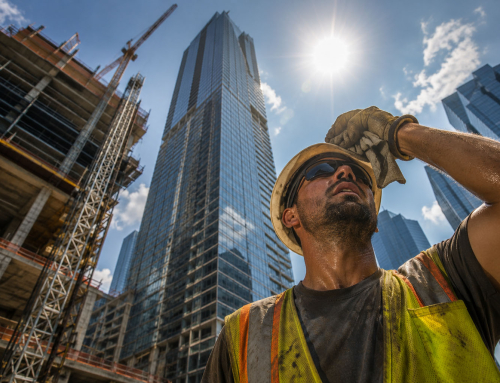
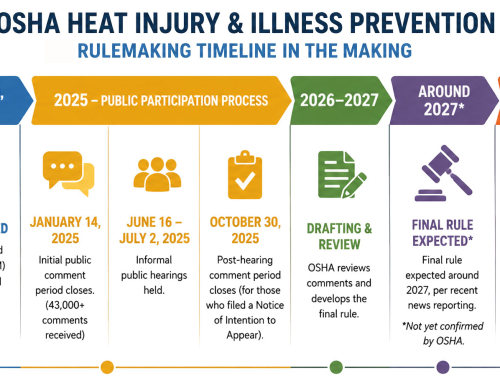
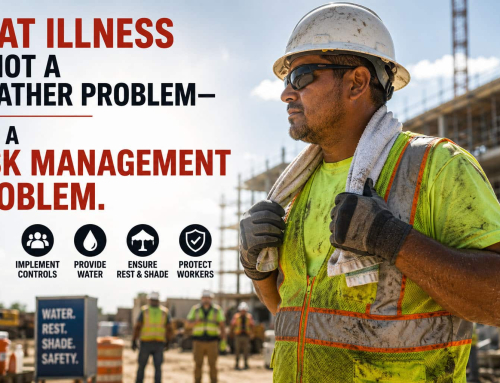
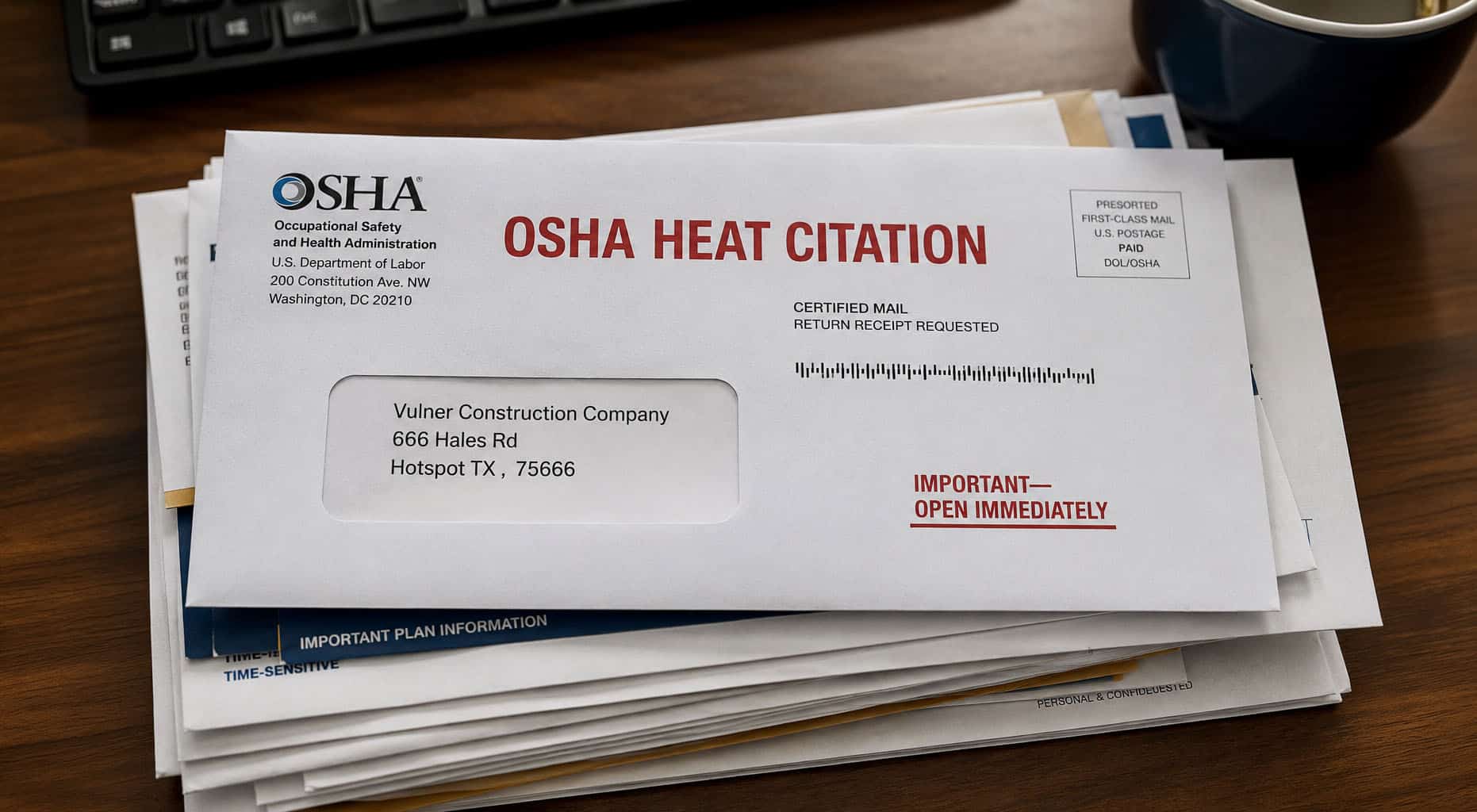
For years, employers argued that OSHA’s heat-illness enforcement lacked teeth because no federal heat-specific standard existed. That argument has aged poorly. Through aggressive use of the General Duty Clause, a rolling National Emphasis Program, and penalty assessments reaching six figures, OSHA has made heat the enforcement priority of the 2020s. The enforcement record is real — real cases, real dollar amounts, real press releases naming employers.
The Legal Framework: Four Elements OSHA Must Prove
Federal OSHA enforces heat through Section 5(a)(1) of the Occupational Safety and Health Act — the General Duty Clause — which requires employers to provide a workplace free from recognized hazards likely to cause death or serious harm. [1] To sustain a General Duty Clause citation, OSHA must establish four elements:
- The employer failed to keep the workplace free of a hazard to which employees were exposed.
- The hazard was recognized — either by the employer or by the industry generally.
- The hazard was causing or was likely to cause death or serious physical harm.
- A feasible and useful method existed to correct the hazard.
Heat meets all four elements on virtually every outdoor or high-temperature industrial worksite. OSHA’s burden of proof is low once a heat illness event has occurred — especially a fatality or hospitalization. The investigation focuses on what the employer failed to do, not on whether a violation existed.
Reporting triggers: Any work-related inpatient hospitalization must be reported to OSHA within 24 hours (29 CFR 1904.39). Any work-related fatality must be reported within 8 hours. Both automatically trigger a formal OSHA inspection.
The National Emphasis Program: Proactive, No Complaint Required
OSHA’s National Emphasis Program (NEP) on Heat, most recently reissued as Directive CPL 03-00-024 on April 10, 2026, fundamentally changed the enforcement landscape. [2] Under the NEP, OSHA compliance officers are authorized to conduct proactive inspections — with no employee complaint required — whenever the heat index is forecast at 80°F or higher in the area.
The NEP explicitly targets: construction (all trades), agriculture and landscaping, commercial roofing, warehousing and distribution, foundries and other hot industrial settings, and any outdoor operation with workers exposed to the sun. Officers are directed to cite all applicable General Duty Clause violations if any element of a heat illness prevention program is missing or inadequate. An employer can receive an inspection, and a citation, without anyone having been hurt.
Current Maximum Penalties
OSHA adjusts its civil penalty maximums annually for inflation under the Federal Civil Penalties Inflation Adjustment Act. As of 2025–2026: [3]
- Serious violation: $16,550 per violation (maximum).
- Willful or Repeat violation: $165,514 per violation (maximum).
- Other-than-serious: $16,550 per violation (maximum).
- Failure to abate: $16,550 per day beyond the abatement date.
Heat citations are typically issued as Serious. They become Willful when OSHA determines the employer knowingly disregarded the hazard or consciously chose not to implement a known remedy. They become Repeat when the employer received a prior citation for a substantially similar condition — regardless of whether the prior citation involved heat specifically.
What Citations Actually Look Like: Construction Pattern
A representative construction fatality investigation pattern runs as follows. A subcontractor on a commercial project has no written heat illness prevention plan, no acclimatization protocol for new workers, water not readily accessible to workers, and supervisors who have received no training on heat illness recognition or emergency response. A worker is hospitalized with heat stroke; OSHA opens a formal investigation.
OSHA issues four Serious citations — one for each missing element of a compliant heat illness prevention program. Initial proposed penalties at maximum Serious rates: $66,200. If the investigation reveals prior heat-related complaints or citations, or if evidence shows supervisors were aware of warning signs and did nothing, OSHA elevates to Willful. A single Willful citation in a fatality case carries up to $165,514. A four-violation Willful package: up to $662,056 in proposed penalties before any settlement.
Actual settlements — conducted through OSHA’s informal conference process — typically reduce proposed penalties by 30–60% in exchange for a payment agreement, an abatement plan, and sometimes ongoing OSHA monitoring. The settlement number is smaller than the proposal, but the abatement obligations and legal costs often cost more than the penalty reduction.
What Citations Actually Look Like: Agricultural Repeat Pattern
In agricultural enforcement, a Repeat violation pattern is common because many large growers have received prior citations over multiple seasons. An employer with a prior heat citation from a previous season that failed to implement agreed-upon abatement measures — or implemented them incompletely — faces Repeat citations when a subsequent heat illness event occurs. The Repeat maximum is identical to Willful: $165,514 per citation.
Documented OSHA enforcement in agriculture has produced proposed penalty packages ranging from $150,000 to over $400,000 before settlement — on a single employer, in a single season. These cases typically involve multiple workers hospitalized, not just one incident.
Penalty math example: Four Serious violations at $16,550 each = $66,200 initial proposal. One Willful citation elevated from Serious = $165,514. Settlement at 50% reduction = $33,100 to $82,757 paid, plus abatement costs, legal fees, and follow-up inspection obligations.
The Full Cost of Enforcement — Beyond the Penalty Number
The penalty figure published in an OSHA press release is the proposed amount before settlement. It is not the full cost to the employer. A complete heat enforcement action typically includes:
- Settled penalty payment: Usually 30–60% of proposed penalties.
- Abatement costs: Implementing the corrective measures OSHA requires — written HIPP, training, water/shade/rest provisions, monitoring equipment.
- Legal fees: Attorney fees for the informal conference and any contest proceedings.
- Follow-up inspection: OSHA may schedule a return visit to verify abatement, at the employer’s ongoing compliance expense.
- Civil litigation: Workers’ compensation claims, and potential third-party wrongful death suits in fatality cases, run entirely separately from the OSHA penalty track.
- Productivity loss: Project delays, crew replacement, investigation cooperation requirements.
The fully loaded cost of an OSHA heat enforcement action routinely exceeds the proposed penalty by 3–5 times. An employer who settles a $66,200 proposed penalty for $33,000 may still face $150,000–$300,000 in total enforcement-related costs once abatement, legal, and civil exposure are included.
State Plans: Higher Penalties and More Specific Requirements
Twenty-two states and two territories operate their own OSHA-approved state plans that have jurisdiction over most employers within their borders. Several of these states have enacted heat-specific standards more prescriptive — and more aggressively enforced — than the federal General Duty Clause. [1]
California (Title 8 §3395): Mandatory shade at 80°F, high-heat procedures at 95°F including mandatory employer-to-employee observation and communication. Cal/OSHA individual citation penalty ceiling: $25,000 per violation for Serious; $131,143 per violation (2024 figure) for Willful/Repeat. California accounts for a disproportionate share of all U.S. heat enforcement actions.
Washington: Specific outdoor heat rule requires shade and cool water available at all times at or above 89°F, with high-heat trigger at 100°F. L&I (the state plan agency) issues citations under its specific heat rule, not a general duty analog.
Oregon: Heat illness rule covers outdoor workers and some indoor workers; triggers at 80°F for outdoor work, with enhanced requirements above 90°F.
Minnesota: MNOSHA enforces heat under a general duty framework with specific guidance documents. Minnesota’s cold-to-heat season transitions produce a distinct acclimatization risk profile that state enforcement addresses.
Colorado: Heat rule took effect 2024; covers most outdoor workers and some indoor workers with elevated heat exposure.
What Every Enforcement Case Has in Common
Across the documented OSHA enforcement record — construction, agriculture, warehousing, roofing — a consistent pattern appears in the violations found: employers lacked a written heat illness prevention program; supervisors had received no heat-specific training; water was not readily accessible; there was no acclimatization protocol for new or returning workers; and there was no emergency response plan specific to heat stroke.
These are not exotic requirements. They are the basic elements of a compliant Heat Illness Prevention Program (HIPP). A documented HIPP, with training records and break logs, is simultaneously the primary compliance defense and the primary evidence of a good-faith safety program if an incident occurs. Employers without this documentation have no defense narrative when OSHA arrives.
Sources
- OSHA. “Heat — Standards.” U.S. Department of Labor. osha.gov/heat-exposure/standards
- OSHA. “NEP — Outdoor and Indoor Heat-Related Hazards.” CPL 03-00-024. April 10, 2026. osha.gov/enforcement/directives/cpl-03-00-024-0
- OSHA. “OSHA Penalties.” osha.gov/penalties
About the author : Bryce Hinckley