
OSHA’s Heat National Emphasis Program Just Got Extended Through 2031 — Here’s What Actually Changed
While the formal federal heat rule remains stuck in rulemaking limbo, OSHA made a much quieter but arguably more consequential move this summer: it extended its Heat National Emphasis Program (NEP) — the enforcement mechanism that’s been driving heat-related inspections since 2013 — through April 2031.1 That’s a five-year extension, and it came bundled with new interim guidance that safety experts are telling employers to treat as their de facto compliance blueprint until a final standard exists.
The NEP Extension, in Plain Terms
The Heat NEP isn’t a law — it’s OSHA’s internal enforcement priority program, and it’s how the agency has been citing employers for heat hazards for over a decade in the absence of a dedicated standard. Every extension of the NEP is a signal about where OSHA is choosing to point its inspectors. Extending it five years, rather than the shorter renewals used in past cycles, tells employers plainly that heat enforcement isn’t a temporary emphasis — it’s now a standing fixture of how OSHA operates, rule or no rule.2
Alongside the extension, OSHA issued new guidance that a worksite heat stress expert quoted in recent coverage described as a blueprint employers should be using right now to structure their compliance efforts — water access, rest scheduling, monitoring, and documentation — even though none of it carries the legal weight of a finalized standard yet.3
Why This Matters More Than the Stalled Rule, in the Short Term
It’s tempting to treat the federal rulemaking process as the only thing that matters and file everything else under “not yet enforceable.” That’s backwards. Two things are true at once:
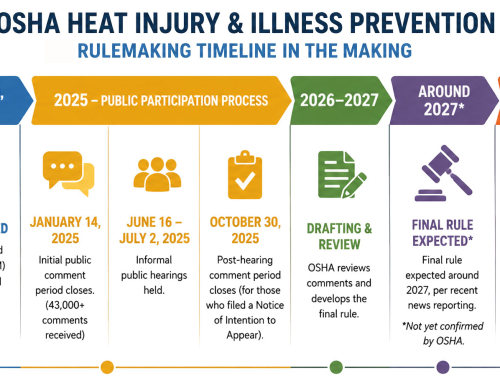
- The formal standard is still pending, with a 2027 timeline now being discussed publicly.
- The NEP is the thing actually generating inspections and citations today, and it just got a five-year runway.
Separately, recent reporting notes that heat has become one of OSHA’s single biggest triggers for on-site inspections this year — not a background risk factor, but the specific condition most likely to bring an inspector to your gate.4 That combination — an actively enforced program with a decade-long track record, freshly extended for five more years, paired with heat now ranking as a top inspection trigger — means employers can’t treat this as a waiting game. The enforcement mechanism you’ll actually be judged against already exists.
What to Do With the New Guidance
Treat the interim guidance the way the quoted expert recommended: as a working blueprint, not a suggestion to file away.
- Map your NEP inspection triggers. Heat index thresholds, active heat advisories, and prior complaints or fatalities in your industry can all initiate a programmed inspection. Know which of your sites and seasons are exposed.
- Build your documentation trail now. NEP-driven inspections lean heavily on whether you can show monitoring records, rest break logs, and acclimatization tracking — not just whether you technically provided water and shade.
- Run a self-audit before OSHA does. A five-year enforcement horizon means this isn’t a one-summer problem. Structure your heat illness prevention plan as a standing program, reviewed and refreshed each season, not a document written once and forgotten.
- Don’t wait on the final rule to invest in infrastructure. Reliable cool-down areas, whether fixed or mobile, satisfy both today’s General Duty Clause obligations and tomorrow’s finalized standard — there’s no scenario where building that capacity now is wasted effort.
The federal rule will eventually finalize. Until it does, the NEP — now locked in through April 2031 — is the enforcement reality employers are actually operating under.
For a practical starting point, see Mock OSHA Heat Inspection: A Self-Audit Checklist and Real OSHA Heat Citations: A 2025–2026 Case Review.
References
- Worksite Heat Stress Expert Encourages Employers to Use OSHA’s New Guidance as a Blueprint for Compliance — Business Insider/GlobeNewswire
- Ibid.
- Ibid.
- Heat Is Now OSHA’s Biggest Inspection Trigger On-Site — Democrat and Chronicle
Disclaimer: This article summarizes recent news coverage of OSHA enforcement activity for informational purposes. It is not legal advice. Consult qualified safety and legal professionals for guidance specific to your operations.
About the author : Bryce Hinckley