Solar Farm Construction: Cooling Crews on Open, Shadeless Sites
1. The Solar Boom and the Heat Problem Nobody Planned For
U.S. utility-scale solar construction has expanded sharply through the mid-2020s, with multi-hundred-megawatt projects breaking ground from the Mojave through the Southwest, the Texas plains, the Southeast, and increasingly the Mid-Atlantic. The Inflation Reduction Act and state renewable mandates accelerated the pipeline; the build crews are working through the largest construction backlog the U.S. renewable sector has ever seen.
The heat problem at these sites is structural, not incidental.
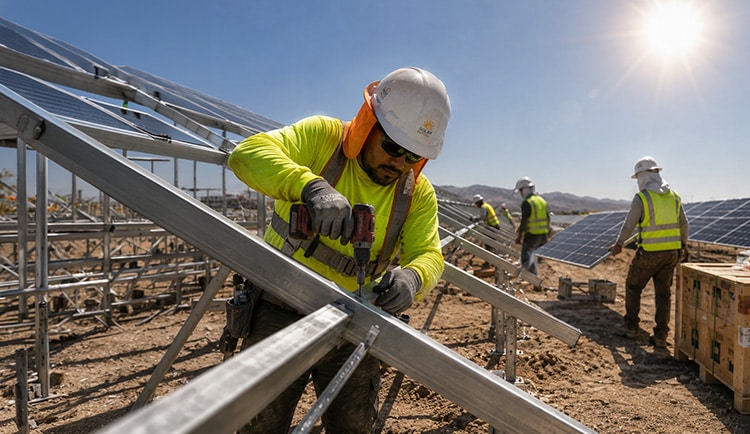
A typical 250 MW solar farm covers 1,500 to 2,500 acres of cleared, shadeless land. The site has no buildings. No mature trees. No infrastructure shade. The EPC crew is exposed to the sun from the first stake to the last torque check — and once the panels are partially installed, the radiant and reflected heat load grows.
This article is about the heat-exposure category most general construction heat programs don’t address — and what a working program looks like for utility-scale solar EPCs.
2. Why Solar Sites Are Worse Than Standard Construction Heat-Exposure-Wise
Three structural differences push solar construction worse than the standard construction baseline:
- No natural or built shade. A standard construction site has scaffolding, partially erected structures, equipment, vehicles — somewhere to step out of the sun for a moment. A solar site has none of those, especially during the racking-and-pile phase before any panels go up.
- Reflective heat compounding. Once panels are installed across part of the site, the ground-mounted glass-fronted surfaces reflect solar load back at the crews working adjacent rows. Effective radiant load on a worker in the partially built field can exceed the open-sky radiant load by a meaningful margin.
- Distance from infrastructure. The site is so large that even the project’s central laydown yard is often a five-to-ten-minute drive from the active work zone. A “shade structure at the trailer” is functionally not a shade structure for the crew on row 247.
The combination produces a heat-exposure environment that the standard construction WBGT-based work-rest cycle systematically underestimates — the same pattern documented for asphalt paving but driven by different physics.
For the paving comparison, see Asphalt Paving and DOT Road Crews: Why Air Temperature Underestimates the Danger.
3. The Reflective Heat Multiplier
Solar panels are designed to absorb the visible spectrum. The back of the panel and the steel racking radiate substantial heat back into the local environment. Workers in the rows adjacent to installed panels report measurably hotter conditions than workers in still-empty sections of the same site.
The phasing of the build matters. Months 1–3 of a project are typically the worst for raw solar exposure (no panels yet). Months 4–9 add the reflective load as installation progresses. The crew’s exposure profile changes with the build phase, and a heat program that doesn’t adjust over the project lifecycle is undersized.
4. The Geometry Problem: Linear Progress Across Hundreds of Acres
Solar construction proceeds linearly. Crews install pile by pile, row by row, table by table. The work face migrates across the site over weeks.
A fixed cool-down infrastructure (containerized AC unit at the laydown yard, fixed shade canopy near the office trailer) gets further from the work crew every day. By the time the active row is half a mile from the cool-down area, workers stop using it. Documentation logs show declining cool-down break utilization; the supervisor signs off because the break was “available.”
The crew is not actually cooling down. They are taking informal shade behind equipment or in their personal vehicles. The HIPP exists on paper. The recovery does not exist in practice.
5. Standard Cool-Down Infrastructure Fails on Solar Sites
The typical heat-mitigation infrastructure on a utility-scale solar build:
- One or two containerized AC units near the office trailer
- Pop-up tents distributed across the site (eventually moved or abandoned)
- Coolers staged in pickup beds, refilled inconsistently
- A vague “go cool off in your truck” understanding among supervisors
Each piece works in isolation. None of it satisfies the engineering-control bar that Cal/OSHA §3395 expects, that the proposed federal heat rule will codify, and that workers actually use during the run.
The result is a heat program that looks compliant in a desk audit but produces no actual recovery on the field.
6. What Actually Works: Mobile Recovery That Follows the Install Line
The solar EPCs running mature heat programs in 2026 share a pattern:
- One or more mobile cool-down trailers in the ClimateRig™ class — 30,000 BTU dual AC, 125 sq. ft. interior, 18-worker capacity per cycle
- Daily repositioning at the leading edge of the active install row, with the trailer parked within walking distance of the work face
- Power configuration matched to site infrastructure — generator on Day 1 to Day 30 before site power is energized, shore power off the project transformer once available, solar-hybrid for ESG-sensitive owners (see Powering a Cool-Down Trailer in the Middle of Nowhere)
- Documented entry/exit logs per cool-down cycle, by worker, by row — defensible evidence that the recovery infrastructure was actually used
- Hydration logistics matched to the trailer location — coolers replenished at the trailer, not at the laydown yard
The infrastructure is sized for the geometry of the work. A trailer that follows the install line satisfies the §3395 “as close as practicable” interpretation and produces actual physiological recovery — which the productivity data also reflects.
7. The ESG Case Most Solar EPCs Are Missing
Solar EPCs are increasingly bidding on contracts where ESG and Scope 1/2/3 emissions reporting matter to the owner. A documented heat-illness prevention program is now a real differentiator in that bid environment.
A trailer powered by solar-hybrid configuration during the day, with battery storage carrying the load through shoulder hours, reduces fuel consumption by 40 to 70 percent against generator-only — and produces an emissions story that maps directly onto the owner’s reporting. The trailer becomes part of the project’s sustainability narrative, not just a safety line item.
For owners with explicit decarbonization commitments, the engineering-controls cooling infrastructure with low-carbon power matches the rest of the project’s brand promise.
8. A Working Heat Program for Solar Construction
Past §3395 compliance, the solar EPC heat programs that move both the injury and productivity number share six features:
- Mobile cool-down infrastructure repositioned daily to the active install line
- Phase-aware exposure planning — heaviest work in the cooler hours of Months 1–3, with mobile cooling deployed in advance
- Hydration logistics at the work face, not at the trailer yard
- WBGT and radiant-temperature measurement at the row, not at the office
- Acclimatization protocol for the constantly rotating EPC labor pool — new arrivals on the project get the first-14-day observation regardless of overall project tenure
- Documentation that supports the bid — utilization logs, training records, language-matched safety talks ready for the next RFP
9. The Bottom Line
- Utility-scale solar construction is structurally hotter than standard construction — no shade, reflective panel load, vast site geometry
- Standard construction heat infrastructure fails on solar sites because the work face migrates faster than the cool-down area
- Mobile cool-down trailers that follow the install line are the engineering control that closes the gap
- Power configuration matters — generator for early-phase, shore power once site is energized, solar-hybrid for ESG-sensitive owners
- The ESG case is real and increasingly differentiating in bids
- A working program protects workers AND closes the productivity gap that hot-site solar construction loses to heat decay
The solar pipeline is not slowing down. The crews are working through summer in the hottest construction environment in America. The EPCs that solve the heat program now will deliver projects on schedule. The ones that don’t will absorb the productivity hit and the citation risk together.
Related reading on ClimateRig.com:
- Asphalt Paving and DOT Road Crews: Why Air Temperature Underestimates the Danger
- Powering a Cool-Down Trailer: Generator, Shore Power, and Solar Hybrid Compared
- Heat Acclimatization for Workers: The Science-Backed Protocol
- The Hydration Math
- Cool-Down Trailers: What They Are, How They Work, and Why You Need One
- ClimateRig™: Built to Outlast Your Longest Projects
Want a phase-aware solar-construction HIPP template and the trailer-placement playbook? Visit atspro.co/BPX-Solar or call 800.747.9953 for a 15-minute solar-EPC heat-program review.
About the author : Bryce Hinckley