Asphalt Paving and DOT Road Crews: Why Air Temperature Underestimates the Danger
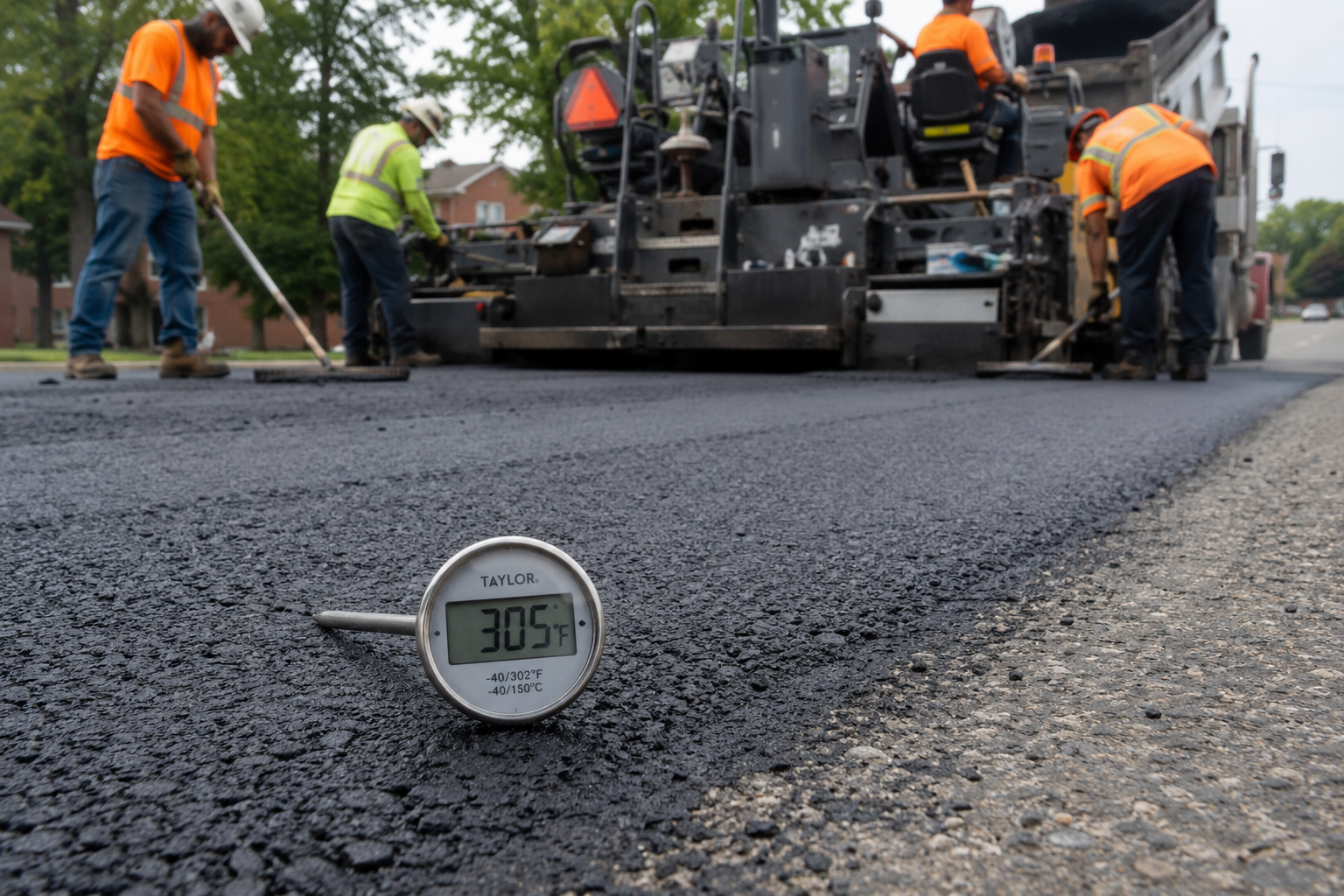
1. The 305°F Microclimate
The truck dash reads 92°F. The radio is calling for a heat advisory in the afternoon. The paving foreman pulls up the WBGT app on his phone — 87°F, within the “moderate work-rest” guidance for the day.
Then the dump truck backs in and unloads. The screed drops. The mat behind the paver is now 290 to 310°F, and the lute man and screed operator are working three to six feet away from it for the next eight hours.
WBGT measured at the dash, the truck cab, or even at hip height twenty feet upwind does not capture what is happening to the worker standing next to fresh asphalt. The thermal load on a paving crew is not driven by air temperature in any meaningful way once the mat is down. It is driven by radiant heat from a 300°F surface, reflected solar from the road, and the worker’s metabolic heat under PPE.
This article is about the heat-exposure category most regulatory guidance does not capture — and the program adjustments that actually protect a paving crew.
2. Why WBGT Underestimates Asphalt Paving
WBGT (wet bulb globe temperature) is the standard occupational metric for combined heat exposure. It blends air temperature, humidity, radiant heat from the sun, and air movement into a single number. For a worker in an open field, WBGT is accurate.
For a worker on a paving crew, WBGT systematically underestimates exposure for three reasons:
- The globe thermometer measures radiant heat from above, not from below. A standard WBGT measurement at chest height does not see the 300°F surface six feet away at boot height.
- The measurement is taken in air, not in the worker’s microclimate. Hot mat releases a thermal plume that rises through the worker’s body. WBGT at hip height measures the plume above the worker’s head, not the air the worker is breathing.
- The measurement assumes the heat source is solar. Solar load is predictable and rises and falls with the sun. Mat radiant heat is constant for the entire shift and does not drop until the mat cools — which on a long paving run can be after the crew leaves.
The net effect: a paving crew working in an environment with WBGT 87°F is experiencing a physiological strain closer to what WBGT 95°F+ would predict for a non-paving crew. The work-rest cycle the WBGT chart prescribes is too lenient for the actual exposure.
For the underlying work-rest math see OSHA Work/Rest Cycles in Heat: What Employers Must Know.
3. The Six Positions on a Paving Crew and Their Heat Exposure
Not every member of a paving crew is exposed equally. Designing the heat program requires knowing the gradient.
- Screed operator — highest exposure. Stands on the back of the paver, directly above the discharge auger, with the mat releasing radiant heat upward at boot level.
- Lute / rake operators — second-highest exposure. Walking the edge of the mat, working with hand tools, frequently bending into the heat plume. Often the position with the most cumulative thermal load over a shift.
- Roller operators — moderate exposure. Air-conditioned cab on newer rollers (uncommon on older fleet). Without AC, the operator is sitting on hot equipment in direct sun behind a mat that may still be 200°F.
- Paver operator — moderate exposure. Cab on the paver is closer to the mat than the roller is, but the operator is mostly seated and not bending into the plume.
- Dump truck driver — lowest of the on-mat positions. In-cab time is air-conditioned; exposure is during loading and unloading.
- Flagger / traffic control — high solar exposure but no mat exposure. WBGT-based scheduling works reasonably well for this position.
A heat program that treats all six positions the same misses the actual risk distribution. The screed operator and lute crew need a work-rest cycle calibrated to the mat exposure, not to the WBGT reading at the equipment trailer.
4. PPE That Helps and PPE That Doesn’t
Three categories of PPE matter for paving crews:
- Phase-change cooling vests — useful for screed operators and lute crews on long runs. Requires on-truck pack rotation and chilling — without that infrastructure, the vests are a one-day intervention. For the full comparison see Personal Cooling Vests vs. Cool-Down Trailers.
- Reflective high-vis shirts — long-sleeve high-visibility shirts in reflective synthetic fabric outperform cotton tee-shirts under reflected solar load. The instinct on hot days is to wear less; for paving crews the right choice is wearing reflective rather than less.
- Insulated boots — overlooked but matters. The boot is the closest part of the worker to the mat. A non-insulated work boot transmits heat into the foot for the entire shift. Insulated paving boots are not standard issue on every crew and should be.
PPE that does not help: cotton tees (soak with sweat, hold heat, become a thermal load), bandanas around the neck (minor cooling, not a substitute), and dark-colored workwear (increases reflected solar absorption substantially).
5. Night Paving Is Not a Heat Solution by Itself
DOT contracts increasingly require night paving for safety and traffic reasons. Operators sometimes treat night work as the heat solution. It is not, by itself.
Night paving reduces solar load and ambient temperature. It does not reduce mat temperature — the asphalt comes out of the plant at the same temperature day or night. A crew working a 9 p.m. paving run in 80°F night air is still working next to a 300°F mat. The radiant exposure is the same.
Night work changes the heat program in three ways that matter:
- Hydration discipline gets harder. Workers are less inclined to drink at night and the supervisor’s visual cues for dehydration are reduced under work lights.
- Acclimatization is reversed. A worker who paved nights all week and then has a Saturday day shift is functionally un-acclimatized to daytime heat. Plan for it. See Heat Acclimatization for Workers.
- The supervisor’s heat program needs to operate on its own schedule. Pre-shift meetings, WBGT readings, and work-rest cycles need to run regardless of the calendar.
6. What a Working Paving Crew Heat Program Looks Like
Past WBGT compliance, the paving programs that actually move the injury number share six features:
- Position-calibrated work-rest cycles. Screed and lute operators on a tighter cycle than roller and dump operators.
- Cooling vests with pack rotation infrastructure. Vests without a chill system are a one-day intervention.
- Insulated boots and reflective long-sleeve high-vis as standard issue, not optional add-ons.
- A mobile cool-down environment that travels with the crew. Paving runs are linear and mobile. A 125 sq. ft. trailer like ClimateRig™ towable behind a half-ton truck, parked at the trailing end of the run, gives the screed and lute crews a 72°F recovery space within walking distance of the work face.
- Hydration logistics that match the schedule. Pre-staged coolers refilled twice per shift, electrolyte mix available, accountability for consumption tracked. See The Hydration Math.
- Documentation that includes mat temperature, not just air temperature. The mat temp is the actual exposure driver; if your incident file does not record it, you cannot defend it.
7. The Documentation DOT Inspectors Credit
DOT contracting agencies are increasingly asking contractors to show heat-illness program documentation as part of the bid qualification process. The documentation that earns credit:
- Pre-shift WBGT readings AND mat temperature readings
- Position-specific work-rest schedule with timestamps
- Cool-down trailer entry/exit log (or recovery break log if no trailer)
- Hydration consumption tracking by crew, by shift
- Symptom-recognition training records in the language understood by the crew
- Post-incident protocol with named supervisor responsibilities (see Heat Illness Recovery and Return-to-Work Protocols)
Contractors who present this documentation as part of bid response are seeing it factor into award decisions on DOT contracts in heat-exposed jurisdictions. The program documentation is no longer just an OSHA hedge; it is a competitive differentiator.
8. The Bottom Line
- Air temperature and standard WBGT systematically underestimate paving crew exposure
- Mat temperature is the driver of thermal load and should be in your documentation
- Position matters — screed and lute operators need a different schedule from roller and dump operators
- Night paving reduces solar and ambient load but does not change mat exposure
- A mobile cool-down environment that travels with the linear progression of the run closes the recovery gap on long paving days
- DOT contracting agencies are starting to evaluate heat-program documentation in bid awards
The paving crews that lose workers to heat are not the ones who never check WBGT. They are the ones whose WBGT readings do not match the actual exposure their crew is working in.
Related reading on ClimateRig.com:
- OSHA Work/Rest Cycles in Heat: What Employers Must Know
- Heat Acclimatization for Workers: The Science-Backed Protocol
- Personal Cooling Vests vs. Cool-Down Trailers
- The Hydration Math
- Heat Illness Recovery and Return-to-Work Protocols
- Wet Bulb Globe Temperature (WBGT): Measurement, Interpretation, and Safety Measures
Want a sample paving-specific HIPP supplement with the six-feature program template? Visit atspro.co/BPX-Asphalt or call 800.747.9953 for a 15-minute paving crew heat-program review.
About the author : Bryce Hinckley