Heat Illness Recovery and Return-to-Work Protocols: What Happens in the 72 Hours After an Incident
The clinical content below is general occupational health information, not medical advice. A worker who has experienced heat illness should be cleared by a qualified medical professional before returning to heat-exposed work. This article is a framework for the program-level protocol that surrounds that clearance.
1. The Gap in Every Heat Plan I Have Audited
Every Heat Illness Prevention Plan I have ever audited covers the same three phases: prevention, recognition, and emergency response. The recognition section identifies symptoms. The emergency response section says, in some form, “cool the worker, call 911, document.”
And then the plan ends. Nothing about the next 72 hours.
Which is a problem, because the 72 hours after a heat illness incident are where the second incident happens, where the kidney failure shows up, where the supervisor sends the worker back to the row too early, and where the legal exposure compounds. This article covers the post-incident protocol that should be in every HIPP and is in almost none of them.
2. The First Hour: What Happens After EMS Arrives
The HIPP usually ends at “call 911.” The protocol should not.
In the hour after EMS arrives:
- Custody of the worker. Does the worker want a family member contacted? Does the worker want a coworker to accompany them? In many ag and construction crews, the worker is undocumented and refuses transport because of cost or status fear. Your HIPP should anticipate this and have a documented refusal protocol that protects the worker and the employer.
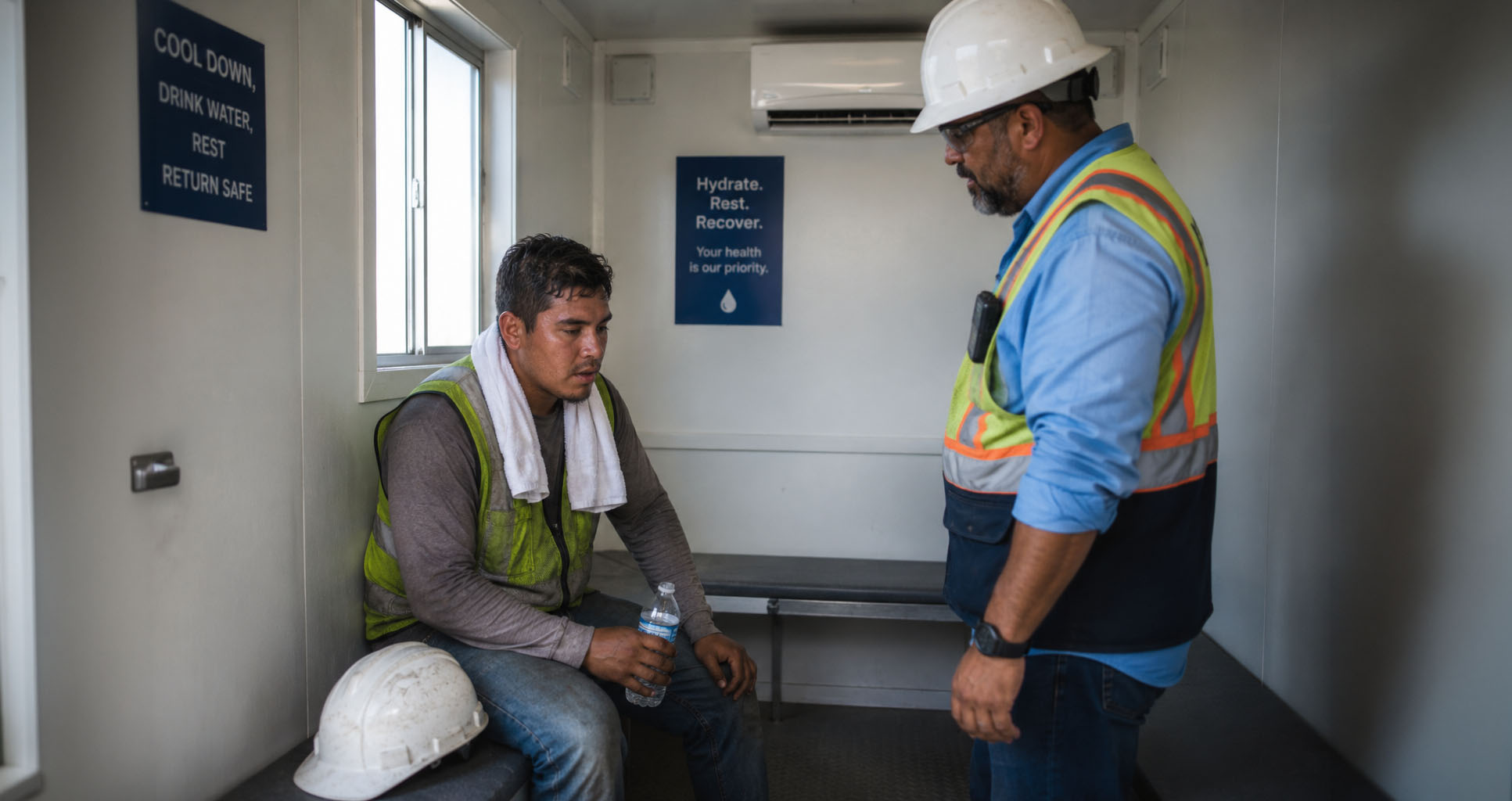
- Incident documentation. Time of onset, time of recognition, ambient temperature, WBGT if measured, recent hydration, acclimatization status, workload, and clothing. Photograph the worksite. Photograph the recovery space. Photograph the water cooler. This is your evidence file.
- Notification chain. Supervisor up the chain, HR, safety lead, legal if the incident involves loss of consciousness or transport. OSHA notification is required within 24 hours for hospitalization, 8 hours for fatality, under federal OSHA. State rules may be stricter.
- Worksite assessment. What conditions were present when this happened, and what conditions will be present at the same time tomorrow? Do not send the rest of the crew back into the same exposure.
3. Hour 1 to 24: The Rhabdomyolysis Window
Heat illness severe enough to produce hospitalization or loss of consciousness often involves muscle breakdown — rhabdomyolysis. The muscle cells release myoglobin and electrolytes into the bloodstream. Myoglobin is nephrotoxic. The kidneys can fail 12 to 48 hours after the initial heat event, with normal mental status and normal-looking presentation in between.
What this means for the program:
- A worker who appears to have recovered in the field is not cleared. Symptoms resolving on the worksite does not mean the worker is safe to send home alone.
- A worker discharged from the ER the same day should be observed for 24 hours. Discharge does not mean cleared. Dark urine, muscle pain disproportionate to the work, weakness, and reduced urine output are warning signs that need re-evaluation.
- The supervisor’s job extends to the next morning. A 6 a.m. phone call to the worker before the shift starts — how are you feeling, did you sleep, are you urinating normally — is a 90-second intervention that has caught more than one delayed-onset rhabdomyolysis case.
This is the gap in most HIPPs. The plan assumes that worker recovery is medicine’s problem. The worker’s safety in the 24 hours after a near-incident is also the employer’s problem.
4. Hour 24 to 48: Why Return-to-Light-Duty Is Not Yet Appropriate
The temptation in operations is to bring the worker back the next morning to “see how they do.” This is wrong for two reasons.
First, the physiology has not reset. Plasma volume is reduced for 48 to 72 hours after a heat event. Acclimatization is partially lost — even a one-day absence from heat exposure measurably degrades the worker’s adaptation, and a heat illness event resets the acclimatization clock more than that. The worker who collapsed on Wednesday is more vulnerable to a second collapse on Thursday, not less.
Second, the legal exposure compounds. If the worker has a second event in the 72-hour window because the employer brought them back too early, the standard of care question gets much harder to defend.
What the protocol should specify:
- No return to heat-exposed work for 48 hours minimum, regardless of how the worker reports feeling
- Medical clearance documented in writing before any return — a verbal “doc said I’m fine” is not a record
- Light-duty assignment to a climate-controlled work area if available, with continued observation
- Hydration discipline at home — the worker should be drinking electrolyte fluid, not just water, for 48 hours minimum after the incident
For the underlying hydration math see The Hydration Math: Gallons Per Worker, Electrolyte Ratios, and Why Plain Water Falls Short.
5. Hour 48 to 72: The Re-Acclimatization Reset
This is the piece most plans miss entirely. A worker who has experienced a heat-illness event has lost acclimatization. Returning them to full heat exposure on day three is the equivalent of putting an un-acclimatized new hire into a high-heat industry without the 14-day observation window.
The protocol that works:
- Day 1 back (post-72-hour window): 50% of normal heat exposure time, supervisor observation continuous, paired with a buddy, no piece-rate or production pressure
- Day 2 back: 60% exposure, same observation
- Day 3 back: 70%
- Day 4 back: 80%
- Day 5 back: Full exposure with continued supervisor awareness for the rest of the week
- Throughout: WBGT-based work-rest schedule held more conservatively than the rest of the crew
This is functionally a compressed re-acclimatization protocol. It is supported by the published occupational physiology and aligns with Cal/OSHA’s expectation of “close observation” for workers returning from absence. For the full acclimatization framework, see Heat Acclimatization for Workers: The Science-Backed Protocol.
6. Documentation: The File That Saves the Program
The 72 hours after an incident produce most of the documentation that matters in workers’ comp adjudication, OSHA investigation, and any subsequent civil action. The file should include, at minimum:
- Incident report with environmental conditions
- Worker statement, witness statements
- Photographs of worksite, recovery space, water sources, shade
- WBGT or heat-index records for the day
- The worker’s recent hydration and acclimatization status
- Medical clearance documentation
- Return-to-work plan with documented graduated exposure
- Supervisor observation log for the re-acclimatization period
- Any follow-up symptoms reported by the worker
A complete file does two things: it protects the worker by ensuring the program actually executed the protocol, and it protects the employer by demonstrating that execution was real, not theoretical.
7. The Supervisor Protocol
The 72-hour protocol lives or dies on the supervisor. Two specific behaviors separate the supervisors whose workers come back safely from the ones whose workers come back too early.
- They check in personally before the next shift starts. A 6 a.m. phone call, not a 6:30 a.m. text. The conversation produces information the text never will.
- They escalate without ego. A supervisor who is willing to say “I think they should not be back yet” to the operations manager is worth more than the supervisor who covers because the production schedule is tight. Build the escalation culture before you need it.
8. The Bottom Line
- The HIPP that ends at “call 911” misses the 72 hours where the second incident happens
- The first 24 hours carry rhabdomyolysis risk that does not present in the field; observation extends past the worksite
- The 24 to 48 hour window is not return-to-work territory regardless of how the worker reports feeling; plasma volume and acclimatization have not reset
- The 48 to 72 hour window and the week after are a compressed re-acclimatization protocol, not a normal return to full work
- The documentation file built during this window is the file that matters in every adjudication or investigation that follows
- The supervisor is the load-bearing element. Train them on the protocol before they need it.
A complete heat program is not just about preventing incidents. It is about what happens after one occurs — and the after is where most programs leave the worker, and the company, exposed.
For the engineering side and a 90-page playbook with WBGT-driven work-rest tables, ROI worksheets, and recovery infrastructure specs, see the Time on Tool guide.
Related reading on ClimateRig.com:
- Heat Stress vs. Heat Exhaustion vs. Heat Stroke: Know the Difference
- Heat Acclimatization for Workers: The Science-Backed Protocol
- The Hydration Math: Gallons Per Worker, Electrolyte Ratios, and Why Plain Water Falls Short
- OSHA Work/Rest Cycles in Heat: What Employers Must Know
- How to Build an OSHA-Compliant Heat Illness Prevention Plan
- Cool-Down Trailers: What They Are, How They Work, and Why You Need One
Want a sample 72-hour post-incident protocol and supervisor checklist you can paste into your HIPP? Visit atspro.co/BPX-Recovery or call 800.747.9953 for a 15-minute heat-program review.
About the author : Bryce Hinckley