Workers’ Comp and Heat Illness Claims: How a HIPP and Cool-Down Trailer Affect Your Premiums
Safety directors think about heat in terms of OSHA compliance. CFOs and risk managers should think about it in terms of balance sheets. A single heat stroke claim can easily exceed $500,000 in direct workers’ compensation costs — before OSHA penalties, civil litigation, or the three-year EMR drag that raises premiums on every subsequent renewal. The employers investing in prevention programs are paying lower premiums and avoiding the claims that compound for years.
What a Serious Heat Illness Claim Actually Costs
Heat illness spans a wide clinical spectrum. At the mild end — heat cramps, mild heat exhaustion managed on-site — the cost is lost work time and a recordable event. The claims that move an experience modification factor involve:
- Heat exhaustion with hospitalization: IV fluids, observation, overnight stay. This is OSHA-recordable and, if admitted, OSHA-reportable (triggers an inspection). Direct medical costs: $5,000–$25,000. Add lost-time wages and temporary total disability (TTD) payments for the recovery period.
- Heat stroke: A medical emergency with a high mortality rate if not treated immediately. Survivors frequently face permanent cognitive, neurological, or organ damage. Direct workers’ comp costs — emergency transport, ICU care, extended rehabilitation, permanent partial disability (PPD) awards — commonly range from $150,000 to over $1,000,000. [1] Total liability including long-term care can exceed this significantly.
- Fatality: Maximum death benefit under applicable state statute — typically 2/3 of pre-injury wage for a statutory maximum period, plus burial benefit. Mandatory OSHA investigation and frequently civil wrongful death litigation running entirely separately from the workers’ comp track. Total liability including civil settlement routinely exceeds $2,000,000.
The severity gap: A heat stroke claim costs 10–50 times more than a heat exhaustion claim. The same underlying hazard — insufficient cooling recovery — produces outcomes differing by an order of magnitude in cost depending on how quickly the condition is recognized and treated.
How Heat Illness Claims Affect Your Experience Modification Rate
The Experience Modification Rate (EMR), also called the X-Mod, is the multiplier applied to your workers’ compensation premium based on your actual claim history relative to other employers in your industry classification. [2] An EMR of 1.00 is average for your class. An EMR above 1.00 raises premiums; below 1.00 lowers them.
The NCCI formula (used in most states) gives extra weight to large individual claims through a “primary” and “excess” loss split. Claims below the primary threshold ($17,000–$22,000 depending on the state) are weighted at 100% in the formula. Claims above the primary threshold — the excess portion — are weighted at a reduced rate (typically 15–30%). This means large claims have a disproportionate EMR impact relative to their dollar value: a single $200,000 heat stroke claim affects the mod more than ten $15,000 claims of equal total cost.
Claim frequency also matters. Two or three heat exhaustion hospitalizations in a single season, even if each resolves quickly, signal systemic hazard management failure to underwriters. Carriers reviewing your loss run watch for clustering of similar incidents — multiple heat events in a single season trigger manual surcharges and underwriting scrutiny independent of the formal EMR calculation.
EMR effects persist for three years under the standard NCCI experience period. A poor heat season in 2024 affects your modification through at least policy year 2027.
Premium impact example: A contractor carrying $2,000,000 in annual workers’ comp premium with an EMR that rises from 0.90 to 1.15 following two heat illness claims pays $500,000 more per year in premium — $1,500,000 over the three-year experience period — for claims that were preventable.
What a HIPP Contains — and Why It Matters to Underwriters
A Heat Illness Prevention Program (HIPP) is a documented, site-specific program that translates OSHA guidance into employer-specific written procedures. [3] A complete HIPP includes:
- Temperature thresholds with tiered responses: Written procedures defining what is mandatory at 85°F heat index, at 95°F, and at 105°F+ — not a generic “stay hydrated” statement.
- Acclimatization plan: New workers limited to 20% of usual heat-exposure duration on Day 1, increasing by no more than 20% per day over 7–14 days. Covers returning workers after illness or extended absence.
- Hydration requirements: Specific water volume, proximity to workers, and frequency — aligned with NIOSH guidance (8 oz every 15–20 minutes for heavy work in heat).
- Rest break schedule: Mandatory cool-down break frequency and duration by heat level, with documentation of compliance.
- Emergency response procedures: Step-by-step heat stroke response protocol, designated responders, and 911 call procedures specific to each worksite.
- Documented supervisor and worker training: Signed training records for every supervisor and worker before heat season begins, with annual refreshers.
The HIPP serves two distinct functions: it is your primary legal defense in a General Duty Clause investigation, and it is your underwriting narrative at renewal. Carriers reviewing your loss-control program want documented evidence that you manage hazards systematically. A HIPP with training records, daily break logs, and documented monitoring tells a fundamentally different story — to an OSHA compliance officer and to an underwriter — than the absence of documentation.
Some carriers offer loss control credits for documented heat illness prevention programs. Ask your broker whether your HIPP qualifies. Even where explicit credits are not available, a clean loss run combined with documented prevention measures supports a better renewal conversation than unexplained claims.
Why a Cool-Down Trailer Beats Shade for Risk Reduction
Shade alone is insufficient for genuine heat recovery in extreme heat conditions. At ambient temperatures of 100°F+, the air in the shade is still 100°F. Workers resting in the shade are not recovering core body temperature — they are simply not adding to it as rapidly as they would in full sun. Air-conditioned rest environments — typically a job-site trailer or van maintained at 70–75°F — provide actual physiological recovery during the break period. [4]
Workers who spend 10–15 minutes in an air-conditioned environment between exposures return to work with meaningfully lower core temperatures than workers who rest in the shade. This translates directly into risk reduction: lower core temperature at the start of each exposure period means more thermal buffer before dangerous territory is reached, and longer time-to-onset of heat illness symptoms if environmental conditions worsen unexpectedly.
There is also a documentation benefit that risk managers should not overlook. A sign-in/sign-out log for the cool-down trailer creates a contemporaneous record that mandatory rest breaks were actually taken. In a workers’ comp defense or OSHA investigation, that log is evidence that the safety program was implemented in practice, not just on paper. It closes the “they had a program but didn’t follow it” gap that frequently turns Serious OSHA citations into Willful citations.
The Return on Investment
The prevention investment required for a compliant heat safety program with a cool-down trailer is modest relative to the liability it mitigates:
- Cool-down trailer: $15,000–$30,000/year for rental (seasonal); $40,000–$60,000 purchase price for a purpose-built unit. Amortized over 5 years of a purchased unit: $8,000–$12,000/year.
- Documented HIPP with supervisor and worker training: $3,000–$7,000 all-in for initial development and annual refresh, assuming internal administration.
- Total annual investment: Approximately $20,000–$35,000 depending on fleet size and season length.
Compare that investment to a single heat stroke event: $200,000–$500,000 in direct workers’ comp costs, plus the three-year EMR impact. On a $2,000,000 annual premium book, a 0.25-point EMR increase driven by one heat stroke claim costs $500,000/year, or $1,500,000 over the experience period. The prevention investment — $20,000–$35,000/year — pays for itself before a single heat stroke occurs, even in years with no incidents, because it is protecting the EMR that determines every subsequent renewal.
Prevention ROI: $25,000/year in a HIPP and cool-down trailer can prevent a heat stroke event that costs $500,000 in direct WC claims and up to $1,500,000 in elevated premiums over three years. That’s a potential 20:1 return on the prevention spend.
Action Steps for Risk Managers and CFOs
- Conduct a heat hazard assessment for each worksite type, identifying exposures by temperature threshold and task category.
- Develop or update your HIPP to meet OSHA guidance and applicable state standards (California, Washington, Oregon, Minnesota, Colorado require compliance with specific heat rules).
- Deploy air-conditioned rest facilities for any operation where workers face 95°F+ heat index conditions — not just shade.
- Implement supervisor training on heat illness recognition, emergency response, and break documentation. Signed training records are essential.
- Establish cool-down trailer sign-in logs and daily break compliance records as a contemporaneous documentation practice.
- Brief your broker at renewal: Share your HIPP, training records, and cooling investments. Ask explicitly whether they qualify for loss control credits or influence the underwriting narrative.
- Review your loss run with a heat lens: If any heat illness claims appear in the three-year experience period, understand how they are weighted in your current mod — and what a recurrence would cost.
The Bottom Line
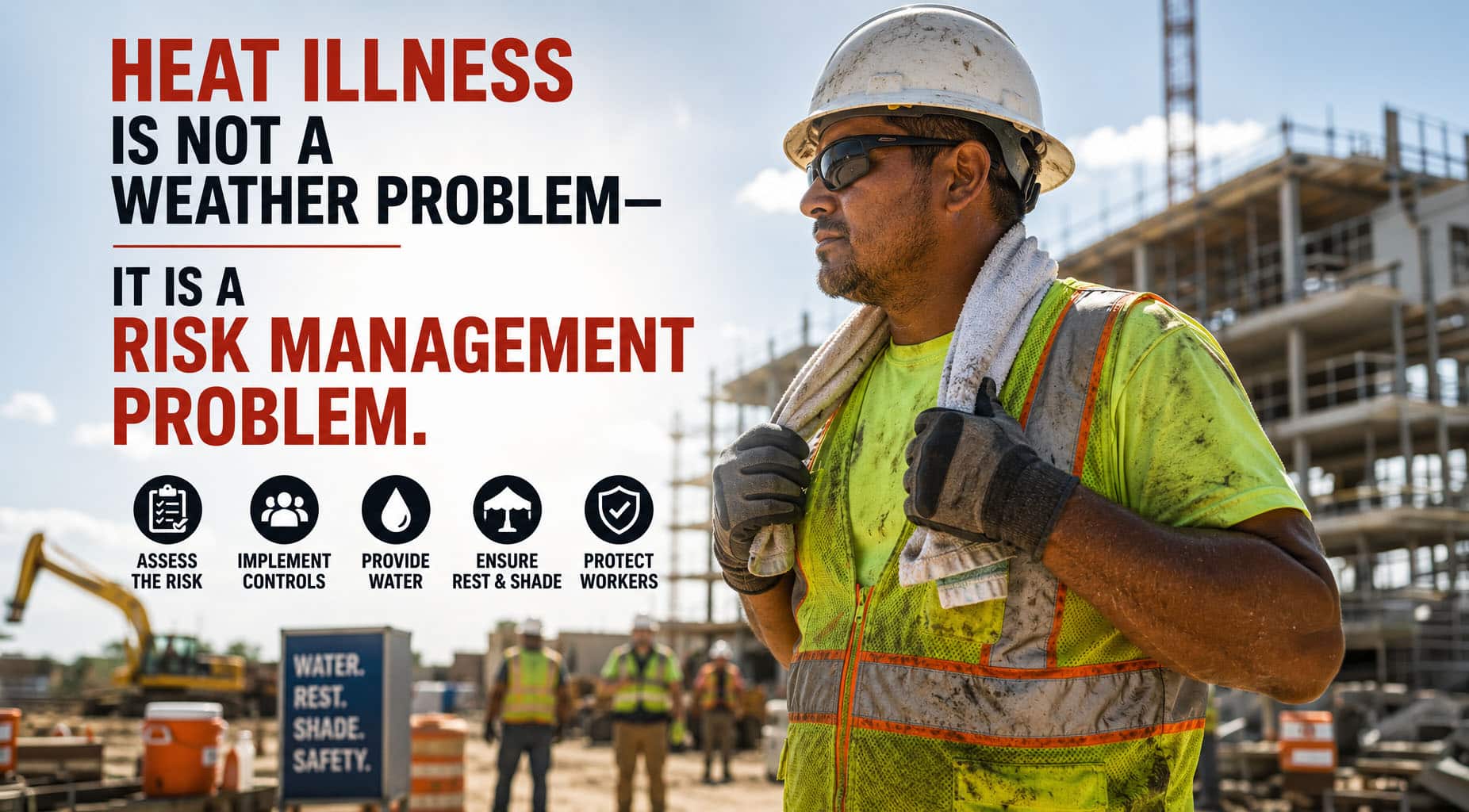
Heat illness is not a weather problem — it is a risk management problem with a well-defined cost structure and a well-defined solution. The employers investing in prevention programs and documentation are paying lower premiums, facing fewer inspections, and avoiding the claims that compound for three years. The employers who treat heat season as an unavoidable hazard without systematic controls are paying the difference — in claims, in penalties, and in the EMR drag that follows every heat season for years afterward.
Sources
- NIOSH. “Workplace Recommendations: Heat Stress.” CDC. cdc.gov/niosh/heat-stress
- NCCI. “Experience Rating.” National Council on Compensation Insurance. ncci.com
- OSHA. “Heat — Standards.” U.S. Department of Labor. osha.gov/heat-exposure/standards
- OSHA. “Heat — Engineering Controls, Work Practices, and PPE.” osha.gov/heat-exposure/controls
About the author : Bryce Hinckley