The Stalled Federal OSHA Heat Rule — and the 50-State Patchwork Employers Now Have to Navigate
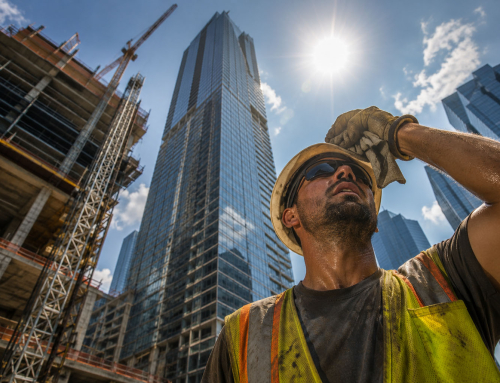
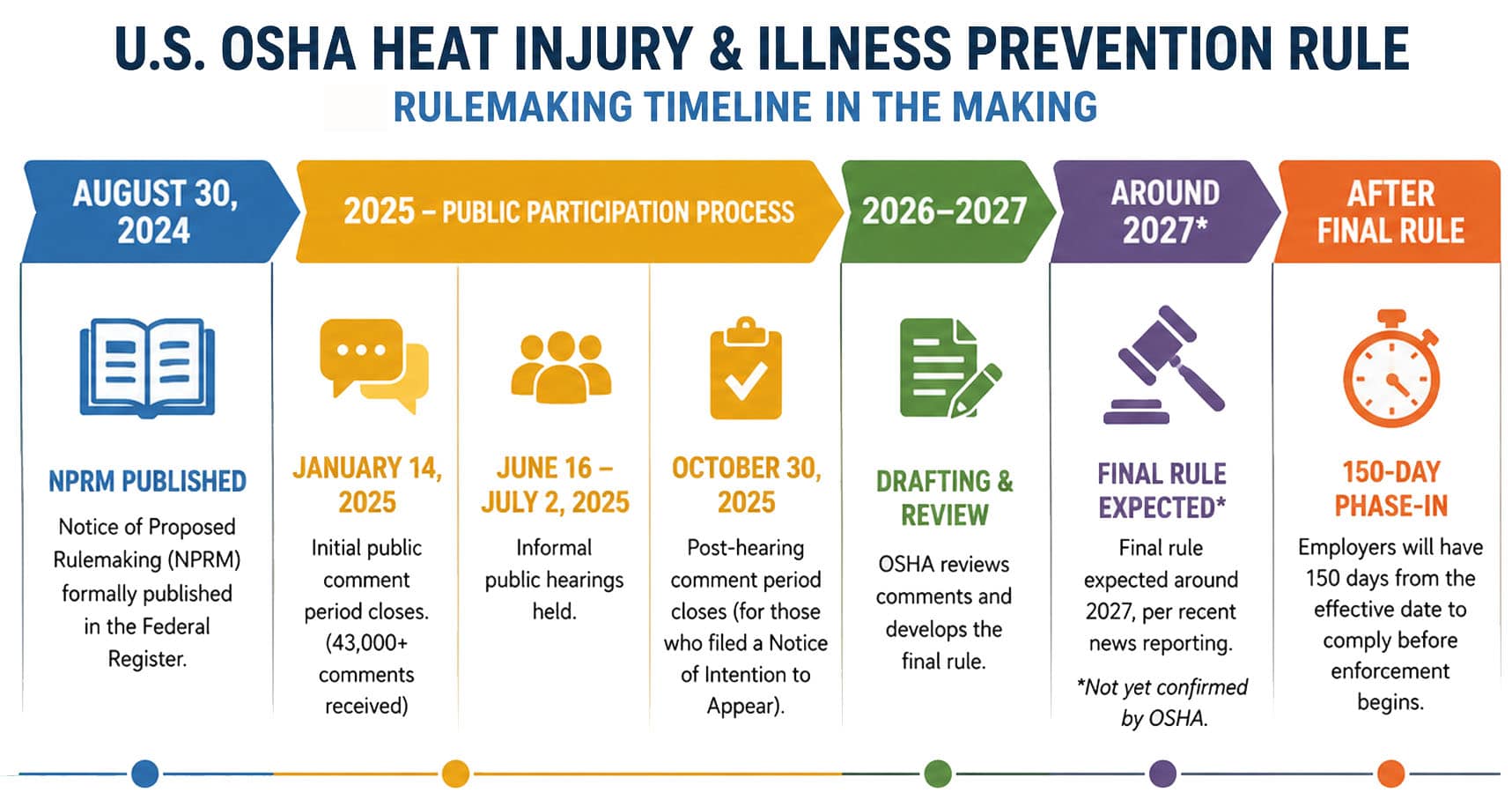
Employers hoping for regulatory clarity on workplace heat exposure got the opposite this month. Coverage across multiple outlets confirms what safety professionals have suspected for a while: the federal OSHA heat standard has slipped again, with a final rule now realistically targeted for 2027 — not 2026.1 In the meantime, the country has split into a patchwork of protection that ranges from comprehensive to nonexistent, and multistate employers are the ones left to sort it out.
Where the Federal Rule Actually Stands
OSHA’s proposed heat illness prevention standard has been in development since 2021. It cleared an advance notice of rulemaking, a small-business review process, a formal proposal, and more than 43,000 public comments. Even with that groundwork done, finalization keeps slipping. Reporting this month puts businesses on notice that binding federal requirements — mandatory rest breaks, acclimatization protocols, written heat illness prevention plans — are still roughly a year and a half away at best.2
That delay does not mean heat is unregulated today. OSHA continues to cite employers under the General Duty Clause and through its Heat National Emphasis Program, treating heat as a “recognized hazard” regardless of whether a dedicated standard exists. Waiting for the final rule to start planning is a bet most safety directors shouldn’t be willing to make.
Only a Handful of States Have Filled the Gap
With the federal rule stalled, state action was supposed to be the fallback. It hasn’t materialized nearly as broadly as workers need. Recent reporting puts the number of states with enforceable, standalone heat standards at just six or seven — meaning roughly 44 states currently offer outdoor and indoor workers no dedicated legal heat protection at all.3
Two states illustrate the gap well:
- Pennsylvania has heat protection legislation sitting in the pipeline, but as of this summer’s early-season heat wave, nothing has been enacted. Workers are exposed now; the law isn’t.4
- Kentucky has no heat-specific safety rules on the books. Reporting following the state’s June heat wave describes UPS drivers, farmworkers, and other outdoor laborers going through dangerous conditions with essentially no legal floor of protection beyond general OSHA duty obligations.5
Indiana’s outdoor workforce faces a similar reality, and a widely shared map from this month’s coverage visualizes just how uneven the picture is nationwide — a small cluster of states with real standards, surrounded by a much larger group with none.6
What This Means for Employers Right Now
If you operate across state lines, “wait for the federal rule” was never a great compliance strategy, and it’s an even worse one now that the timeline has moved again. The practical reality:
- A handful of states (California, Washington, Oregon, Nevada, Colorado, Maryland, Minnesota) already have binding requirements — water, shade, rest breaks, acclimatization, written plans — that apply today, independent of the federal process.
- Most states have nothing state-specific, which pushes enforcement back to the General Duty Clause and OSHA’s National Emphasis Program — both of which are active and being used.
- Legislative activity is picking up in states like Pennsylvania, meaning the map will keep shifting. Employers need a process for tracking state and local changes, not a one-time compliance check.
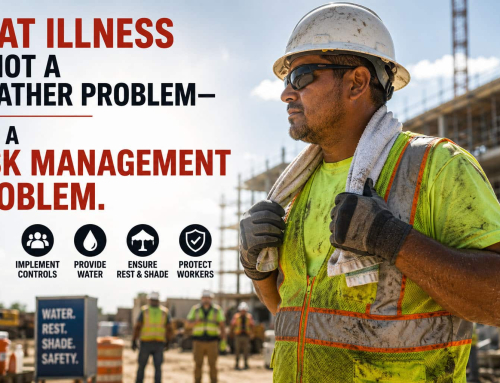
The safest posture is to build a heat illness prevention program that meets the strictest state standard you operate under and apply it everywhere, rather than maintaining a patchwork of your own to match the regulatory patchwork. Written plans, monitoring, acclimatization schedules, and reliable cool-down infrastructure are cheap relative to a serious injury, a wrongful death claim, or a six-figure willful violation — and none of it requires waiting on Washington.
For the underlying compliance framework, see OSHA Heat Regulations 2026: What Changed & How to Comply and State-by-State Heat Standards Beyond California.
References
- Heat Is Killing More Workers Than You Think. OSHA Is Acting. — Inc./MSN
- Ibid.
- Only six states require heat breaks for workers. The other 44 are on their own. — Latin Times/MSN
- With a hot start to summer, Pa. has legislation waiting on workplace heat precautions — PennLive/MSN
- ‘Brutal’ summer heat puts Kentucky workers at risk. And it may get worse — USA Today Network
- Map reveals the patchwork of US heat protections for workers — Newsweek/MSN
Disclaimer: This article summarizes recent news coverage of workplace heat regulation for informational purposes. It is not legal advice. Consult qualified safety and legal professionals for guidance specific to your operations and jurisdiction.
About the author : Bryce Hinckley