State-by-State Heat Standards Beyond California: Washington, Oregon, Nevada, Colorado, Maryland, and Minnesota in 2026
1. The Six State Standards Cal/OSHA Coverage Always Skips
Most U.S. heat-stress regulatory coverage in trade press centers on Cal/OSHA §3395 and §3396 — for good reason. California has the oldest and most prescriptive state standard, the most developed enforcement record, and the largest population of covered workers.
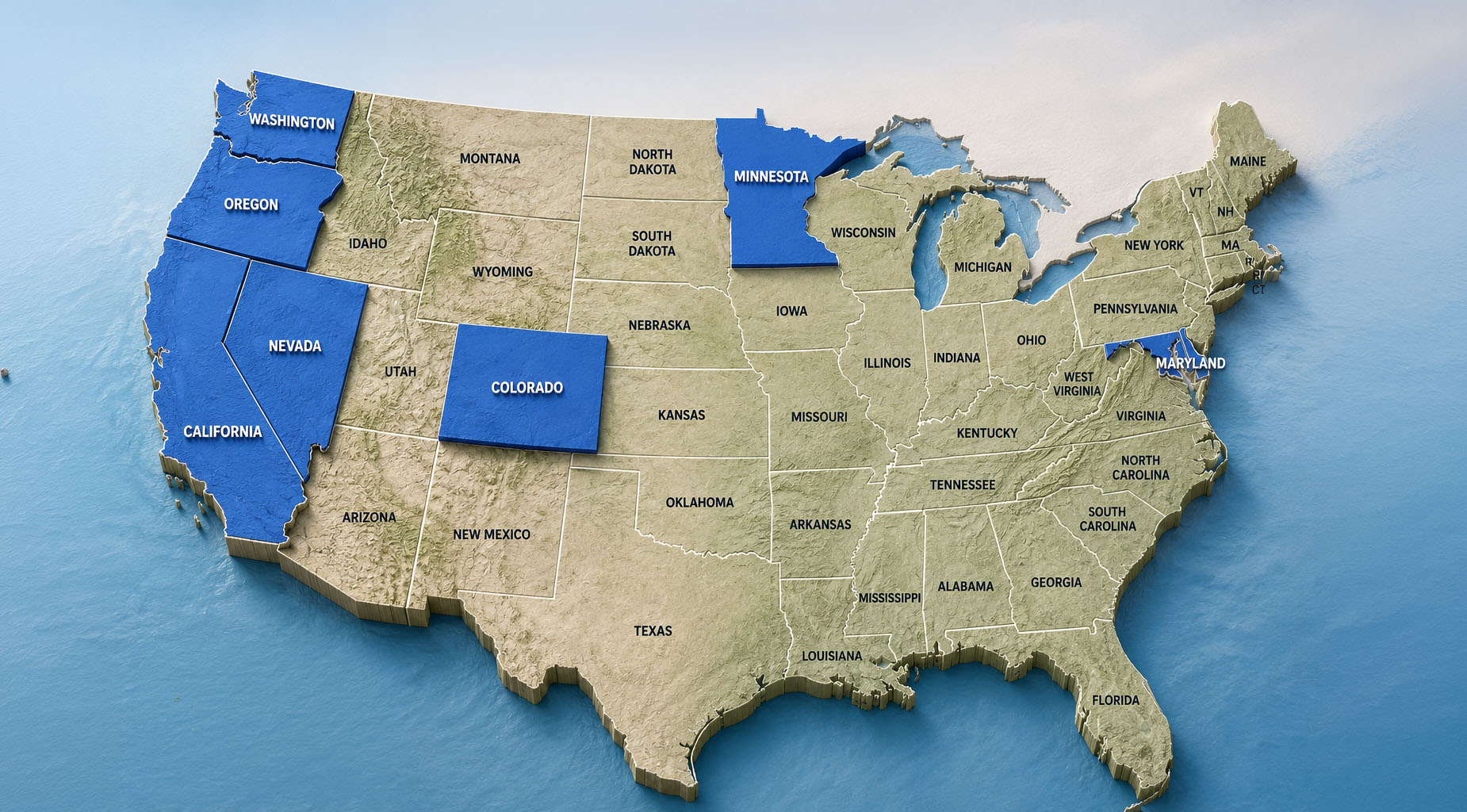
The result is that most multi-state employers know California cold and treat the rest of the country as the federal General Duty Clause baseline. That assumption is wrong. Six other states have active heat-illness prevention standards in 2026, with prescriptive triggers and obligations that operate independently of federal OSHA. Multi-state employers operating in these jurisdictions are subject to state requirements that frequently differ from the federal baseline and from each other.
This article covers each of the six in enough detail to support a multi-state compliance posture, plus the states most likely to act in 2026-2027 ahead of the federal rule.
2. Washington (WAC 296-62-095): The Three-Threshold Model
Washington State’s outdoor heat exposure standard was made permanent in 2023 after years of emergency rulemaking. It applies to all outdoor employers and uses a three-tier threshold model that is more granular than most state standards.
Key triggers and requirements:
- 52°F and above: Employers must have a written outdoor heat exposure safety program. Yes, 52°F — Washington’s standard kicks in earlier than any other state’s, reflecting that heat illness is possible in moderate temperatures with high humidity and heavy work.
- 80°F and above: Increased water provision (one quart per worker per hour), accessible shade, heat illness prevention training, mandatory rest periods.
- 90°F and above: Additional protections including mandatory cool-down periods, more aggressive observation, written authorization required for any extension of shift in extreme heat.
What makes it unique: The 52°F floor and the explicit three-tier escalation. Washington is the most granular state standard in the country and is the model most likely to influence the federal rule’s final form.
Industries most affected: Agriculture (Yakima Valley, Wenatchee), construction (Seattle/Tacoma metro), and forestry. Apple, cherry, and hop harvests are particularly affected during the late summer heat dome events the state has experienced multiple times since 2021.
3. Oregon (OAR 437-002 Division 4): Heat Index, Not Just Temperature
Oregon OSHA’s heat illness prevention rule applies to all outdoor employers and uses heat index — a combined temperature and humidity metric — rather than pure air temperature as the trigger.
Key triggers and requirements:
- 80°F heat index: Standard protections including water, shade, training, acclimatization plan, emergency medical plan.
- 90°F heat index: Additional protections including more frequent rest, increased observation, mandatory communication with all workers.
- Training requirement: Must be in the language understood by the worker. Oregon has substantial Spanish, Vietnamese, Russian, and indigenous-language workforces; the regulation explicitly addresses this.
What makes it unique: Heat index as trigger (instead of air temperature) is closer to physiological reality and reduces edge cases where 85°F at high humidity is more dangerous than 95°F at low humidity. Oregon is the second state (after Washington) likely to influence the federal rule’s metric choice.
Industries most affected: Agriculture (Willamette Valley), nursery and greenhouse operations, construction, and warehousing.
4. Minnesota (Minn. R. 5205.0110): The Oldest Standard, Indoor Only
Minnesota’s indoor ventilation and temperature standard predates every other state heat rule by more than a decade. It was originally promulgated in the 1990s and is the oldest active U.S. state heat standard.
Key features:
- Indoor only. Minnesota has no outdoor heat standard. The state’s climate has historically not driven outdoor rulemaking, though recent summers have prompted discussion.
- Categorized by workload: Light, moderate, and heavy work each have distinct temperature limits.
- Older regulatory model. The rule is less prescriptive than Cal/OSHA §3396 and predates the modern WBGT-based framework.
What makes it unique: The age and the workload-based categorization. Minnesota’s standard is narrow but enforceable and applies to most indoor manufacturing, food processing, and warehouse operations in the state.
Industries most affected: Indoor manufacturing (the state’s substantial industrial base), food processing, and indoor warehouse operations.
5. Maryland (COMAR 09.12.32): East Coast’s First Comprehensive Standard
Maryland Occupational Safety and Health (MOSH) enacted COMAR 09.12.32 as a comprehensive heat stress standard effective 2024. It is the first East Coast state with a Cal/OSHA-style comprehensive rule covering both indoor and outdoor work.
Key triggers and requirements:
- 80°F heat index: Standard protections. Heat illness prevention plan required.
- Both indoor and outdoor coverage. Indoor application is similar in structure to Cal/OSHA §3396 but with Maryland-specific thresholds.
- Written HIPP required, in English and Spanish at minimum, plus other languages as needed.
What makes it unique: First comprehensive East Coast standard. Maryland’s enactment signals that the regulatory model is no longer confined to Western states with arid climates and has crossed into Mid-Atlantic humidity-driven exposure environments.
Industries most affected: Construction (Baltimore-Washington metro), warehousing (the expanding logistics corridor along I-95 and I-70), and outdoor seasonal work.
6. Colorado (HB21-1213): The Agriculture-Only Standard
Colorado’s agricultural workers’ rights legislation includes heat stress provisions specific to agricultural workers. The scope is narrower than the other state standards but the protections within agriculture are substantive.
Key features:
- Agriculture-only scope. Construction, oil and gas, manufacturing in Colorado are subject to federal OSHA only.
- 80°F trigger. Standard protections apply including rest, water, shade, training.
- Worker protections beyond heat. The statute also covers overtime pay, organizing rights, and other labor protections; heat is one element of a broader framework.
What makes it unique: Sector-specific (agriculture) rather than industry-spanning. Colorado is one of two states (with Washington) where the state heat standard is specifically driven by agricultural worker advocacy.
Industries affected: Agriculture only — Colorado’s substantial fruit, vegetable, hemp, and nursery sectors. For the broader ag heat picture see Heat Stress on the Farm.
7. Nevada (NAC 618.7270): Hazard Analysis-Driven
Nevada Administrative Code §618.7270 enacted in 2024 establishes heat illness prevention requirements for employers with 10 or more heat-exposed workers. The structure is hazard-analysis driven rather than threshold-driven.
Key features:
- 10-worker minimum scope. Smaller employers are not directly covered but operate under federal General Duty Clause.
- Job hazard analysis required. Employer must perform and document a JHA for heat-exposed work and implement controls based on the analysis.
- Written heat illness prevention plan required.
What makes it unique: The JHA-driven structure is methodologically distinct from threshold-based standards. Employers must demonstrate the analysis, not just compliance with a temperature trigger.
Industries affected: Construction (Las Vegas metro, Reno-Sparks), warehouse and logistics (growing Nevada distribution sector), and mining (the state’s substantial mining industry).
8. States to Watch in 2026 and 2027
Five additional states are in active rulemaking or pre-rulemaking on heat-illness standards as of 2026:
- Texas — substantial advocacy, repeated legislative attempts, currently no state standard. Federal NEP enforcement is the binding constraint in Texas.
- Florida — recent legislative activity opposing local heat ordinances; state-level rulemaking unlikely near-term but enforcement environment is shifting.
- New York — active rulemaking discussion. Most likely Mid-Atlantic state to follow Maryland.
- Illinois — agricultural and warehouse advocacy driving legislative attention.
- Arizona — surprisingly, no state standard despite extreme summer exposure. Federal NEP and General Duty Clause are the operative constraints.
Multi-state employers operating in these jurisdictions should expect rulemaking activity in 2026-2028 and plan to absorb the most stringent state requirement they face rather than build per-state compliance.
9. Building a Multi-State Compliance Posture
For employers operating across state lines, the operative principle is the same as in the broader Cal/OSHA comparison: build to the most stringent state standard you operate under, and the rest takes care of itself.
For most multi-state employers, that means building to Cal/OSHA §3395 and §3396 — the most prescriptive standard in the country. A compliance posture that satisfies California will, in nearly all cases, satisfy Washington, Oregon, Maryland, and Nevada as a byproduct. Minnesota’s indoor standard and Colorado’s agriculture-specific rule require attention to their narrower scope but rarely conflict with a California-grade program.
A practical 6-state compliance program includes:
- A single written HIPP that satisfies the highest applicable standard
- Threshold-based work-rest cycles using heat index (Oregon, Maryland) rather than air temperature where applicable
- Acclimatization protocols matching California’s 14-day window
- Engineering controls including cool-down infrastructure that satisfies California’s §3396 indoor requirements
- Training delivered in the languages required by Oregon and California
- Documentation that satisfies the most rigorous state audit posture (California or Washington)
For the full Cal/OSHA reference framework, see Cal/OSHA vs. Federal OSHA: Where Heat Illness Rules Differ in 2026.
10. The Bottom Line
- Six states beyond California have active heat-illness standards in 2026: Washington, Oregon, Minnesota, Maryland, Colorado, and Nevada
- Each has different triggers, scope, and methodology — Washington uses three thresholds, Oregon uses heat index, Minnesota is indoor-only, Colorado is agriculture-only, Maryland covers both indoor and outdoor, Nevada is hazard-analysis driven
- Multi-state employers should build to the most stringent applicable standard, which for most operators is Cal/OSHA
- Five additional states are in active rulemaking or pre-rulemaking through 2027 — the patchwork will continue to grow ahead of the federal rule finalizing
- Engineering controls including cool-down infrastructure satisfy the upper bar across all six state standards and the federal proposed rule simultaneously
The multi-state heat compliance posture is not seven separate programs. It is one program built to the highest bar, with state-specific documentation overlays. The operators who recognize this in 2026 will be ahead of the federal rule when it finalizes; the ones who wait will be retrofitting.
Related reading on ClimateRig.com:
- Cal/OSHA vs. Federal OSHA: Where Heat Illness Rules Differ in 2026
- OSHA Heat Regulations 2026: What Changed & How to Comply
- How to Build an OSHA-Compliant Heat Illness Prevention Plan
- Heat Stress on the Farm
- OSHA Work/Rest Cycles in Heat: What Employers Must Know
- Heat Acclimatization for Workers: The Science-Backed Protocol
Want a state-by-state compliance matrix and a single-HIPP template that satisfies all seven standards? Visit atspro.co/BPX-States or call 800.747.9953 for a 15-minute multi-state heat-compliance review.
About the author : Bryce Hinckley