Mock OSHA Heat Inspection: A Self-Audit Checklist for Employers Before the Compliance Officer Arrives
1. Why Inspectors Are Showing Up Unannounced in 2026
OSHA’s Heat National Emphasis Program (NEP) has run more than 6,000 heat-related inspections since 2022, and the program was renewed and expanded in 2025. Under the NEP, federal OSHA can open a programmed inspection on any day the National Weather Service issues a heat advisory in a region — no complaint required.
The state-level posture is the same or sharper. Cal/OSHA, Washington L&I, Oregon OSHA, MOSH, and Nevada OSHA all conduct programmed heat inspections in 2026, and California adds the §3396 indoor standard to the inspector’s checklist.
Most employers’ first encounter with a heat inspection happens on a day that surprises them. This article is the self-audit you run before that day arrives, organized in the same order an inspector actually conducts the audit.
2. The First 15 Minutes: What They Look At Before Anyone Notices
The inspector arrives. The clock starts before they introduce themselves.
In the first 15 minutes, they are already evaluating:
- Whether the worksite has visible shade or cool-down infrastructure at the work face, not 400 feet away at the equipment trailer
- Whether workers visibly have water within reach at their position
- Whether work-rest behavior matches the temperature — are workers taking breaks at the cadence the standard requires?
- Whether supervisors are visibly observing the crew — Cal/OSHA’s “effective two-way observation” requirement is judged by what the inspector sees, not what is documented later
- Whether the cool-down area actually cools — a fan on a wall does not pass the test
These five observations frame the rest of the inspection. If they’re already concerning at the 15-minute mark, the documentation review that follows is uphill.
3. Documentation Checklist
When the inspector formally requests records, they look at:
- Written Heat Illness Prevention Plan (HIPP) — available at the worksite, dated, in English plus the language understood by the majority of employees
- Training records for every employee and supervisor, in language understood, with topics covering heat-illness symptoms, the employer’s HIPP procedures, water/rest/shade access, and reporting symptoms
- Acclimatization records for employees in their first 14 days, returning from absence, and during heat waves
- Daily WBGT or heat-index readings, taken at the work face — not at the office thermostat
- Cool-down break logs — entry/exit times if you maintain a trailer-based recovery environment
- Hydration consumption tracking — gallons available and refilled, by day, by crew
- Incident records including any first-aid response, EMS calls, and OSHA 300/301 entries
- Multi-employer worksite documentation if subcontractors, staffing-agency workers, or labor-supply firms are present
A complete documentation file is the difference between “we have a program” and “we operate a program.” Inspectors evaluate the latter.
For the underlying HIPP framework, see How to Build an OSHA-Compliant Heat Illness Prevention Plan.
4. Worksite Walkthrough Checklist
After documentation, the inspector walks the site. They measure, photograph, and record:
- Temperature at multiple points — the work face, the loading dock, the upper rack level, the cool-down area, the transition zones
- Shade structures — are they ventilated, large enough for the crew on simultaneous break, close enough to the work that the walk does not consume recovery time?
- Water access — quart per worker per hour, suitably cool, free, with consumption visibly encouraged
- Cool-down area conditions — actual interior temperature, seating capacity, water availability, signage in language understood
- PPE conditions — if workers are in restrictive clothing (cold-chain suits, food-processing PPE, FRC), the lower 82°F engineering-control threshold applies, not 87°F
- Visible heat-illness symptoms in any worker — the inspector will pull a worker aside privately if anything looks off
The walkthrough is where most citation patterns originate. Documentation can be fabricated after the fact; the worksite conditions cannot be.
5. The Worker Interviews
The inspector will speak with workers — privately, without the supervisor present, in the language the worker understands.
Common questions:
- How often do you take breaks, and where?
- How much water do you drink per shift, and where do you get it?
- What are the symptoms of heat illness, and what should you do if you experience them?
- Who do you call if a coworker collapses?
- Is the written HIPP available to you in your language?
Workers’ answers are evidence. If supervisors say workers are trained and workers cannot describe the symptoms or the escalation contact, the documented training was not effective. That’s a citation pattern.
6. Multi-Employer Worksite Allocation: The Most Common Citation Gap
Inspectors increasingly arrive at sites with multiple employer entities present — host operator, prime contractor, specialty subs, staffing agency workers, 3PL employees inside the operator’s facility.
The most common 2026 citation pattern: each entity points at another for HIPP responsibility, and the inspector cites all three under the multi-employer worksite doctrine.
The self-audit question: can each tier produce its own HIPP that explicitly addresses workers from other entities working on the same site? If no, that’s a documented gap to fix before the inspector arrives.
7. Top 7 Citation Patterns Under the Heat NEP in 2026
These are the patterns showing up repeatedly in NEP enforcement actions:
- Cool-down area at the wrong temperature — a fan and water cooler in 86°F air called “cool-down”
- Documentation in English only at a site where the majority of employees speak Spanish or an indigenous language
- No acclimatization observation for new hires in their first 14 days
- WBGT measurement at the office, not the work face — temperature gradient between measurement point and worker is documented during the walkthrough
- No work-rest cycle adjustment when WBGT crosses the 86°F or 90°F threshold
- Multi-employer responsibility disclaimed in MSAs but not in actual onsite practice
- No mat temperature, radiant heat, or PPE thermal load considered for paving, roofing, or refining crews working in elevated thermal microclimates
If any of these describe your operation, fix it before the inspection — not during it.
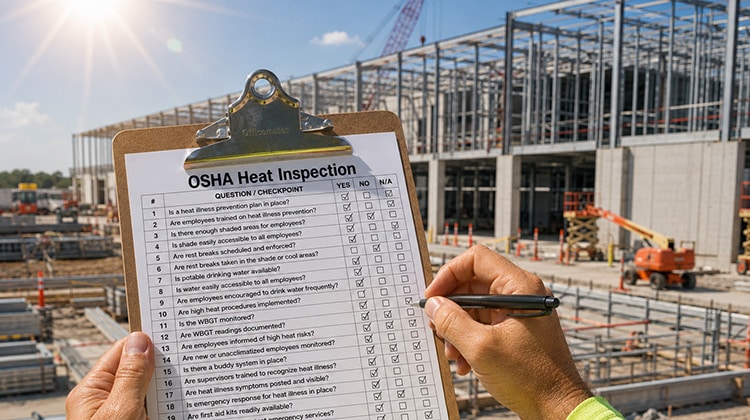
8. The 30-Item Self-Audit in 90 Minutes
A complete self-audit, run by your own safety lead, on a typical worksite, takes about 90 minutes:
- 15 minutes: documentation review (HIPP, training records, acclimatization log)
- 30 minutes: worksite walkthrough with handheld thermometer measuring at multiple points
- 20 minutes: worker interviews (3–5 workers, language matched)
- 15 minutes: cool-down area inspection (temperature, capacity, water, signage)
- 10 minutes: gap-list compilation and prioritization
Run it once per quarter during heat season. The cost of running it is hours; the cost of failing to is multiples of that in citation exposure plus the productivity and worker-safety impact.
9. What to Fix in the Next 7 Days
If your self-audit produces a gap list, prioritize:
- Engineering controls first — cool-down area temperature, mechanical cooling, infrastructure that satisfies the §3396 hierarchy
- Documentation second — HIPP translation, training records, acclimatization log
- Worker-facing communication third — signage, language-matched safety talks, escalation contacts visibly posted
In that order. The engineering gap is the longest lead-time fix and the largest citation exposure. The documentation gaps can usually be closed within a single week.
10. The Bottom Line
- OSHA Heat NEP inspections in 2026 are programmed, unannounced, and triggered by heat advisories — no complaint required
- The first 15 minutes of a site visit set the tone; visible cool-down infrastructure and work-rest behavior matter most
- Documentation, walkthrough measurements, and worker interviews are the three evidence pillars
- The seven most common citation patterns are predictable and fixable
- A 90-minute self-audit per quarter during heat season is the cheapest insurance you can buy
- Engineering controls (a 72°F cool-down environment that actually cools) close the largest citation gap
The inspections are coming. The operators who run the self-audit before the inspector arrives are the ones who don’t get cited.
Related reading on ClimateRig.com:
- Cal/OSHA vs. Federal OSHA: Where Heat Illness Rules Differ in 2026
- OSHA Heat Regulations 2026: What Changed & How to Comply
- How to Build an OSHA-Compliant Heat Illness Prevention Plan
- State-by-State Heat Standards Beyond California
- OSHA Work/Rest Cycles in Heat: What Employers Must Know
- ClimateRig™: Built to Outlast Your Longest Projects
Want the downloadable 30-item self-audit checklist and the supervisor-interview question bank? Visit atspro.co/BPX-MockOSHA or call 800.747.9953 for a 15-minute self-audit walkthrough.
About the author : Bryce Hinckley