Cool-Down Trailer Rental vs. Ownership: A Total-Cost-of-Ownership Breakdown Over a 5-Year Horizon
1. The Question Every CFO Asks Before the EHS Director Has Built the Case
The EHS director walks into the CFO’s office with a request for a $50,000 capital line for a cool-down trailer. The CFO has three questions, and they are always the same:
- Could we just rent one when we need it?
- What is the actual five-year cost difference?
- What happens if we rent and the rental is unavailable during a heat wave?
This article answers all three. The numbers below are field-realistic ranges, not vendor list prices. The point is the structure of the decision, not the precision of any single line item.
2. The Numbers: Capital Cost, Rental Cost, and the Crossover Point
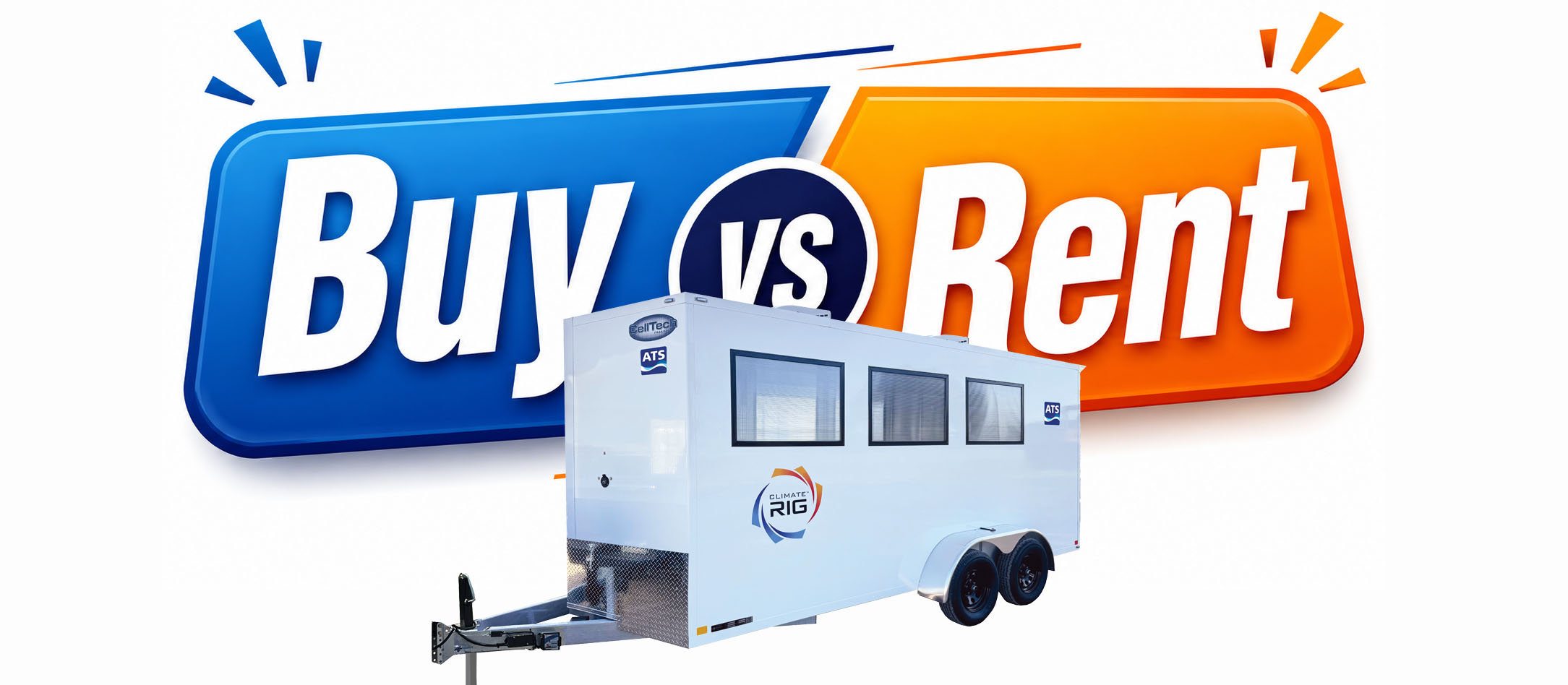
A current-generation cool-down trailer in the ClimateRig™ class — dual 15,000 BTU AC, 125 sq. ft. interior, half-ton towable, CellTech™ construction — runs in the $45,000 to $65,000 range depending on configuration (generator upgrade, C1D2 rating, heater, power station, etc.).
Daily rental rates from regional safety-equipment rental houses run $150 to $250 per day. Monthly rates run $2,500 to $4,500. Long-term contract rates for season-long programs run lower per-day but require commitment.
The breakeven math, before hidden costs:
- At $200/day rental and $55,000 capital: breakeven at 275 days of use
- Over a 5-year horizon: breakeven at 55 days of use per year
- For most industrial operators using a trailer for summer hot work: 60 to 90 days/year is typical, putting ownership ahead within 18 to 36 months
This calculation alone does not tell the whole story. Both sides have hidden costs.
3. The Hidden Costs of Renting (That Nobody Lists in the Quote)
- Delivery and pickup fees. Often $200 to $500 per move, sometimes per leg. Sites with multiple mobilizations per year compound fast.
- Availability during heat waves. This is the largest hidden cost. When the entire region is in a heat advisory, rental fleets are over-committed. Renters who waited until the heat wave to call are routinely told “next available in 10 days.” A trailer in your yard does not have this problem.
- Damage waivers and insurance. Rental contracts typically charge 8 to 15% of the daily rate for damage waivers. Adding up over a season.
- No control over configuration. You get the trailer the rental house has on the lot. If you need C1D2-rated power for refining work, generator-equipped for remote, or branded for client requirements, the rental option may not exist.
- Fuel and consumables. Generator-equipped rentals require fuel. Cleaning fees on return. AC filter replacements may be billed.
- Logistical lead time. A rental needs to be ordered, scheduled, delivered. Owned equipment is available in the time it takes to hitch up.
The honest five-year rental cost is roughly 15 to 30% higher than the daily-rate math suggests.
4. The Hidden Costs of Owning (That Nobody Lists in the Brochure)
- Maintenance. Annual AC servicing, generator service if equipped, tire and brake inspection, structural inspection. Budget $500 to $1,500 annually for a well-built trailer.
- Storage. A 16-to-20-foot trailer in your yard takes real space. Outdoor exposure shortens lifespan; indoor storage is a real-estate cost.
- Transport between sites. Towing wear-and-tear, fuel, driver time. Multi-site operators move equipment more than single-site owners.
- Insurance. Commercial equipment insurance, generally $300 to $800 annually depending on coverage and use case.
- Depreciation. A well-built trailer depreciates 10 to 15% per year initially, leveling out. Resale value at year 5 is typically 40 to 60% of original capital for a well-maintained unit.
- Opportunity cost of capital. The $55,000 in a trailer is not in a CD or invested in operations.
The honest five-year ownership cost is roughly 15 to 25% higher than the capital cost suggests once you add maintenance, insurance, and transport.
5. Tax Treatment: Section 179 and Bonus Depreciation
This is where the decision can swing for many operators.
Section 179 allows the immediate expensing of qualifying capital equipment up to an annual cap (the cap has historically been adjusted upward; consult your tax advisor for the current year’s limit). For most industrial operators buying a single trailer or a small fleet, the entire capital cost can be expensed in the year of purchase.
Bonus depreciation allows additional first-year deduction on top of Section 179, though the percentage has been phasing down from 100%. Current treatment varies — your tax advisor’s answer is the operative one.
The practical impact: in many tax scenarios, the after-tax capital cost of a $55,000 trailer is closer to $35,000 to $40,000. The breakeven math against rental shifts accordingly.
Rental payments are deductible as operating expense in the year incurred. They do not provide the front-loaded benefit of Section 179 / bonus depreciation.
For the operator with the tax position to use them, the tax treatment is the single largest swing factor in the TCO model. Worth a conversation with your tax advisor before the decision, not after.
6. The 5-Year TCO Model: Three Real-World Scenarios
Scenario A — Single site, 60 days of use per year, predictable usage
- Rental 5-year cost (incl. hidden): roughly $75,000 to $95,000
- Ownership 5-year cost (incl. hidden, pre-tax): roughly $65,000 to $80,000
- After Section 179/bonus depreciation, ownership lands meaningfully lower
- Ownership wins. Buy.
Scenario B — Multi-site operator, 120+ days of total use per year across sites
- Rental 5-year cost (incl. hidden): roughly $150,000 to $200,000
- Ownership 5-year cost (incl. hidden, pre-tax) for 2 trailers: roughly $130,000 to $160,000
- After tax treatment, ownership is significantly cheaper
- Ownership wins decisively. Buy 2 (or 3 if growth is projected).
Scenario C — Project-driven, unpredictable usage, 20 to 40 days per year
- Rental 5-year cost: roughly $25,000 to $50,000
- Ownership 5-year cost: roughly $65,000 to $80,000 — equipment sits unused most of the year
- Rental wins. Keep flexibility.
The honest answer: most industrial operators in oil and gas, construction, refining, and large-scale ag fall into Scenario A or B. Most event production, disaster response, and short-cycle project work falls into Scenario C.
7. When Rental Wins, When Ownership Wins, and When You Want Both
Beyond the TCO scenarios, three operational considerations should weight the decision:
- Heat-wave availability. If your operation cannot afford a 10-day rental wait during a regional heat advisory, you cannot afford to rent. Period.
- Configuration needs. C1D2 refining work, branded client requirements, or specific power configurations argue for ownership.
- Fleet operations. Multi-trailer fleets benefit from standardization on a single platform, single maintenance schedule, single parts supply.
The mature operators in 2026 run a hybrid model:
- Owned trailers as the baseline fleet that covers consistent summer demand
- Rental as overflow during peak heat waves, major turnarounds, or unexpected demand spikes
This pattern shows up across most multi-site industrial operators with mature heat programs. The owned trailer is the floor; rental is the cap.
8. The Bottom Line
- For most industrial operators with 60+ days of annual use, ownership wins on five-year TCO
- Hidden costs add 15 to 30% to both rental and ownership; the relative ranking does not change
- Section 179 and bonus depreciation can swing the math substantially in favor of ownership; verify current tax treatment with your advisor before deciding
- Availability during heat waves is the single largest non-financial factor; renters who plan to “rent when we need it” routinely discover they cannot get one when they need it
- The mature fleet model is owned-as-baseline with rental-as-overflow
The wrong answer is paralysis. A trailer in your yard during a regional heat advisory is worth multiples of its sticker price; a procurement decision delayed by a season is the most expensive outcome on the menu.
For an engineering case study of long-term operational lifespan and ROI, see ClimateRig™: Built to Outlast Your Longest Projects.
Related reading on ClimateRig.com:
- ClimateRig™: Built to Outlast Your Longest Projects
- Cool-Down Trailers: What They Are, How They Work, and Why You Need One
- Powering a Cool-Down Trailer: Generator, Shore Power, and Solar Hybrid Compared
- Personal Cooling Vests vs. Cool-Down Trailers
- The Heat Response of CellTech Panels: A Deep Dive
- Heat Stress Mitigation for Oil & Gas
Want the editable 5-year TCO spreadsheet with your own utilization, capital, and tax inputs? Visit atspro.co/BPX-TCO or call 800.747.9953 for a 15-minute TCO conversation with your specific numbers.
About the author : Bryce Hinckley