Wearable Core-Temp Sensors and Heat-Strain Monitors: Hype, Useful Tool, or Liability? A 2026 Field Review
1. The Pitch and the Reality
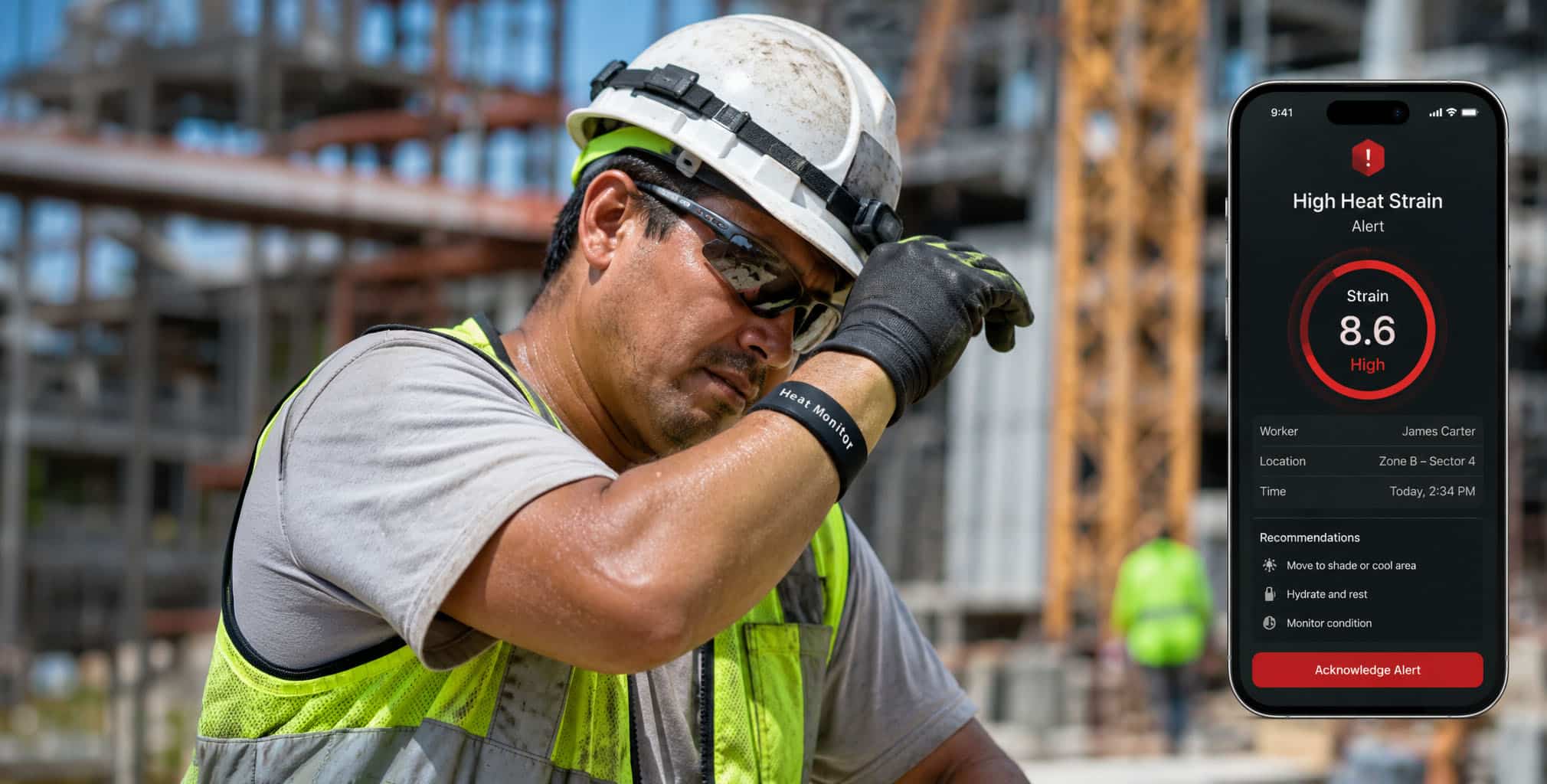
A device clips to a worker’s bicep, reads physiology in real time, and pings a supervisor when the worker is approaching a heat-strain limit. The pitch is irresistible. The category — Kenzen, SlateSafety, Thermonator, KuduSmart, and a half-dozen others — has gone from research curiosity in 2020 to a real procurement line in 2026.
The reality is more complicated. This article is a field review of what these devices actually do, where they earn their place in a heat program, where they introduce risk you may not have priced in, and the liability question that has not been resolved.
2. What These Devices Actually Measure (and Don’t)
The marketing language is “core body temperature monitoring.” The engineering reality is that none of these wrist or armband devices measure core body temperature directly. Core body temperature requires an esophageal probe, a rectal probe, or an ingestible pill sensor (the e-Celsius or CorTemp). All of those are clinical instruments, not jobsite wearables.
What the wearables actually measure:
- Skin temperature (highly variable based on ambient air, clothing, recent exposure)
- Heart rate (reliable, but driven by many factors besides heat)
- Heart rate variability (more predictive than HR alone, still indirect)
- In some devices, sweat composition or galvanic skin response
- Motion and activity level
From those inputs, a proprietary algorithm estimates physiological strain or “predicted core temp.” That estimate is useful — but it is an estimate, not a measurement. The published validation studies on these devices show correlation with true core temperature in the 0.7 to 0.85 range under controlled conditions, which is good but not gold standard. Under field conditions, the correlation is lower.
This matters because how the device is sold (“real-time core temperature monitoring”) and what it actually does (“real-time algorithmic estimate based on skin temp, HR, and motion”) are not the same claim, and the liability gap between them is non-trivial.
3. Where Wearables Win
Honest assessment: there are programs where these devices add real value.
- High-exposure individual workers — tower climbers in PPE, hazmat suit responders, structural firefighters in training. The worker cannot easily self-report and the supervisor cannot see them clearly. A wearable’s HR-driven alert is more useful than nothing.
- Acclimatization training programs — for the 14-day acclimatization window, a wearable produces a documented record of physiological adaptation that beats supervisor observation alone.
- Research and program calibration — if you are building a heat program for a new industry or work type, a wearable rollout for one season produces the WBGT-to-strain data you cannot get any other way.
- Defending against false workers’ comp claims — a continuous physiological record can corroborate or rebut a claim that the worker collapsed from heat versus a non-occupational cause.
4. Where Wearables Fail
The failure modes are less discussed in vendor decks.
- False positives create alert fatigue. A supervisor who gets 12 alerts a day, 11 of them from workers who are sweating but fine, will stop responding to the 12th alert. This is well-documented in clinical alarm fatigue research and translates directly.
- Battery and durability. Field wear destroys consumer-grade devices fast. Eight-hour shifts in dust, sun, and sweat are not the same as a gym workout. Replacement budget is often higher than the procurement projection.
- Compliance and privacy push-back. Workers, particularly union shops, often resist continuous physiological monitoring as surveillance. The data the device collects is also subject to privacy law in states with comprehensive consumer privacy statutes (California, Colorado, Virginia, Connecticut, others through 2026), and HIPAA-adjacent law for health information.
- Algorithm bias. The published validation studies skew heavily toward young, male, healthy subjects in lab conditions. Older workers, female workers, and workers with chronic conditions may produce algorithm outputs that are systematically off — in either direction.
- No substitute for environment. A wearable detects strain. It does not reduce strain. If your environment is producing heat strain and your only intervention is a wristband that beeps, you have a notification system, not a safety program.
5. The Liability Question
This is the part vendors are quietest about.
If you deploy wearables and they generate data showing a worker was approaching a strain threshold, and the worker then has a heat-illness incident, you have created a record that may or may not help you in litigation.
The favorable interpretation: the data shows you were monitoring, you had a response protocol, the incident happened despite the program. Plaintiff’s counsel sees the same data and asks why the supervisor did not pull the worker at the first amber alert. If your protocol said pull at amber, and there is documented amber data 22 minutes before collapse, you have a problem.
The unfavorable interpretation runs deeper. Even if the algorithm is imperfect, once you have it deployed you have constructive knowledge of strain. The legal question of whether algorithmic estimates create employer duty to act is unresolved in 2026 and varies by jurisdiction. Some defense counsel are advising clients to write explicit protocols around how the data is used; others are advising against deployment until the case law settles.
The honest answer is that the liability landscape is unsettled, the data is real and discoverable, and the decision to deploy should be made with counsel, not just procurement.
6. The Decision Framework
Three questions before you write the PO:
- Will the data be reviewed in real time by someone trained and authorized to act? If no, the wearable is a data-collection device with liability exposure and no safety benefit. Pass.
- Do you have a written, signed protocol covering alert response, escalation, and what happens to the data after collection? If no, build that first. The wearable is the second purchase.
- Is the wearable adding sensitivity to a high-exposure population where supervisor observation is genuinely impossible? If yes, the cost-benefit is favorable. If you are deploying it to a general crew that supervisors can see directly, you are buying a notification layer on top of work already being done.
7. Where Wearables Fit in a Mature Heat Program
The mature programs in 2026 use wearables as one input in a layered system:
- Environment — WBGT monitoring, mechanical cooling, shade
- Behavior — hydration, acclimatization, work-rest cycles
- Observation — supervisor and buddy-system
- Wearable monitoring — on the subset of workers where direct observation is impossible
Wearables alone are a notification system. Layered, they are a sensitivity boost. The category is moving from “novel technology” to “specialized tool” — useful in specific configurations, dangerous if treated as a substitute for the underlying program.
For the foundation that wearables sit on top of, see The 3 Key Elements of OSHA Heat Illness Prevention (and the 4 Most Plans Miss) and OSHA Work/Rest Cycles in Heat.
8. The Bottom Line
- These devices estimate physiological strain. They do not measure core body temperature directly. Treat the marketing language with appropriate skepticism.
- They earn their place on specific populations: high-exposure individuals, acclimatization training, program calibration, claims defense. They do not earn their place as a general-crew deployment substituting for supervisor observation.
- The liability picture is unsettled. The data is real and discoverable. Deploy with written protocols and legal review, not just procurement approval.
- A wearable detects strain. It does not reduce strain. Pair with environmental control — mechanical cooling, hydration discipline, work-rest infrastructure — or the device is just a notification layer on a program that still needs to do the actual safety work.
Related reading on ClimateRig.com:
- The 3 Key Elements of OSHA Heat Illness Prevention (and the 4 Most Plans Miss)
- OSHA Work/Rest Cycles in Heat: What Employers Must Know
- Heat Acclimatization for Workers: The Science-Backed Protocol
- Wet Bulb Globe Temperature (WBGT): Measurement, Interpretation, and Safety Measures
- Personal Cooling Vests vs. Cool-Down Trailers: When Each Wins, and Why Most Sites Need Both
- The Hydration Math: Gallons Per Worker, Electrolyte Ratios, and Why Plain Water Falls Short
Want a side-by-side capability matrix for the four major heat-strain wearables and a sample alert-response protocol? Visit atspro.co/BPX-Wearables or call 800.747.9953 for a 15-minute heat-program review.
About the author : Bryce Hinckley