
Airport Ground Operations: The 140°F Tarmac and the Heat Program Nobody Runs
1. The 140°F Tarmac
The terminal is climate-controlled. Business-class passengers walk from a 72°F concourse across a jet bridge to a 72°F cabin without noticing the temperature outside.
Twenty feet below them, on the ramp, the surface temperature of the asphalt hits 130 to 140°F on a summer afternoon in Phoenix, Dallas, Miami, Atlanta, or Las Vegas — regularly published in aviation-safety and pavement-engineering literature. Concrete apron surfaces run slightly cooler but still routinely exceed 120°F.
The ramp workers loading that flight — baggage handlers, aircraft mechanics, fuelers, marshallers, GSE operators — are working in that environment for eight-to-twelve-hour shifts. Under jet exhaust. Inside dark, unventilated cargo holds. Wearing high-visibility vests over long-sleeve safety shirts. And in most U.S. airports, there is no formal ramp-heat program.
This article is about the heat-exposure category that most airline safety plans and airport authority operating agreements do not address — and the working program that mature ground-handling operators are starting to run.
2. Why Ramp Heat Isn’t in Most Airport Safety Plans
Aviation safety in the U.S. is primarily governed by the FAA — but the FAA regulates flight operations, air traffic, and airfield surface safety, not worker safety. Occupational safety on the ramp falls to OSHA, and OSHA’s Heat National Emphasis Program applies to airport ramp operations the same way it applies to any outdoor employer.
The gap is that airport authorities and airlines historically treat the ramp as an aviation-safety environment, not an occupational-heat environment. Ramp incident reporting focuses on collisions, FOD (foreign object debris), and jet-blast injuries. Heat-related worker incidents get logged as “heat illness” without the same root-cause analysis a runway incursion would trigger.
The result: most ramp-heat programs in 2026 are informal. Cold water in coolers, an air-conditioned break room somewhere inside the terminal (usually a five-minute walk from the aircraft), a supervisor telling workers to “take a break if you need one.”
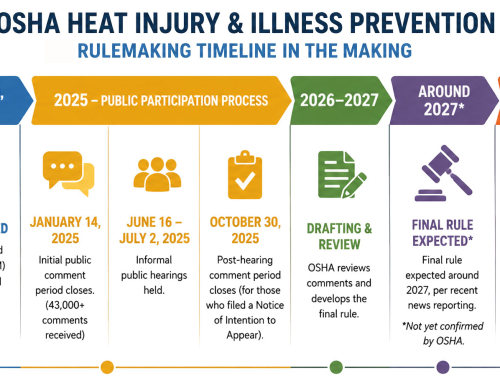
Under OSHA’s Heat NEP — extended through 2031 — that is no longer a defensible posture. For the enforcement environment behind that statement, see OSHA’s Heat National Emphasis Program Just Got Extended Through 2031.
3. The Four Worst-Exposure Positions on the Ramp
Not every ramp job carries the same heat exposure. Four positions carry the highest thermal burden:
- Baggage handlers loading cargo holds. Aluminum aircraft holds sit in direct sun with no ventilation. Interior temps of a widebody cargo hold on a hot afternoon ramp regularly exceed the ambient temperature by 20°F+. Workers climb in and out of that environment repeatedly, sometimes carrying 70-pound bags in restrictive positions.
- Fuelers and lavatory service. Standing on hot pavement next to a running aircraft, working with pressurized systems, in PPE. The pavement radiates upward through the boots; the aircraft skin radiates from the side; the sun hits from above.
- Aircraft mechanics performing turn maintenance. Access panels open, mechanics inside engine cowlings or wheel wells, often on aircraft that just came off a several-hour flight — the airframe itself is warm from friction and aerodynamic heating.
- Marshallers and pushback tug operators. Continuous jet-blast exposure. Wands, headsets, and radios in one hand; hot exhaust wash from adjacent aircraft. The exhaust plume from a 737 engine at idle raises local air temperature 40 to 60°F above ambient at close range.
Ramp GSE (ground support equipment) operators — belt loaders, tugs, deicing trucks — are moderate exposure. Cabin crew and gate agents are lowest.
4. Jet Blast, Cargo Holds, and Thermal Compounding
Standard WBGT measurement at chest height in open air systematically underestimates ramp exposure — the same pattern documented for asphalt paving crews (see Asphalt Paving and DOT Road Crews: Why Air Temperature Underestimates the Danger) but driven by different physics.
Three compounding factors:
- Reflective and radiant surface heat. A 140°F asphalt or concrete apron radiates upward. Workers in the direct radiant field feel the pavement temperature more than the air temperature.
- Jet exhaust wash. Engine exhaust remains at elevated temperature far from the nozzle. Marshallers and push-back operators work in intermittent hot plumes that WBGT sensors do not capture.
- Confined-space thermal accumulation in cargo holds. Aluminum cargo holds function as heat traps. Interior temp rises through the shift; worker exposure inside is high.
The physiological load on a ramp worker at ambient 92°F, standard WBGT 86°F, is comparable to what WBGT 94–98°F would predict for a worker in an open unshielded environment. The published work-rest chart, applied against ambient temperature, is too lenient.
5. OSHA Applies to Ramp Workers Even Though FAA Runs the Airfield
OSHA’s Heat NEP-eligible industries include air transportation ground handling under the applicable NAICS codes. That covers airline ground employees, third-party ground handlers (GHAs), and airport authority ramp operations.
Under the multi-employer worksite doctrine, an airport authority hosting multiple GHA contractors and airline direct-employee ramp crews is potentially a controlling employer for heat-illness prevention purposes across all of those crews. That’s a citation exposure most airport authorities have not yet mapped.
State jurisdictions add layers. Cal/OSHA §3395 applies to LAX, SFO, SAN, OAK, SMF, and other California airport ramp operations. Washington L&I applies at SEA. Oregon OSHA at PDX. MOSH at BWI. Nevada at LAS. In each of these, the state standard is more prescriptive than federal. For the full multi-state framework, see State-by-State Heat Standards Beyond California.
6. What a Working Ramp Heat Program Looks Like
Past the OSHA and state baseline, the ramp heat programs that would materially reduce worker exposure share six features:
- WBGT measurement at the ramp, not at the terminal. The terminal reading is not the worker’s reading.
- Cool-down infrastructure at the concourse-adjacent hardstand, not inside the terminal five minutes away. A five-minute walk each way turns a 10-minute break into 20 minutes of non-productive time, and workers skip it.
- Rotation policies that account for cargo-hold time, not just wall-clock shift length.
- Hydration logistics at the ramp, with cold beverage available on the GSE tug or in a fixed cooler near the hardstand.
- Acclimatization protocols for new hires and seasonal peak-season workers, particularly during summer surge staffing.
- Language-matched training and signage — ramp workforces are frequently multilingual.
For the underlying HIPP framework applicable to any outdoor employer, see How to Build an OSHA-Compliant Heat Illness Prevention Plan.
7. Where a Mobile Cool-Down Trailer Fits (Concourse-Adjacent, Not Terminal)
The engineering-control question for ramp heat is placement. The terminal has HVAC. The concourse breakrooms have HVAC. Neither is close enough to the aircraft to be functional recovery infrastructure during a 45-minute turn.
A 125 sq. ft. mobile cool-down trailer parked at the concourse-adjacent hardstand — near an active gate group, not at the operations center — solves the geometry problem the same way it does on a paving run or a solar-farm install line. Dual 15,000 BTU AC producing sub-75°F interior air, 18-worker capacity per cycle, powered off airport 30-amp shore power via the L14-30 inlet where available (see Powering a Cool-Down Trailer in the Middle of Nowhere for the power-configuration options on remote hardstands).
For airport authorities and GHA contractors, this is a shared engineering control that satisfies the §3395 / federal-rule “as close as practicable” interpretation, produces documented entry/exit logs for compliance defense, and — critically — is used, because it’s actually near the work.
8. The Bidding Question for Ground-Handling Contractors
GHA contracts (Menzies, Swissport, Worldwide Flight Services, dnata, Unifi, and airline-direct handling operations) are competed on price, on-time performance, and increasingly on safety metrics. Airlines are asking bidders for heat-illness prevention documentation as part of RFP response for hot-weather stations.
A GHA with a documented ramp-heat program, engineered cool-down infrastructure at the hardstand, and entry/exit logs is bidding into a different tier than a GHA relying on “workers can go to the terminal break room.”
The same argument applies to airport authority operating agreements. Hot-station airports (PHX, LAS, DFW, ATL, MIA, IAH) awarding hardstand or maintenance-hangar concessions can require heat-program documentation as a condition of the operating certificate. For the underlying citation-cost math, see Real OSHA Heat Citations: A 2025–2026 Case Review.
9. The Bottom Line
- Ramp surface temperatures at hot-station airports routinely exceed 130°F in summer; interior cargo-hold temps run higher still
- Standard WBGT measurement at the terminal or open-air chest height underestimates the physiological load on ramp workers
- OSHA’s Heat NEP applies to ground handling under the applicable NAICS codes; state standards (Cal/OSHA, WA L&I, Oregon, MOSH, Nevada) apply in their respective jurisdictions
- Most current ramp-heat programs are informal and would not survive a NEP-driven inspection
- Engineering controls — cool-down infrastructure at the concourse-adjacent hardstand, not inside the terminal — close the compliance gap and are used because they are where the work is
- Ground-handling agreements are increasingly a heat-program-documentation buyer’s market; the GHAs with programs are bidding into a different tier
The tarmac has always been the hottest part of the airport. What’s new in 2026 is that OSHA is treating it as a heat-exposure environment, and airlines are treating it as a bid-qualification input. Programs that ran informally for decades do not survive either.
Related reading on ClimateRig.com:
- OSHA’s Heat National Emphasis Program Just Got Extended Through 2031
- Asphalt Paving and DOT Road Crews: Why Air Temperature Underestimates the Danger
- How to Build an OSHA-Compliant Heat Illness Prevention Plan
- Powering a Cool-Down Trailer in the Middle of Nowhere
- State-by-State Heat Standards Beyond California
- Real OSHA Heat Citations: A 2025–2026 Case Review
Want a ramp-station heat-program template and a hardstand cool-down placement diagram? Visit atspro.co/BPX-Airport or call 800.747.9953 for a 15-minute airport-operations heat-program review.
About the author : Bryce Hinckley